
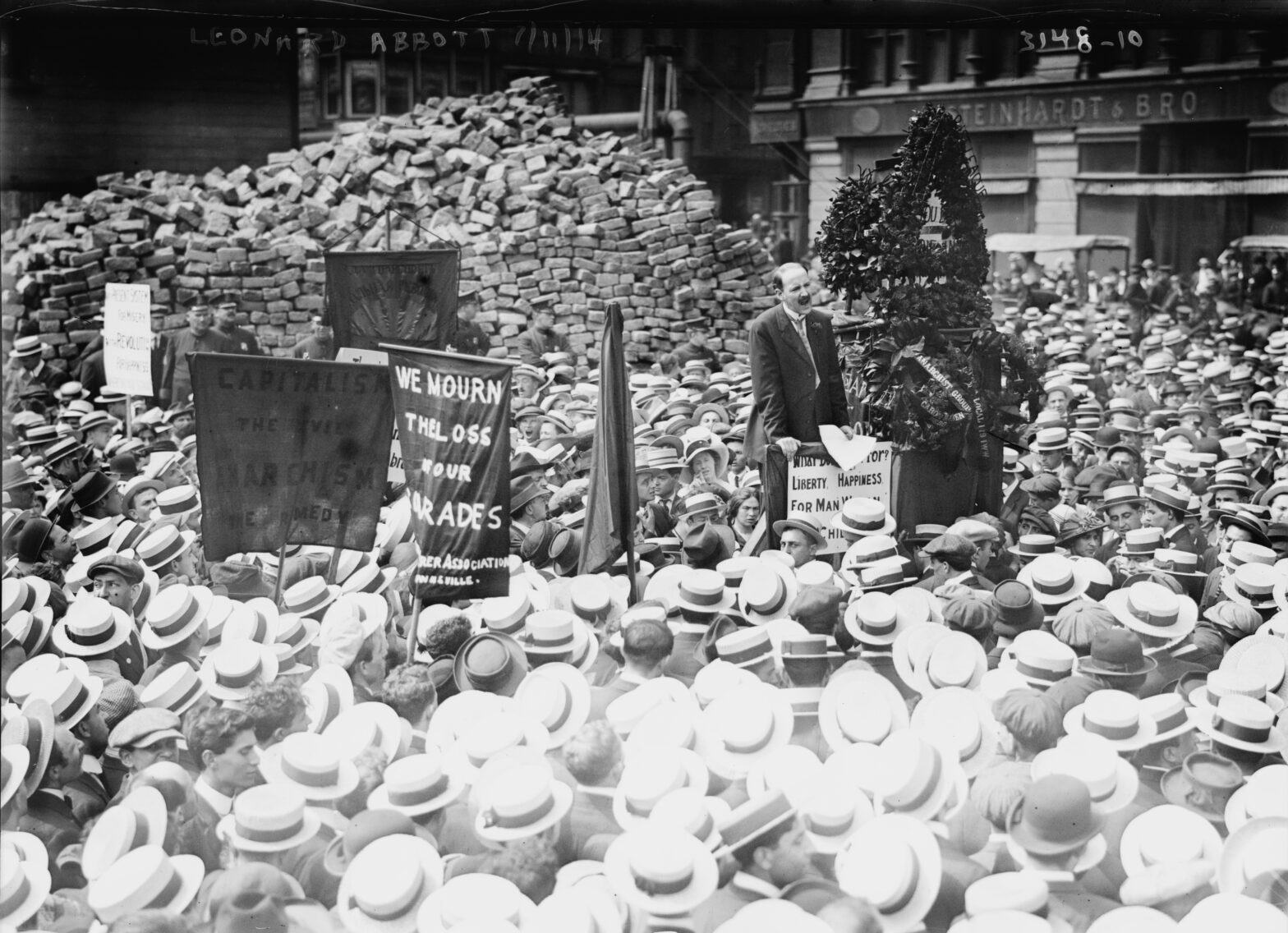
From ‘Mother Earth: Monthly Magazine Devoted to Social Science and Literature’, August 1917, New York City, published and edited by Emma Goldman
If it had not actually happened it would be unbelievable — the complete reversal of American ideals during recent months. Black has become white, and white is now black. “Liberty,” as Bernard Shaw puts it, “is a crime, and homicide is a virtue.”
Under the stress of war hysteria, practically every principle which Americans have pretended to believe in has gone by the board.
The sanctity of the individual life has been regarded as the very foundation of every liberty that Americans possess, But in war time, it seems, the individual life is of no account. This is true not only in a military, but in a civil, sense. Lynching has become justifiable and even praiseworthy. On July 31, Frank Little, a member of the National Executive Board of the Industrial Workers of the World, was taken from his room in a Butte, Montana, hotel, by six masked men, and hanged to a railroad trestle near the city. Little was a cripple. His offense was his activity as a labor organizer. A more fiendish murder was never committed. Yet the press of the country applauded the crime, and no efforts have been made to arrest the murderers.
Freedom of speech is supposed to be one of the cornerstones of the American Government. The National Constitution specifically forbids Congress to pass any law abridging freedom of speech. Yet Emma Goldman and Alexander Berkman have been sentenced to two years’ imprisonment and have been fined $10,000 for merely protesting against conscription.
Freedom of assemblage and the right to peacefully petition the Government for the redress of grievances have been accepted as inalienable rights of Americans. Yet on July 1, a peace parade in Boston was deliberately broken up by sailors and soldiers. They tore banners from the hands of women. They beat and injured men and women. They forcibly entered the Socialist Party headquarters, destroyed property and burned many valuable papers and much literature. The police did nothing throughout this performance to protect the citizens’ rights.
Freedom of press has been one of the most venerated of American traditions. Thomas Jefferson and Abraham Lincoln both declared that it was better to permit even an abuse of free press rather than its suppression. Yet within the space of a few weeks, fifteen Socialist and a number of Anarchist and labor papers have been declared unmailable by the Government.
The right of workmen to agitate for better conditions and to strike has always been recognized as reasonable until the advent of war hysteria. Now it is regarded as criminal. Since Samuel Gompers has delivered the labor movement — or tried to deliver it— into the hands of the capitalists, the rebellious worker is in about the same position as the rebellious slave before the Civil War. On August 19, James Rowan, leader of a lumber workers’ strike in Spokane, Washington, and twenty-six others were arrested without even the pretense that they had violated any law, and were imprisoned, A few weeks previously, 1,500 striking workmen had been shipped in cattle cars from Bisbee, Arizona, into the desert, where they were left without food and water.
The list of the violations of fundamental American liberties might be prolonged indefinitely. We mention only a few:
In Philadelphia thirteen persons were recently arrested and charged with treason for distributing a leaflet entitled “Long Live the Constitution of the United States.”
In Indianapolis an ordinance has been passed making it a misdemeanor “to speak disrespectfully of the President or the Government of the United States.”
In Oakland, California, a radical club-room was invaded by bullies in uniform, and its contents smashed and dumped into the street.
In San Francisco, the acquittal of Rena Mooney, after she had been submitted for weeks to the vilification of the prosecuting attorney, has served, to emphasize a local situation that has been inflamed almost to the point of civil war by military hysteria, And these are only the first-fruits of militarism!
War inevitably means a reversion to the physical plane, and this alone is enough to damn it. Man has struggled painfully up from the muck and the soil — a little spirit gleams in his eyes — and then war comes along, like a Caliban, and thrusts him back into the mire!
War inevitably means the steam-roller. It means crushing out every spark of initiative, of independence of mind. The quintessence of war-psychology has seldom been more aptly conveyed than in the little poem of Ernest Crosby, which carries as its refrain the words: “I do not think, I obey!” We find already in much of the war-literature of the day a deliberate glorification of militarism on the ground that it suppresses individuality and self-expression, and that it enthrones coercive organization, the spirit which makes the organization everything and the unit nothing. Regimentation, uniformity, absolute obedience to authority are the acknowledged military standards.
Some Socialists in this country have been so false to their own revolutionary claims as to go running to Washington to inform the authorities of “treasonable” activities of their own comrades, But, as Morris Hillquit told Allan Benson, there are some things worse than treason; and one of the things that are worse is betrayal of an ideal.
There is a sense, it is true, in which the management of war may be described as the very apotheosis of State Socialism, but in this fact lies the condemnation of Socialism. War management is the reductio ad absurdum of Socialism. It shows how far the State-obsessed mind is willing to go. Just because the principle of State Socialism carries within itself the possibilities of such outrages upon liberty as conscription, just because it involves the power to crush out ruthlessly the individual life, it is bound to challenge the undying opposition of every true libertarian,
Modern wars mean the massacre of youths. Old men make national quarrels, and young men are taken, against their wills, to fight these quarrels. The principle involved is hideous, inhuman and unjustifiable. The State has no more right to compel men to act only in one way than the Roman Catholic Church, in the Middle Ages, had the right to compel men to think only in one way.
Elihu Root and Charles Edward Russell have attempted to use even the Russian Revolution as a club with which to beat American anti-militarists and revolutionaries. How little do they grasp the inner spirit of that mighty revolt against militarism and autocracy, that mighty idealistic gesture! The spirit of Russia is the one inspiring and vitalizing spirit in a world reeking with corruption. It is almost a miracle that this great people should have succeeded in throwing off the yoke not only of Government but also of military rule, and are insisting upon the right to rule their own destinies in their own way. The taunt of pro-Germanism is futile. Only the shallowest of minds could attribute the longing for peace, in Russia as in every country involved, to German propaganda.
There is opportunity, at the present juncture, for two kinds of protest against militarism. We need the individual protest, and we need the social and collective protest. All honor to those who, whether in prominence or in obscurity, are warring against war! The spirit of the man who knows his own mind and who stands by the integrity of his own personality is stronger than the spirit of governments, and in the end will vanquish them. The men who as “conscientious objectors” in this country and in England are going to prison as a protest against militarism are already vindicated in the minds of multitudes of all nationalities. The same may be said of working-class rebels of the type of the I.W.W. They are weak today, but one day they shall be strong. Already they are phophetic of a working-class movement that shall create its own standards of living and of thought, that shall go to war if it chooses to go, and not otherwise.
Let us never forget that what we are working for is:
(1) Individual Liberty,
(2) Anti-militarism,
(3) Internationalism,
(4) Working-class Solidarity.
It is conceivable that voluntary enlistment on the pro-Ally side in the present war might help to promote some of these ends. But coerced enlistment promotes mainly the spirit of coercion and government. It is a violation of fundamental rights. It cannot be tolerated for an instant by a true libertarian.
The ruling idea of the patriot today is that war can only be ended by piling armament upon armament until Germany is “smashed.” But there is a far better way to end war. If the workers would withhold their economic support, war would cease. If one-hundredth part of the time and energy, of the money, now being spent in the militarization of America had been spent in revolutionary and anti-militarist propaganda among the workingmen and soldiers of all countries, among the youth of all nations, this war might have been stifled in the first week of its existence, and an era of freedom inaugurated.
Also
“The Armed Nation”, by Errico Malatesta (1902)
The Fight For Free Speech in Tarrytown, by Leonard D. Abbott (1914)
Wars and Capitalism, by Peter Kropotkin (1914)
A Letter on the Present War, by Peter Kropotkin (1914)
Have the Leopards Changed Their Spots?, by Thomas H. Keell (1914)
Correspondence on Kropotkin’s Letter to Professor Steffen, by Fred W. Dunn (1914)
If We Must Fight, Let It Be For The Social Revolution, from Mother Earth (1914)
Anti-Militarism: Was It Properly Understood?, by Errico Malatesta (1914)
In Reply to Kropotkin, by Alexander Berkman (1914)
Observations and Comments on Kropotkin and the European War, from Mother Earth (1915)
Is This the Last War?, by W.T. Crick (1915)
To the Anti-Militarists, Anarchists, and Free Thinkers, by Ferdinand Domela Nieuwenhuis (1915)
Anti-War Manifesto, by the Anarchist International (1915)
Looking Forward, by Alexander Schapiro (1915)
Italy Also!, by Errico Malatesta (1915)
Between Ourselves, by Emidio Recchioni (1915)
While the Carnage Lasts, by Errico Malatesta (1915)
First Year of the War, by Emma Goldman (1915)
The Last War, by George Barrett (1915)
The Psychology of War, by Alexander Berkman (1916)
Manifesto of the Anarchist Federation of Britain (1939)
Manifesto of the Anarchist Federation on War (1943)
The Avalanche, by Clara Cole (1947)
Neither East Nor West, by Marie Louise Berneri (1952)
Lilian Wolfe: On Her 90th Birthday, by Vernon Richards (1965)
Lilian Wolfe – Lifetime Resistance, by Sandy Martin (1972)
Anarchism and the First World War, by Matthew S. Adams (2019)
Lilian Wolfe (1875-1974), de Paris Luttes (2022)
If We Must Fight, Let’s Fight for the Most Glorious Nation, Insubordination
