
By M.Gouldhawke (Métis-Cree)
Updated: April 9, 2021 (originally published April 4, 2020)
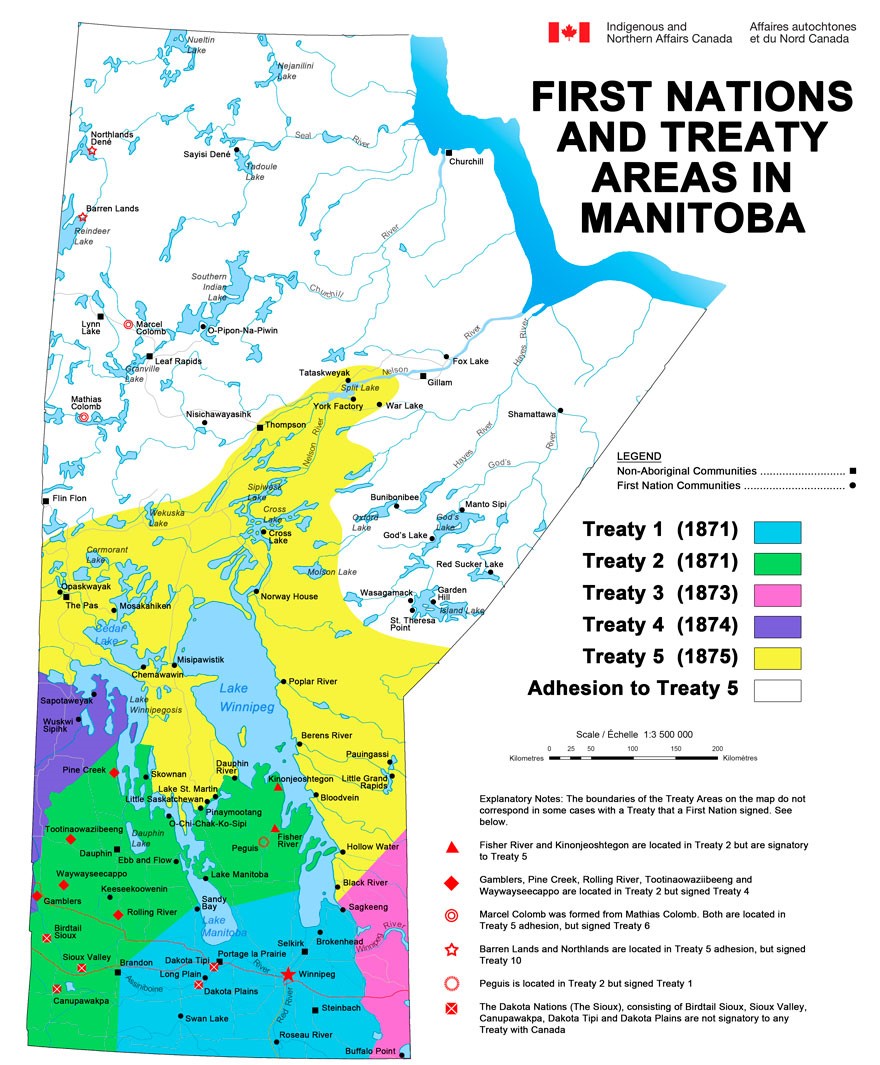
In 1876, a smallpox epidemic hit the Indigenous peoples around Lake Winnipeg, in territories which had recently been the subject of the Numbered Treaties between the British Crown and various Indigenous Nations (at first the Cree and Anishinaabe, and later other peoples).
Settler academic and writer Ryan Eyford has written an article and thesis, as well as the 2017 book “White Settler Reserve,” which describe the epidemic, its larger political and colonial context, and the relationship between Icelandic settlers and Indigenous peoples in the region at the time.
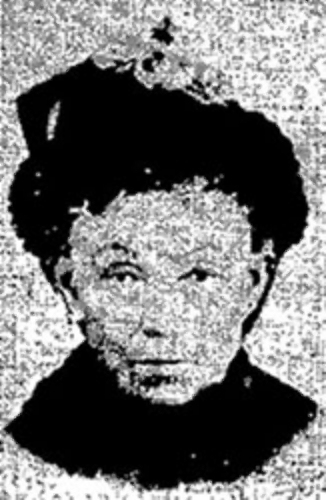
In his writing on the subject, Eyford explains that two of my own ancestors, the married couple James Settee (Cree) and Sarah Sally Settee (née Cook-Sinclair) (Métis/Cree), had knowledge through oral histories of previous disease epidemics, and in the case of Sarah, specific first-hand knowledge about smallpox which she communicated to Indigenous people in the area in the mid to late 1800s.
Although Eyford was perhaps unable to provide further detail on how Sarah Settee had obtained this information, I speculate that in addition to Indigenous oral histories she may have gained part of her knowledge, either directly or indirectly, from the renowned settler doctor William Todd Sr., who had been administering the smallpox vaccine in the region in the 1830s, and who married into a Métis family.
Eyford, in his article “Quarantined Within a New Colonial Order” (which also forms part of his book White Settler Reserve), explains that disease epidemics are not just a natural occurrence in the context of colonialism, but that they are also produced by the settler State and result in structural transformations of the State.
Sarah Settee’s prior knowledge of smallpox was disregarded by colonial officials on account of her race, gender and lack of colonial credentials, Eyford argues.
An article in Maclean’s magazine in 2017, “How a smallpox epidemic forged modern British Columbia“, detailed the colonial (mis)management of the 1862 epidemic in the pre-Canadian colonies of British Columbia and Vancouver Island and how it still reverberates through the province today in regards to the fraudulent modern BC Treaty Process and colonial politics in general.
“The colonial authorities… knew that [expelling Indigenous people from Victoria] would spread smallpox throughout British Columbia,” explained Marianne Nicholson, a Dzawada’enuxw / Kwakwa̱ka̱’wakw artist with a PhD in Linguistics and Anthropology. “That was an act of genocide against Indigenous people… At that point in time the [government] wanted to be able to claim those lands without having to compensate or recognize Indigenous title.”
A history book published by the Secwepemc Cultural Education Society in 1990 explained that the colonizer John Tod, the Hudson’s Bay Company’s chief trader at Fort Kamloops, had used the smallpox vaccine as a means of extortion, refusing to vaccinate Secwepemc people in 1846 until they had brought him a year’s supply of salmon.
For more on the historical colonial use of disease epidemics, including in British Columbia, I recommend reading Zig-Zag’s 2004 text, “Biological Warfare: Disease and Depopulation.”
Below I’ve reposted relevant excerpts from Eyford’s article on the 1876-1877 smallpox epidemic around Lake Winnipeg, which I also recommend reading in full (or his book).
For context, I’ve also republished, below Eyford’s work, excerpts from an article by academic Derek Whitehouse-Strong on Sarah Settee’s tendency to be thorn in the side of settler Christian missionaries, and a very brief background (with links to sources) on her husband James Settee and his place in the Cree literary tradition, written by myself.
Excerpts from Quarantined Within a New Colonial Order:
“Smallpox broke out in the fall 1876 and within two months had decimated the Sandy Bar band. A doctor sent by the Canadian government reported that their numbers had been reduced from fifty or sixty to only seventeen. He found the scarred survivors huddled in tents surrounded by newly dug graves. The band’s homes and possessions were ordered burned to prevent further infection, and shortly thereafter Dominion Land Surveyors arrived to plant posts marking the boundaries of the proposed Icelandic town of Sandvík (Sand Cove)…”
“What happened at Lake Winnipeg in 1876-1877 was not inevitable; it was the product of a historically contingent set of circumstances. Historical geographers of medicine Jody Decker and Paul Hackett have demonstrated that the impact of disease on Aboriginal populations in Northwest North America varied greatly over time, and changed with shifting patterns of trade, migration, and settlement. From the onset of European contact, epidemics stimulated migrations, shifted balances of power, and altered boundaries between peoples. The 1876-1877 smallpox epidemic demonstrates how Aboriginal dispossession and settler-colonialism were linked through the overlapping governmental apparatuses of territoriality and public health. The measures taken in response to the epidemic allowed the Canadian state to exercise new forms of power over spaces and people where its influence had previously been quite limited. This occurred both through coercive means and — perhaps more significantly in a context where the state’s presence was relatively light — the self-regulation of individuals and groups acting in their perceived best interests. Ultimately, however, quarantine and sanitation measures helped to reify a new spatial order mandating the compartmentalization of land and people into a system of racially-segregated reserves that was integral to the Canadian colonization of the Northwest during the late nineteenth century…”
“In 1876, neither the Icelanders nor their Aboriginal neighbours had much first-hand knowledge of the physical effects of the smallpox virus. However, the devastating results of past epidemics were preserved in their oral and written historical traditions. When recording the epidemic in their respective journals Þorgrímur Jónsson and James Settee both made reference to previous epidemics that had afflicted their people. Over the long term, these two groups had remarkably similar histories with the disease. Both had been affected by disastrous smallpox epidemics in the eighteenth century. In 1707-1709, the disease killed twenty-six percent of Iceland’s population. Iceland was affected by the world-wide epidemic of the early 1780s, which also devastated a village of Cree, Assiniboine, and Ojibwa at the mouth of the Red River around 1780. The effects of smallpox were mitigated after 1800 with the introduction of vaccination as a preventative measure. In the late 1830s, there were vaccination campaigns in Northwest North America by the Hudson’s Bay Company and in Iceland by Danish colonial authorities that helped stop another epidemic in its tracks. But by 1876, neither the Icelanders nor the natives had been subject to a comprehensive vaccination campaign, and therefore the generations born since 1840 were susceptible to smallpox. In his 1877 report on the epidemic, Jónasson blamed the authorities in Iceland for becoming lax in their duty to vaccinate every person in the country. He asserted that those settlers who had been properly vaccinated in the past five to seven years did not contract the disease.
By the time John Taylor wrote to Dr. David Young at Lower Fort Garry requesting medical help, rumours of smallpox among the Icelanders and Indians at Sandy Bar had been circulating at Red River for some time. News had been carried to St. Peter’s by friends of the Sandy Bar band, and from there conveyed to Winnipeg. Local government officials began to take these rumours seriously only after the Manitoba Daily Free Press published a letter from one of the surveyors at work at Sandy Bar on 15 November. Based on this report the paper’s editor asserted, “there can be no doubt that it is the small-pox that is raging, and that too of a most virulent type.” J.A.N. Provencher, Acting Superintendent of Indian Affairs in Manitoba, sent Dr. James Spencer Lynch to the Icelandic colony to assist Dr. Young and to treat the Indians of the district. On 22 November, Drs. Young and Lynch reported from Gimli, “The disease here is smallpox of a mild variety varioloid but very fatal owing to unfavourable circumstances bad food, want of ventilation. About twenty persons had died in this immediate neighbourhood within the past ten days; it is reported that only two Indians are left living at Sandy Bar out of twenty.” With this official pronouncement, government officials began to formulate their response, but it was too late; the disease had already spread throughout the Icelandic colony and its immediate environs. By the time the epidemic had run its course, 103 Icelanders had died out of a population of approximately 1,200. According to a list compiled by Sigtyggur Jónasson, the vast majority of the victims were children; only twenty-five persons out of the total dead were older than twelve years of age. No precise numbers, either of population or mortality, are available for the Aboriginal population. According to the Manitoba Free Press reporter who attended the Treaty 5 negotiations in July 1876, the Big Island band consisted of 100 persons and the Sandy Bar band of 57. In January 1877, Lt. Governor Morris stated that the number of ascertained deaths was 52, but based on information received from Dr. Lynch, he believed the number of Indian dead could be as high as 200.
The disease was only identified as a problem of public health and governance when officially pronounced upon by two white physicians working as agents of the Canadian government. However, at least one person had correctly identified the disease two months earlier. On 25 September Sarah Settee, the mixed-blood wife of the missionary James Settee, told the Sandy Bar band that the disease afflicting the Icelanders was smallpox, and that they should leave Sandy Bar if they valued their lives. This advice was apparently ignored by all but one man who fled with his family, possibly spreading the disease to the other side of Lake Winnipeg. James Settee also disregarded his wife’s claims even though he acknowledged that she had first hand knowledge of the disease. Sarah’s medical knowledge was discounted because of her race and gender and lack of professional credentials. The same can be said for the Icelandic immigrant Rebekka Guðmundsdóttir, who had received training as a nurse and midwife in northern Iceland. Rebekka’s role in distributing helpful medicines to smallpox victims was noted in community histories, but her name does not appear on the list of Icelanders employed by the Keewatin Board of Health or in any of the official documentation.
Epidemics are not only the naturally occurring result of discrete biological processes, but also events produced by public health authorities reading a situation and taking particular courses of action. As the epidemic is pronounced upon and actions are taken to address it, new forms of knowledge about a population are generated and new modes of governance are created. The response to the 1876 smallpox epidemic was, literally, the creation of a new government that served both as a Board of Health and as a territorial authority for Keewatin, the region north and east of the province of Manitoba and including the Icelandic reserve. This territory was created in October 1876, largely at the behest of Lieutenant Governor Alexander Morris, to respond to the planned transfer of the government of the Northwest Territories from Winnipeg to a point further west. Morris argued that because of limited transport and communication networks in the region, it would be utterly impossible to govern the areas north and east of Manitoba. The Keewatin Act stipulated that the region was to be governed by a council of five to ten men, headed by the Lieutenant Governor of Manitoba. The Dominion government did not appoint this council until the emergency of the smallpox epidemic forced its hand. Morris recommended a council of six senior civil servants from various departments and agencies of the Dominion and Manitoba governments. The constant slippage between the council’s role as a territorial government and as an instrument of public health enforcement was manifested in how it was alternately referred to in official documents as the Council of Keewatin and as the Keewatin Board of Health…”
“In the Lake Winnipeg region, the public health practices of quarantine and sanitation and the spatial practices of treaty, survey, and colonization reserves operated hand in hand as apparatuses of governmental power. The quarantine and sanitation measures used by the Keewatin Board of Health during the smallpox epidemic belong within Bashford’s model. It was the dynamic interaction between the state’s coercive force and disciplinary modes of governance that allowed the new colonial organization of space to take hold around Lake Winnipeg.
The tension between coercion and self-discipline was evident in the debate over the use of a cordon sanitaire to prevent travel between Manitoba and the “infected district” of Lake Winnipeg. Lieutenant Governor Morris and Manitoba Premier R.A. Davis argued that a rigid quarantine, enforced by the military, was essential to prevent the spread of the disease throughout the Northwest, and the death of thousands of Indians. Dominion government officials, by contrast, believed that this measure was unnecessary. Prime Minister Alexander Mackenzie argued that responsibility for the maintenance of health rested with the individual. In an encrypted telegram to Morris, Mackenzie stated bluntly, “People themselves must avoid contagion decline expenditure for Quarantine.”
Ambivalence about the use of a quarantine also appeared in public discussion. The editor of the Manitoba Free Press came out strongly in favour of the measure:
“The Dominion has a grave responsibility. Let them keep watch and guard over their colonists in Keewatin. Let the Indians be confined to their reserves and vaccinated. Let the public give the authorities their moral support. What has already been accomplished at Gimli proves that the disease can, humanely speaking, be controlled. Let us all bear in mind that “an ounce of prevention is worth a pound of cure.”
On the other side, The Manitoba Herald opined: “[T]he quarantine line is distinctly announced as being made of red tape.” A correspondent to the paper wrote: “Small Pox!! Bah! All we have to do is keep ourselves clean, live well, observing the laws by which God governs the world and allow science (medical men) to do the rest and none of us will die from that loathsome disease.” After the crisis was over a letter writer to the Free Press complained that the destruction of clothes and property at the Quarantine Station had been useless. The editor saw fit to rebut this claim, and congratulated the people of Manitoba for adopting and enforcing the quarantine regulations.
The editor was correct in recognizing that the quarantine was successful only because local people chose to enforce it. The area which the quarantine covered was simply too large to have been effectively policed by the small number of soldiers and health officers employed by the Board of Health. Prominent among those who were recognized by Lieutenant Governor Morris for helping to stop the spread of the disease through their strict adherence to the rules were the Ojibwa bands at St. Peter’s (Peguis), Fort Alexander, and Brokenhead. In 1869-1870, these bands had been spared from an epidemic that killed more that 2,600 Blood, Peigan, Blackfoot, Cree, and Assiniboines on the Plains. They therefore recognized the danger posed by smallpox, cut off their communication with people who had been to the Icelandic settlement, and voluntarily confined themselves to their reserves. Keeping the Lake Winnipeg Indians on their reserves was a policy goal of the Dominion government that the emergency itself enabled. While this action served to protect the bands from smallpox, it nonetheless had negative effects on their health. Being confined to their reserve prevented them from venturing farther out when their local resources failed, as happened with the fishery in the fall of 1876.
The chief and councilors of the Fort Alexander reserve wrote to Lieutenant Governor Morris stating that they required provisions from the government in order to make it through the winter, and that the local Indian agents and Acting Indian Superintendent J.A.N. Provencher had turned a deaf ear to them. They also stated that Dr. Willoughby Clark, who was sent to vaccinate them, was doing nothing because he had run out of vaccine matter. Dr. Clark confirmed the Fort Alexander band’s account of poor health owing to causes other than smallpox: “I found a great deal of sickness at this place caused principally by want of proper food and clothing — scrofula and pulmonary complaints predominantly.” He recommended that assistance to the band be increased, although there is no evidence that his recommendation was acted upon.”
(Ryan Eyford)
Context for Sarah and James Settee
Academic writer Derek Whitehouse-Strong, in his article “Purveyors of ‘religion, morality, and industry’: Race, Status, and the Roles of Missionary Wives in the Church Missionary Society’s North-West America Mission,” provided some snippets of background info on Sarah Sally Settee and her conflicts with the Church Missionary Society (CMS) that her husband James worked for:
“In the eyes of many, for example, [Sarah] Sally Settee, who assisted and worked alongside her husband, Native agent Reverend James Settee, was far from the image of the perfect missionary wife. Mrs. Settee admirably performed many of the duties that Victorian English missionaries expected of the wives of CMS agents: she cared for sick congregants, taught school, led mothers’ meetings, prepared food, and mended clothes. She did not, however, meet Victorian expectations regarding acceptable submissiveness, moral standards, and social status, and her experiences, along with those of Julia McDonald, give form to the increasingly negative suppositions about race, status, and ability that confronted the wives of Native CMS agents after the mid-nineteenth century.
Because the Settees did not share all the beliefs of their European counterparts regarding the acceptability of specific behaviours, European missionaries such as Reverend Robert Hunt claimed that they lacked “moral sense” and “moral courage”. In reality, however, the Settees were more liberal than the Reverend Hunt and his wife because their perspectives were shaped not only by their experiences with the CMS and with Euro-Christianity, but also by their exposure to Aboriginal cultures…”
“…the Settees reserved their criticism for the Reverend and Mrs. Hunt. They suggested that the Hunts erred in their decisions to separate the school children and to supervise them more closely and “efficiently”. Moreover, Mrs. Settee went so far as to “confron[t] and oppos[e]” Hunt, “den[y]” his “authority in this matter”, and “advised the Indian women not to attend Mrs. Hunt’s class for spiritual instruction”…”
“The cumulative effect of Mrs. Settee’s outspoken nature and her tendency to “den[y]” the “authority” of European missionaries when she believed them to be wrong was that by the 1870s many Europeans considered her to be not only “quarrelsome” and “worthless”, but also a detriment to the Society’s work. The Bishop of Rupert’s Land, for instance, lamented that Mrs. Settee and her “worthless family neutralize greatly the old man’s efforts wherever he is”. Similarly, Reverend Cowley observed that “Mrs. Settee’s temper & bearing” presented an “insuperable difficulty” to her husband’s efforts to disseminate Christianity: “He needs to be where these can in some way be nullified.” Reverend W. Stagg, however, most succinctly summarized the reason that many European missionaries expressed consternation with the attitudes and actions of [Sarah] Sally Settee. Stagg informed the CMS that, because Settee’s “wife is not in subjection”, she was “a great hindrance to him in his work”. Reflecting on [Sarah] Sally Settee, Stagg recommended, “It is necessary [that] all Missionaries should be well married, especially our ordained natives.””
(Derek Whitehouse-Strong)
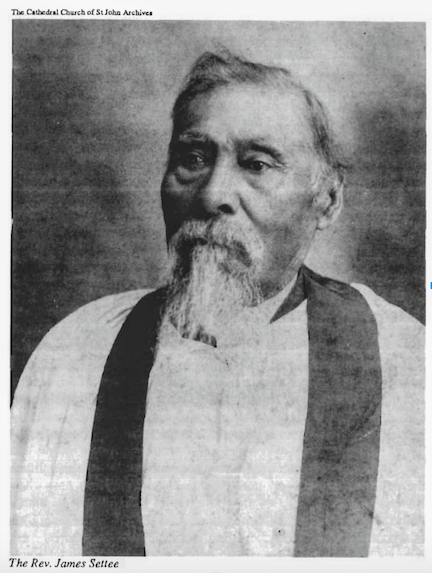
For more on James Settee (and some of the same information on Sarah) see Derek Whitehouse-Strong’s thesis, “‘Because I Happen to Be a Native Clergyman’: The lmpact of Race, Ethnicity, Status, and Gender on Native Agents of the Church Missionary Society in the Nineteenth Century Canadian North-West.”
For a background on the residential school that James Settee was taken to as a child in order to be raised as a Christian clergyman see Winona L. Stevenson’s (now Wheeler) thesis, “The Church Missionary Society Red River Mission and the emergence of a native ministry 1820-1860,” as well as “Canada’s Residential Schools: The History, Part 1, Origins to 1939” from “The Final Report of the Truth and Reconciliation Commission of Canada, Volume 1.”
Later in his life, James Settee became one of the earliest Cree writers in the English language, one of his stories, “An Indian Camp at the mouth of the Nelson River, Hudson’s Bay, 1823” finally being published by academic Jennifer S.H. Brown in a Carleton University publication in 1977. The book “First People, First Voices” published in 1983 then put in print another of Settee’s stories, “Wars between the Sioux and Saulteaux (April 1891).
These two stories have now been published together in the book “kisiskâciwan, Indigenous Voices from where the River Flows Swiftly” in 2018 (* see note below for a problem with this book.)
In James Settee’s story “An Indian Camp…” written in the late 1800s, the West and East are reversed from the current day Western worldview. The East (“Wahpun”) is Europe, who will bring cannibals and plagues to the Americas. “Nekawpahun” (the West) will resist them and the “disease & death” they bring to this land.
This is a story of a dispute between brothers, including “Wahpus”, the rabbit, who despite his small size, defeats his older brother “Keewatin”, the great Northern wind, in battle.
“Wahpus told his brothers that he was entirely independent of them and [would] never be under control [of] no ruler, no master but his own will,” wrote Settee, in his retelling of this story that he heard told by his own grandfather to their community as a youth.
“I mean to be good and kind to all. It will so follow, I will have enemies but they will never conquer me. I will stand to the end of time,” said Wahpus.
James Settee’s description of Wahpus (the rabbit) in this story reminds me of Sarah Sally Settee, defiant toward imposed authority, but dedicated and kind to her kinship networks.
In the 2013 book “The Literary History of Saskatchewan, Vol. 1,” writer Kristina Bidwell placed James Settee within a Cree literary tradition encompassing other Cree and Métis writers such as Edward Ahenakew, Louise Bernice Halfe and Maria Campbell, also commenting on Settee and Ahenakew’s strong maintenance of Cree storytelling traditions and culture despite, or alongside, their work as Christian preachers.
– M.Gouldhawke
* Note regarding the book kisiskâciwan, Indigenous Voices from where the River Flows Swiftly. Six Indigenous women writers pulled their work from the book due to the editor’s inclusion of the work of Neal McLeod, who had been recently charged at the time with domestic assault, which he pleaded guilty to, and which to their knowledge he had failed to make amends for to those that he has harmed. See the CBC article: “Indigenous authors pull works after anthology publisher keeps contributor with violent past (2017)”
Also
The First Hundred Years of Contact, by John Coffey (Secwepemc Cultural Education Society, 1990)
Biological Warfare: Disease and Depopulation, by Zig-Zag (2004)
How a smallpox epidemic forged modern British Columbia (2017)
An Exchange Between Sam Greenlee and Lawrence Ytzhak Braithwaite (2007)
(Note the similarity between James Settee’s story of Wahpus (the rabbit) defeating a larger and more powerful enemy and the Brer Rabbit tales as described by Sam Greenlee)

2 replies on “A Smallpox Epidemic & Colonial Quarantine around Lake Winnipeg”
Unfortunately not.
Thanks for sharing, do you have more about Sarah?