
Translated by Paul Avrich from the Russian-language text that had been republished in ‘Put’ k Svobode’, Geneva, May 1917, first having been published elsewhere in August 1916 according to Avrich
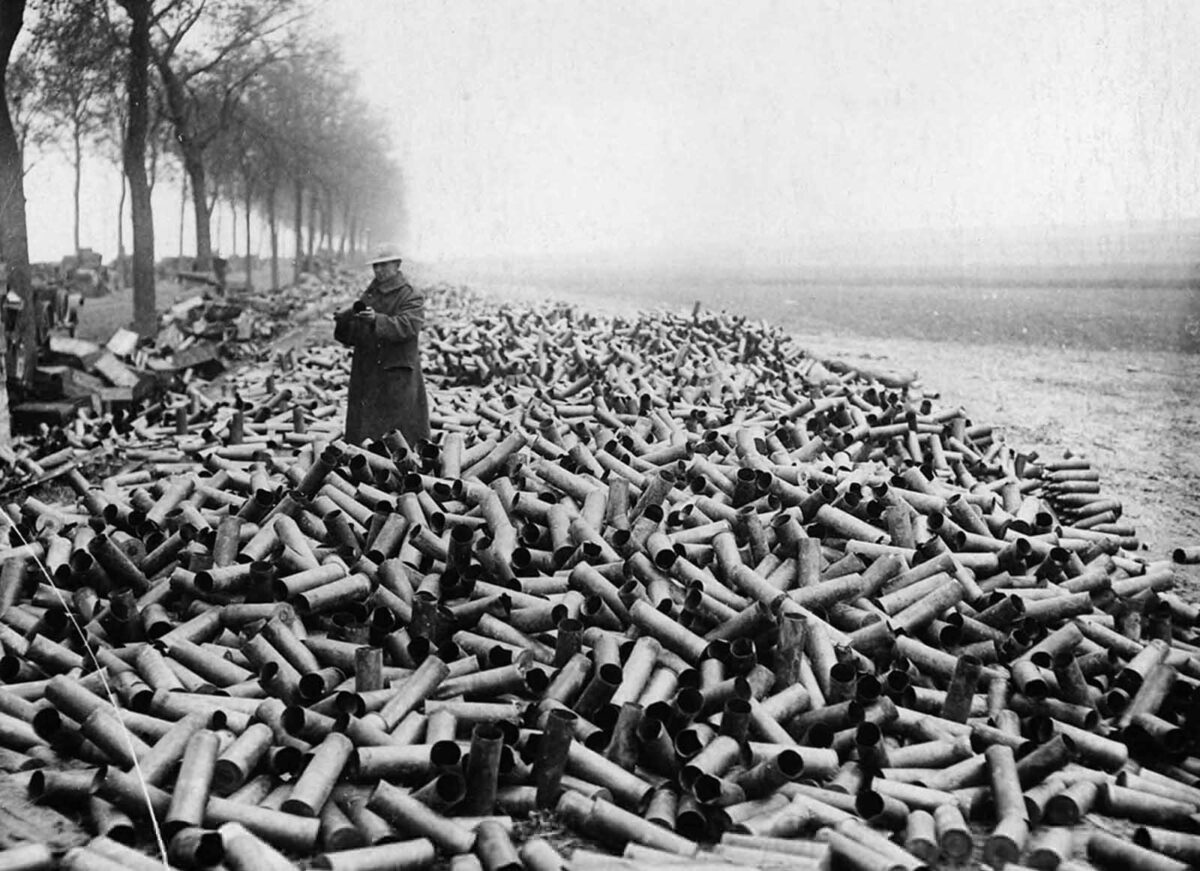
It will soon be two years since this terrible war began, a war such as humanity has never before experienced, yielding millions of nameless graves, millions of cripples, millions of widows and orphans. Billions of valuables, the products of long years of human toil, have been consigned to the flames, swallowed up by a bottomless abyss. Enormous sorrow, terrible suffering, the profound despair of humanity — all this is the result.
At this time, when cries of despair are audible everywhere — ‘Enough bloodshed! Enough destruction!’ — we look with deep sorrow upon our former comrades, P. Kropotkin, J. Grave, C. Cornelissen, P. Reclus, C. Malato and other anarchists and anti-militarists who declare in their recently published manifesto: ‘No, there has been little bloodshed, little destruction. It is too early to talk of peace!’
In the name of what principles, for the sake of what ends have they found it possible to proclaim the necessity of fratricide? What has led such passionate adherents of peace to become the advocates of armed conflict? To us it is totally incomprehensible since, when reading their manifesto, one is struck by the wretchedness of that ideal in whose name they demand the continuation of the war to the end.
The authors of the manifesto declare that the guilty party in the war is Germany, which has set as its aim the annexation of Belgium and the northern departments of France, has demanded of the latter heavy indemnities and intends in the future to seize its colonies. They reproach the German people for their obedience to their government and declare that so long as the population of Germany does not renounce the conquering schemes of its rulers there can be no talk of peace.
A clear partiality for the Entente pervades the whole manifesto. And this partiality, born of a gross overestimation of the dubious superiority of democratic regimes, has compelled the authors of the manifesto to remain silent about much that seriously compromises the Allied powers, to apply different criteria in evaluating identical actions of the belligerents, and finally to confuse the desires of the people with the desires of the governments that have enslaved them.
The signatories of the manifesto regard the German government as the guilty party in the war. But it is hardly a secret that all the great powers had long been preparing for a European war. And not merely for a defensive war, not merely to protect themselves against a German invasion. They were preparing, rather, for a war of conquest, for the conquest of new territory or for the economic domination of their neighbours. Has it not been a passionate dream of England to eliminate German rivalry on the seas? Isn’t everyone well aware of Russia’s desire to possess the shores of the Bosporus? Hasn’t Russia turned a hungry eye towards Galicia? Has France ceased to dream of becoming a great colonial power?
All the states were preparing for war. And if war did not break out before 1914, it was only because the German Kiel Canal had not yet been widened, the construction of the English fleet had not yet been completed, the French army had not yet been perfected, nor new divisions yet created in Russia. And if, thanks to their organizational talents, the crowned pirates of Germany made preparations earlier than the others and decided before the others to set Europe in flames, this in no way diminishes the moral responsibility of the crowned pirates of England, Russia and the other states for the large number of victims who have been sacrificed on the altar of militarism.
The authors of the manifesto protest against the possible annexation by Germany of the territory it has occupied without the agreement of the people living there. But why have they not protested against the annexation of Egypt, an annexation already carried out by England during the course of the war and without the agreement of the Egyptian population? Why don’t they issue a manifesto with a call for the workers to rise up against slave-holding England? Isn’t it because such an act would pull the rug from under the feet of these anarcho-militarists? Would they not be obliged then to say clearly and distinctly that the present war is a war between two groups of predators equally inimical to freedom?
The authors of the manifesto are sure that to speak now of peace would be to encourage the designs of the German war party, which prepared the German invasion of its neighbouring states, an invasion that menaces all hopes of liberation and of human progress. We believe, however, that it is not the German invasion but the war as a whole, the responsibility for which falls equally on all states taking a direct or indirect part in it, that constitutes a threat to all hopes of liberation and to human progress. And we call the people to struggle not only against the German government but to rise against all their enslavers. We welcome the demonstrations at the Reichstag building by German women demanding peace and bread. All that is healthy and pure has manifested itself in these as yet feeble protests. We summon the toilers of all countries to stormy protests, to a popular uprising, because only by such means can we expect the regeneration of humanity, and not by the continuation of the war.
The authors of the manifesto summon only the German people to revolt, while at the same time summoning the people of the Allied states to the trenches. Let them be consistent and reject both anti-militarism and revolution. For anti-militarism in France or revolutionary ferment in Russia or England will only benefit Germany. And any anti-militarism or revolution outside Germany will further the designs of the German war party. Yet this is precisely what Kropotkin has done. To our horror we have learned that even before the war he was opposed to the struggle against the law requiring three years of military service in France.
Do the authors of the manifesto really fail to understand that not only in the present war but in all wars one can find — in a purely formal sense — an allegedly greater or smaller degree of guilt, and that among the belligerents there will always be a greater or smaller degree of democracy? Thus they will always call on the less guilty to defend themselves; they will always remain slaves to the shameful slogan: ‘Make the cannon and move them into position!”
Even now, as they shift from general phrases about progress and about the German menace to concrete declarations about the possible consequences of a German victory, they harbour only the fear that Germany might take France’s colonies and reduce its neighbour to economic subjection in the guise of commercial agreements. And after all this Kropotkin and the other authors of the manifesto declare that they are anarchists and anti-militarists as before! Those who summon the people to war can be neither anarchists nor anti-militarists. They defend a cause which is alien to the toiling people. They would put the worker in the line of fire not in the name of his emancipation but for the glory of progressive national capitalism and of the state. They would tear up the spirit of anarchism and throw the pieces to the servants of militarism.
We, however, remain at our post. We appeal to the workers of the world to attack their immediate enemies, whoever their leaders may be — the German emperor or the Turkish sultan, the Russian tsar or the president of France. We know that, on the question of corrupting the will and conscience of labour, democracy and autocracy do not yield to each other. We make no distinction between acceptable or unacceptable wars. For us there exists only one war, the social war against capitalism and its defenders. And we repeat our old slogans which have been rejected by the authors of that shameful manifesto:
Down with the war!
Down with the rule of Authority and Capital!
Long live the brotherhood of free people!
Geneva Group of Anarchist-Communists
Also
The Conscripts Strike, by Louise Michel (1881)
The Russo-Japanese War, by Peter Kropotkin (1904)
To the Conscripts, by l’anarchie (1906)
Wars and Capitalism, by Peter Kropotkin (1914)
Have the Leopards Changed Their Spots?, by Thomas H. Keell (1914)
Correspondence on Kropotkin’s Letter to Professor Steffen, by Fred W. Dunn (1914)
The Conquerors of Bread, by Anselmo Lorenzo (1915)
Observations and Comments on Kropotkin and the European War, from Mother Earth (1915)
Anti-War Manifesto, by the Anarchist International (1915)
War and Preparedness, by the Anarchist Propaganda Group Philadelphia (1916)
The Manifesto of the Sixteen (1916)
Open Letter to P. Kropotkin, by Alexandre Ghé (1916)
Georgi Gogeli, by I. S. Grossman-Roschin (1925)
Obituary – Paul Avrich, by Stuart Christie (2006)
Anarchism and Revolutionary Defeatism, by K. C. Sinclair (2025)
