
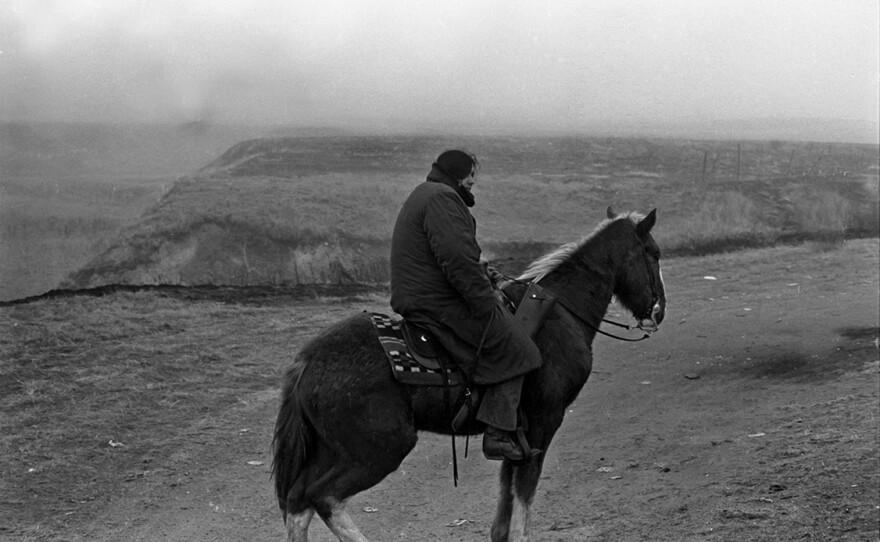
Sid Mills at Wounded Knee, 1973
Statement at Frank’s Landing on the Nisqually River, Washington, October 13, 1968
I am a Yakima and Cherokee Indian, and a man. For two years and four months, I’ve been a soldier in the United States Army. I served in combat in Vietnam — until critically wounded. I recently made a decision and publicly declare it today — a decision of conscience, of commitment and allegiance.
I owe and swear first allegiance to Indian People in the sovereign rights of our many Tribes. Owing to this allegiance and the commitment it now draws me to, I hereby renounce further obligation in service or duty to the United States Army.
My first obligation now lies with the Indian People fighting for the lawful Treaty Rights to fish in usual and accustomed waters of the Nisqually, Columbia and other rivers of the Pacific Northwest, and in serving them in this fight in any way possible.
This fight is real — as is the threat to Indian existence under the enforced policy objectives of the State of Washington, as permitted by the compromised position and abdication of responsibilities by the U.S. Government.
The defense of Indian People and a chosen way of life in this fight for unrelinquished fishing rights is more compelling and more demanding of my time and commitment than any duty to the U.S. military. I renounce, and no longer consider myself under, the authorities and jurisdiction of the U.S. Army.
I have served the United States in a less compelling struggle in Vietnam and will not be restricted from doing less for my People within the United States.
The U.S. would have accepted sacrifice of my life in Vietnam in a less legitimate cause — in fact, nearly secured such sacrifice and would have honored such death. Yet I have my life and am now prepared to stand in another battle, a cause to which the United States owes its protection — a fight for People who the United States has instead abandoned. My action is taken with the knowledge that the nation that would have accepted and “honored death” by its requirement may now offer only severe consequence and punishment because I now choose to commit myself to Indian People. I have given enough to the U.S. Army — I choose now to serve my People.
My decision is influenced by the fact that we have already buried Indian fishermen returned dead from Vietnam, while Indian fishermen live here without protection and under steady attack from the power processes of this Nation and the States of Washington and Oregon. I note that less than a month ago, we counted the death of another Indian fisherman, Jimmy Alexander, because of conditions imposed upon our People to secure a livelihood while avoiding arrest. These conditions continued off Cook’s Landing on the Columbia River, where Jimmy drowned, largely because the President of the United States ignored a direct appeal to intervene in the arrest case of Army Sergeant Richard Sohappy, a friend and fellow fisherman of Jimmy Alexander.
Sergeant Sohappy is back in Vietnam on this third tour of duty there. He was arrested three times in June for illegal net fishing, while home on recuperative furlough, recovering from his fourth series of combat wounds, and while attempting to secure income for his large family.
For his stand in Vietnam, this Nation awarded him Silver and Bronze Stars, among other awards. For fighting for his family and People, this Nation permitted a professional barber acting as Justice of the Peace to interpret his Treaty, to ignore his rights, and to impose punishment and record under criminal conviction. His Commander-in-Chief, Lyndon Johnson, routinely referred the appeal for intervention to the Department of Interior, which routinely refused to act on basis of false information and facts — and on basis of a presumption of guilt on the part of Sergeant Sohappy.
He now continues to fight for this Nation in Vietnam. His fellow Yakima tribesman Jimmy Alexander is dead, and the United States stands indifferent while his People and their rights are destroyed.
Equally, I have been influenced by the fact that many Indian women and children have become obligated by conditions and necessity to sustain a major burden in this fight. These women and children have sustained some of the most brutal and mercenary attacks upon their lives and persons that have been suffered by any Indian People since prior Indian wars.
Just three years ago today, on October 13, 1965, 19 women and children were brutalized by more than 45 armed agents of the State of Washington at Frank’s Landing on the Nisqually River in a vicious, unwarranted attack.
It is not that this is the anniversary of that occasion that brings us here or which prompts my declaration on this day — but rather the fact such actions have gained in frequency and have come to be an everyday expectation in their lives. As recently as last night we witnessed the beating or injury of women simply because they are among the limited numbers who will not surrender our limited rights.
This consideration, as much as any, gives immediacy to my decision and prompts me to act upon it now. I will not be among those who draw pride from a past in which I had no part nor from a proud heritage I will not uphold.
We must give of ourselves today — and I will not be content to have women and children fighting in my stead.
At the least, I will be among them — at the least they will not be alone.
The disturbing question is, “Why must our People fight?”
Is it because the U.S. Constitution, which declares all Treaties made to be the Supreme Law of the Land and contradictory state laws void, is almost 200 years old? But treaties are still being made under force of that document.
Or, is it because the Indian Treaties involved here are slightly more than one hundred? Or is it because the non-Indian population in this area has increased in that century from 3,900 to more than 3,000,000?
We do not believe that either antiquity in years or numerical superiority in population act to diminish legitimate rights not granted by this Nation, but rights retained in valid agreement and guaranteed the protection of the United States in their continued existence and exercise.
The Treaties define the extent of these fishing rights, as well as their limitation. The Indian “right of taking fish” exists only in the traditional waters of each respective Tribe and do not extend beyond these geographical boundaries.
State laws act to permit commercial fishing of salmon almost exclusively in areas where the Indian rights to fish do not exist. There are no State laws or regulations which would specifically permit Indian commercial fishing on the Nisqually River where several Tribes or bands of Indians hold co-existing rights. In no way do state laws and regulations account for the existence of Indian fishing rights in the waters where these rights exist.
The greatest impact upon the salmon resource, or 80% of the total catch, is made by non-Indians permitted to fish commercially by all types of gear and equipment in areas where Indian fishing rights do not exist. Roughly 15% of the salmon catch is annually taken by sport fishermen.
Indian fishermen have shown the utmost regard for conservation, but have maintained that the question of conservation must involve all elements which or who have impact upon the salmon resources. All adult salmon caught are returning to spawning grounds to engage in reproduction processes — whether they be among an 11,000,000 salmon caught by non-Indians or among the few hundred thousand caught by Indians.
The State must deal with conservation issues at the point where adult salmon return to its territorial waters.
Conservation must draw its validity in force from consideration of the total resource, irrespective of its being salt water or freshwater fisheries, and of being on or off reservations.
The State claims it seeks only to give equal application of law to all persons. Yet their equal application of law would permit non-Indians to catch up to 11 million salmon in all waters — yet can and does prohibit Indians from catching any in areas where the Supreme Law and their rights exist. The State claims that any other situation would give superior status to Indian “citizens”, not recognizing under law that a separate and distinct status or legal dimension of the Indian exists.
Citizenship of the Indian has too frequently been used as a convenience of government for deprivation of rights or property held owing to our being Indians.
We did not generally become citizens of this nation nor lawful residents of its states until June 2, 1924 — and not when all other people gained nationality and citizenship under the Fourteenth Amendment since it was immediately held in the U.S. Supreme Court that Indians were born unto the allegiance of their Tribes and not unto the allegiance of the United States. The granting of citizenship was not to act negatively upon Indian allegiance nor rights.
It is such first allegiance that I now declare and embrace in making total commitment to the Indian Cause and the immediate fight for undiminished Fishing Rights.
There is no legitimate reason why this nation and the State of Washington can not respect the equitable interests and rights of Indian People and be responsive to our needs.
Interestingly, the oldest human skeletal remains ever found in the Western Hemisphere were recently uncovered on the banks of the Columbia River — the remains of Indian fishermen. What kind of government or society would spend millions of dollars to pick upon our bones, restore our ancestral life patterns, and protect our ancient remains from damage — while at the same time eating upon the flesh of our living People with power processes that hate our existence as Indians, and which would now destroy us and the way of life we now choose — and by all rights are entitled to live?
We will fight for our rights.
Also
The Yakima War (1855–1858), from Wikipedia
Why They Oppose Civilization, by Why? (1913)
Nisqually Proclamation or “Statement of Facts” (1965)
The Last Indian War, by Janet McCloud (1966)
Sohappy v. Smith (1969), from Wikipedia
Is the Trend Changing?, by Laura McCloud (1969)
Viewpoint of People Living on Puyallup River, by Ramona Bennett (1970)
Proclamation of the Puyallup Tribe on the Repossession of the Cushman Indian Hospital Lands (1976)
So I Started Fighting For My People, by John Waubanascum Jr. (1976)
Taking Back Fort Lawton, by Bernie Whitebear (1994)
Sovereignty, by Monica Charles (2005)
The Fish-in Protests at Franks Landing, by Gabriel Chrisman (2008)
The Carver’s [John T. Williams’] Life, by Neal Thompson (2011)
Ramona Bennett Receives 2018 Bernie Whitebear Award, by Frank Hopper (2018)
Leonard Peltier’s Statement for Ramona Bennett (2018)
Henry “Hank” Lyle Adams Obituary, by Northwest Treaty Tribes (2020)
The Day the Indians Took Over Seattle’s Fort Lawton—and Won Land Back, by Frank Hopper (2023)
Fighting for the Puyallup Tribe: A Memoir, by Ramona Bennett Bill (2025)
ICE looks to WA tribes to house detained immigrant, by Nina Shapiro (2025)
What is Fascism? What is Democracy?
