
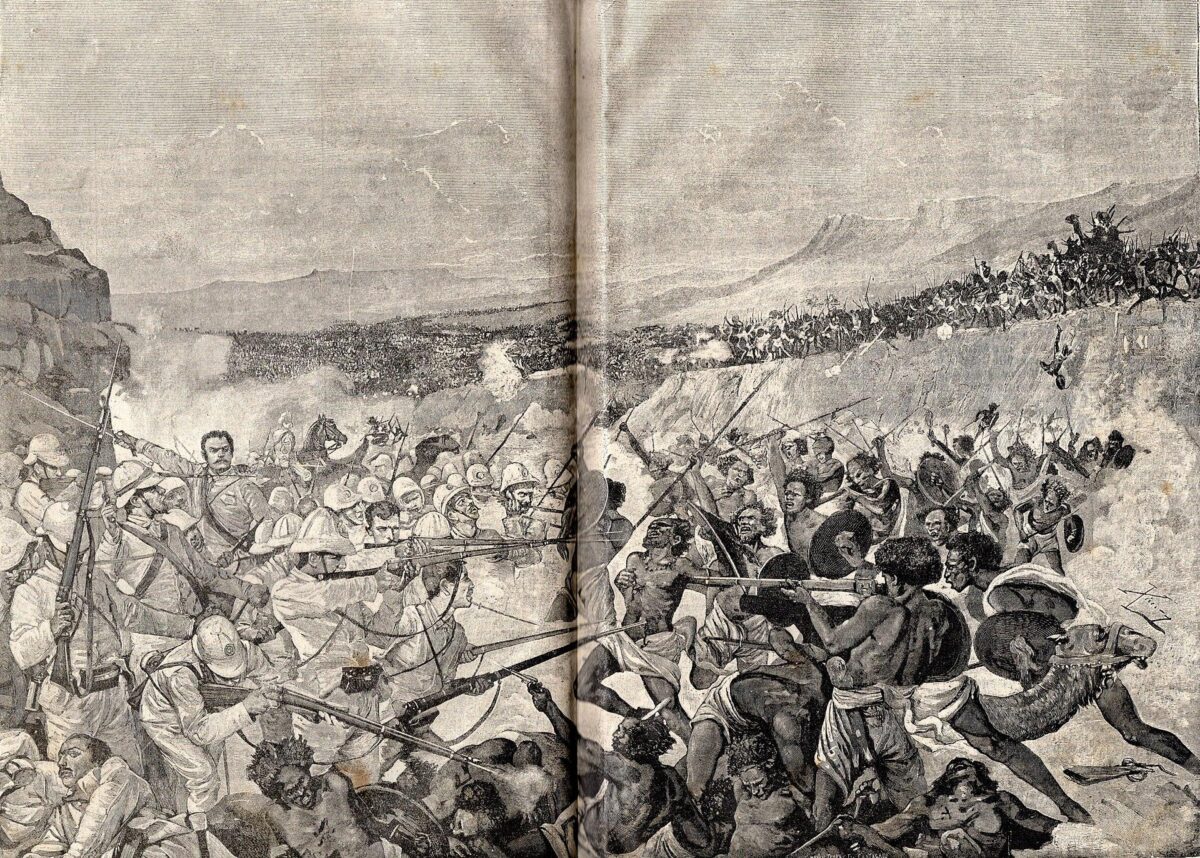
Ethiopian forces prevail over the Italians at the 1887 Battle of Dogali
From ‘Freedom: A Journal of Anarchist Socialism’, March 1887, London, UK
For some years the eyes of Italian capitalists and speculators have been turned towards Northern Africa. It is a necessity to every nation, in which the capitalist system of producing for profit has reached a certain degree of development, to possess colonies, as markets for its shoddy [goods] and nurseries for its raw material. Therefore, of course it is the business of the government, the agent and swash-buckler of the ruling classes, to aid and abet them in the spoliation of uncivilised peoples.
Now the French Republic outdid the Italians in the scramble for Tunis; and that after the Italian speculators had already obtained land there, and also permission from the Bey to open up the country with railways. So naturally these worthy folk were grievously annoyed. But when Cardinal Massaia wrote from Abyssinia [Ethiopia] of the land there to be conquered and natives to be exploited, the Italian capitalists saw another chance. For some time Italy has rung with the cant so familiar to English ears, about carrying the blessings of civilisation to savage nations. Exploring parties were dispatched; finally General Pozzolini was sent “on a mission” to King John. The old, old story we English know so well; explorers, missionaries, traders, land grabbing, exploitation, and then armies and artillery to enforce the submission of the “barbarians” to the tyranny of the whites who rob and enslave them.
The Abyssinians, however, were better prepared than is usual with a semi-savage people marked out by a great capitalist State as its victim. The rulers of Italy and Austria are allies, and Italy is therefore detested by the Tzar. Accordingly Cossack emissaries found their way into the court of King John, and Russian gold into his treasury; and the Italians, creeping stealthily towards their prey, found the suspicions of the people aroused and a nation in arms to receive them. Thus it has come about that the Massowah expedition, intended to overawe the natives, has met with determined resistance, and the Italian Ministry, who assured Parliament that there would be no fighting, have had to confess not only a battle, but a serious defeat.
“It is a noteworthy fact,” writes an Italian correspondent, “that only the declared enemies of government and capitalism are able to withstand the temptation of military glory and territorial conquests.” And indeed the only public protests against Italian aggression in Abyssinia have come from the circle of the Lega dei Figli del Gavora at Naples and the Italian colony in London, all of whom are Socialists, and the majority Anarchists.
In truth the masses of the people know nothing of these little wars. They are too hopelessly ground down by the oppression of their masters at home to look with anything but stupid indifference on their crimes abroad. It is only when the workers realise their own position, and how they themselves are the slaves of those who possess land and capital, and, if they would live, must work for these men for a wage — i.e., a miserable fraction of what they produce — that they wake up to the wrong and shame of hiring themselves out as cut-throats to minister still further to their masters’ lust for gain and power. A Social Revolution which shall free the working classes of Europe and America is the only hope of peace and well-being for those races which have as yet escaped the blessings of shoddy, exploitation, brandy, and vice.
Conquest — Incorporation — Federation
Three ways, these, of social union. The first is the barbaric fashion, honestly brutal, and effective after a fashion.
The second is the way of the modern “civilised” powers — Russia, Prussia, Britain, France. Let India, Tonkin, Poland, Alsace-Lorraine, and Ireland bear witness to the hypocrisy and hollowness of this way.
True union, and truly social union, may only be through Federation. But federation enforced by a majority’s will and vote is only the second bad way over again in disguise.
To be itself and real, Federation must be free — i.e., spontaneous and of good-will. No single one individual or group may be federated against its will. Whether applied to the smallest commune, the largest group of communes, or to the whole inhabited world, this is the faith of Anarchism.
But this way of uniting people demands intelligence, reasonableness, character, forbearance, self-control — and
powerful meekness and kindness, like that of the good bishop in ‘Les Miserables.’
Also
Anarchism & Indigenous Peoples
Anarchism and Revolutionary Defeatism, by K. C. Sinclair (2025)
(Zine) Anarchists on South West Asia and North Africa (1912-2024)
Mussolini’s Colonial Inspiration, by Matthew Wills (2022)
The Myth of Benevolence, by Milan Rai (1995)
New Phase in Oil Struggles, by Freedom (1953)
This Is Not A War For Freedom!, by War Commentary (1939)
“What Are We Fighting For?”, by Vernon Richards (1939)
Those Who Make War Possible, by Spain and the World (1938)
Capitalist Peace, by Ethel Mannin (1938)
Call to Moroccan Proletarians, by Ahmed Ben Thami (1936)
The Right of Peoples to Determine Themselves, by Solidaridad Obrera (1936)
Militians, Yes! But Soldiers, Never!, by various Spanish anarchist militias (1936)
Mussolini’s War Upon East Africa, by Marcus Graham (1935)
Attention! Fascism Installed in Tunisia, by Nguyen Nam (1933)
Anti-War Manifesto, by the Anarchist International (1915)
Our Foreign Policy, by Errico Malatesta (1914)
The War and the Anarchists, by Errico Malatesta (1912)
Concerning the Beginning of the End, from Tiempos Nuevos (1912)
Which Makes the Greater Savage, the Blanket or the Uniform?, by Emily G. Taylor (1902)
Imperialism: Monster of the Twentieth Century, by Kōtoku Shūsui (1901)
The War Spirit, by Lizzie M. Holmes (1898)
Our Colonizations, from Le Révolté (1884)
The Indians, from The Alarm (1884)
War and the State, by Mikhail Bakunin and James Guillaume (1870)
