
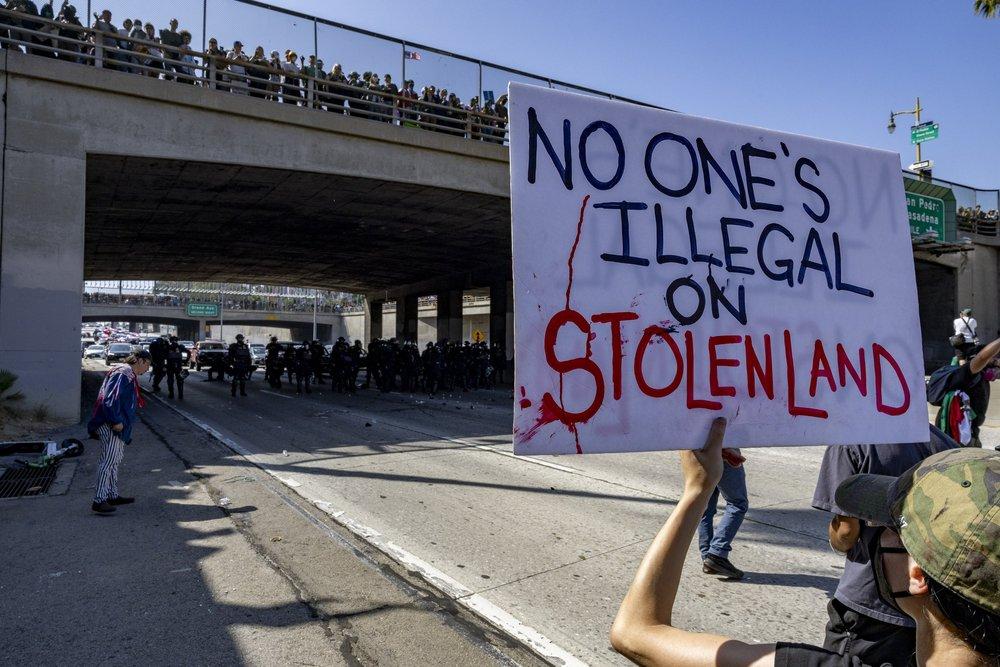
Los Angeles 2025
Freedom to Move
Freedom to Stay
Freedom to Return
NoBorders/LandBack
* Jump ahead to latest updates *
Intro
From the streets of Minneapolis and Los Angeles to the streets of Palestine, we are constantly reminded that the category of ‘migrant’ (or ‘refugee’) and that of ‘Native’ are not mutually exclusive. They never have been.
The city of Minneapolis was built around Fort Snelling, where hundreds of Dakota and Ho-Chunk people were confined in a concentration camp after the Dakota War of 1862. Some Dakota people fled the region’s conflict to join their relatives on the Canadian side of the border, where part of Dakota traditional territory sits as well. In 1968, the American Indian Movement was founded in Minneapolis in response to mass incarceration and police brutality against Natives. State repression, and resistance to it, are not something new to Minneapolis, or to other colonized territories, they only take more or less different forms at different times and places.
Before the colonizer’s borders crossed us, we moved freely. Once they imposed their lines upon our territories, we continued our movements, as best we could. Sometimes we crossed the line looking for relief from state repression. Aside from the Dakota people who fled to Canada, there were Louis Riel and Little Bear’s people, who sought refuge in “Montana”; Sitting Bull and hinmatóowyalahtq̓it’s (Chief Joseph’s) people, who looked to “Saskatchewan” for the same; and much later, Leonard Peltier, who sought refuge in “British Columbia” and “Alberta”; among other lesser-known examples.
Each Indigenous nation has its own stories and histories. Not all of our peoples were nomadic hunters and gatherers. Some peoples’ stories place them in the locations in which they currently live as far back as can be remembered. On the other hand, some of our peoples’ stories, including some of our origin stories, are tales of migration. Since before colonialism, we’ve always traveled, made new relations, and sometimes made new places our homes (or old places our homes once again) as part of making those relations.
The colonizer’s imposed borders restrict our movements within our own homelands and prohibit us from welcoming our kin from other places. Settler colonialism has always confined us in various ways and often forced us to move to other restricted areas, at the cost of many lives. This doesn’t make us any less Indigenous; it’s part of what makes us Indigenous. This system has made us refugees in our own territories, and in the lands of others, but we’ve always resisted and sought ways to get around or escape their restrictions.
The Jay Treaty of 1794 was supposed to secure freedom of movement for Native persons between Canada and America, but it has not been fully implemented by the US, and Canada doesn’t even recognize it. There is no equivalent for the border between the US and Mexico, although some tribes have enhanced identification cards to make their crossings easier.
Most of the 1854-56 Stevens Treaties in the State of Washington prohibit the tribes who signed them from trading with their relatives on the Canadian side of the border and from allowing those relatives to reside with them on Washington reservations without settler consent.
In light of all this it becomes clear that ultimately we can’t rely on settler laws to uphold our freedoms, or on the settler system to do the right thing.
We also can’t stop the present-day practices of racial profiling, mass incarceration and deportation by throwing our relatives under the bus and saying “hey, look, we’re the good ones, we’re the ones who belong.” We can only stop these kinds of harms by opposing all the white supremacist systems of control that oppress us all. It is in our own interest as Native peoples to act in solidarity with (other) migrants, and it is in our interests as migrants to act in solidarity with (other) Indigenous peoples.
An injury to one is an injury to all. Until every border falls.
-Ed. (âpihtawikosisân), 2026
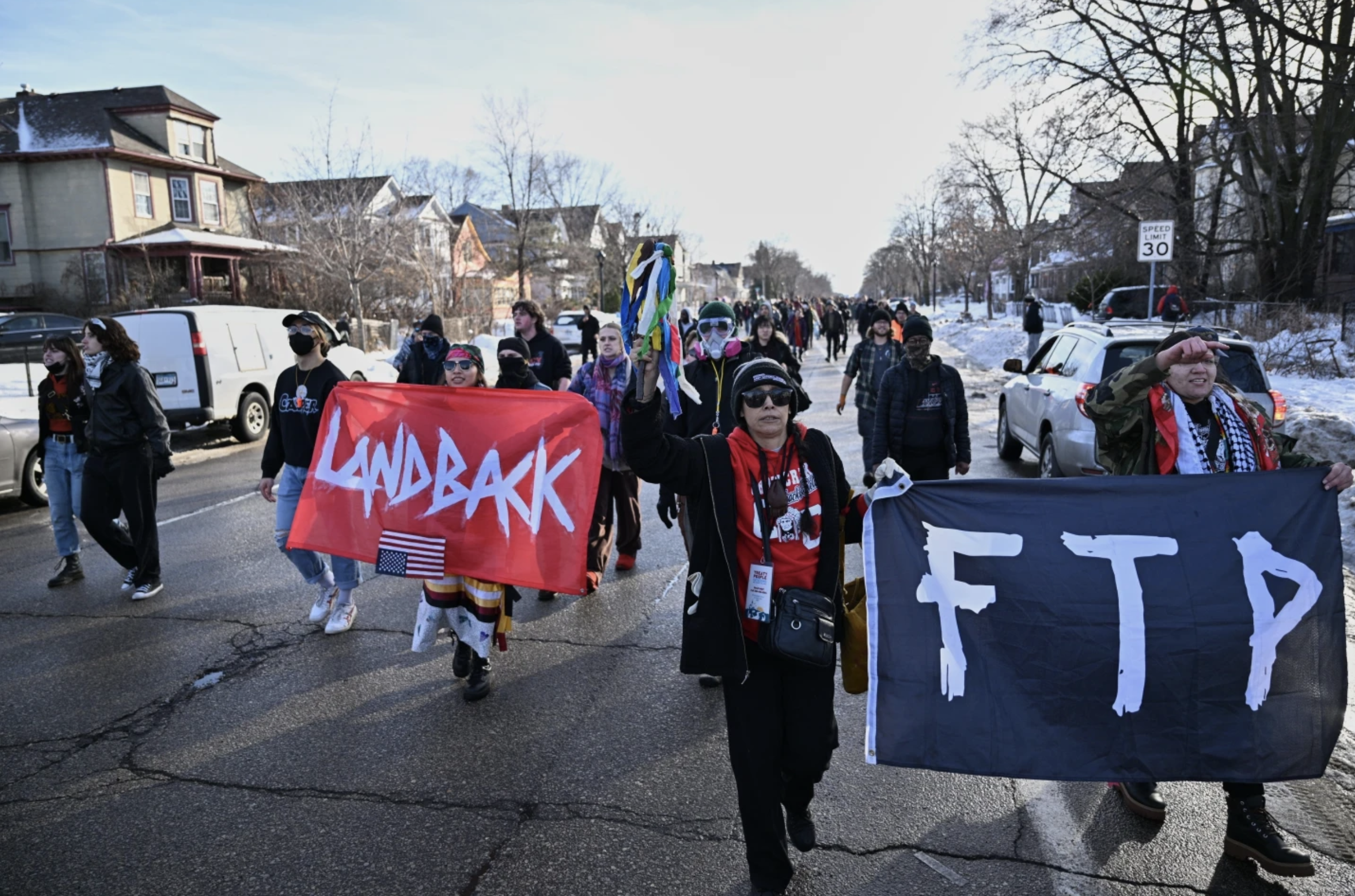 Minneapolis 2026
Other sites & pages
AIM Patrol Minneapolis, from the Minnesota Historical Society
Fort Snelling & the Dakota War of 1862, from Wikipedia
We Are Here: Indigenous Diaspora in Los Angeles
Pascua Yaqui Tribe, from Wikipedia
Canada’s Truth and Reconciliation Commission Reports
Mapping Deportations: Unmasking the History of Racism in U.S. Immigration Enforcement
Myth: Palestinian refugees are unique, from Decolonize Palestine
Canadian Imperialism (including support for ICE/DHS)
What is Fascism? What is Democratic Colonialism?
Stories & Statements
In reverse chronology
“]Jacque] Wilson says her fear of ICE is part of blood memories of the state taking Indigenous people from their families. Wilson is from the Bois Forte Band of Chippewa in northern Minnesota.”
“To think that somebody that is uneducated, full of testosterone, armed, and has a quota to meet for incarcerated citizens [is] terrifying,” said Arihhonni David.
“The Little Earth Native housing complex became the target of federal immigration enforcement efforts during immigration surge in January and early February.”
“For more than 50 years, Native activists have organized in south Minneapolis. The American Indian Movement, a Native civil rights organization, opened its first office out of storefront on Franklin Avenue in the late 1960s in response to police violence, with the AIM patrol later re-forming briefly in the 1980s.”
How Native communities pushed back as ICE operations escalated, by Melissa Olson (2026)
“Haskell Indian Nations University students and community members on Friday protested the presence of U.S. Immigration and Customs Enforcement in Lawrence after sightings were confirmed on social media Tuesday.”
Native American students lead protest against ICE presence in Kansas town, by Maya Smith (2026)
Democratic colonialists proud of how they’ve outdone autocrats.
“Following the program, people gathered in front of the Minneapolis American Indian Center for a 1-mile march through the Phillips neighborhood. Marchers later returned to share a meal. Marches also took place in Bemidji and Duluth on Saturday.”
“The American Indian Movement was established in Minneapolis more than 50 years ago in response to police brutality. After ICE agents flooded the city this winter, neighborhoods reprised citizen patrols.”
“Yet the administration has continued jailing people indefinitely even after courts ruled the policy was illegal.”
“I will continue to use my voice to speak up for the freedom and dignity of others.”
Statement by Leqaa Kordia from Immigration Detention (2026)
“Back in 1862, as masses of Native Americans were imprisoned in Fort Snelling, a military commission held trials for 498 Dakota men who were suspected of raiding settler towns. 38 men were convicted and sentenced to public execution by hanging.”
“I’m going to cry,” Dodie White Eagle, a member of the foundation’s board and descendant of survivors of the massacre, said. “The kidnapping of children, the invading of our sovereign lands, and they’re taking our own people.”
“Leqaa Kordia, a 33-year-old Palestinian woman detained in the United States by the Immigration and Customs Enforcement (ICE) agency since March, has been rushed to a hospital after a medical episode, according to media reports.”
Who is Leqaa Kordia, the Columbia protester still in ICE detention?, by Yashraj Sharma (2026)
“There was a time in this county when everything about Native people was illegal,” said Kelly Sherman-Conroy.
Indigenous-led demonstration serves ICE symbolic ‘eviction notice’, by Melissa Olson (2026)
“Members of the American Indian Movement and the Many Shields Warrior Society are patrolling the streets of Minneapolis.”
Indigenous-Led Collectives Are Keeping Minnesotan Communities Safe From ICE, by (2026)
“As a daughter of immigrants and a journalist, I came to Minneapolis to cover what feels like the unravelling of an empire – and to document the growing violations against constitutional rights and our right to free speech.”
“Indigenous Peoples across Turtle Island must not be subjected to such questioning and detainment. Our Nations have been here since time immemorial, before the U.S.A. and Canada.”
Travel Advisory, by the Chippewas of Nawash Unceded First Nation (2026)
“My fear is that they will be detained and have to face the horrific detention facilities until they can get cleared,” said Diana Moffat, communications officer for Upper Nicola Band.
First Nations in B.C. issue travel advisory for Canada-U.S. border crossings, by CBC News (2026)
“Minnesota’s Somali community has organized mutual aid and neighborhood patrols…”
Somali Communities Are Building Collective Power, by Jamila Osman (2026)
“More than 162 years after the Mdewakanton Dakota people were forcibly detained and held at Fort Snelling in Minnesota, a Mdewakanton woman found herself detained in the same place her ancestors had been.”
Dakota woman recounts more than 48 hours in immigration detainment, by Amelia Schafer (2026)
“Jingle dress dancers gathered on Sunday to hold healing ceremonies at the locations where Renee Macklin Good and Alex Pretti were shot and killed by federal immigration agents while observing their operations.”
“We’re not a thing of the past. We’re here, we’re present, and we’ve been here for a really long time and we’ll be here for a long time to come,” Keianna Cachora said.
“Why Indigenous communities are on the frontlines defending rights for all.”
“It gives me some peace of mind. But at the same time, why do we have to carry these documents?” [Shane] Mantz said. “Who are you to ask us to prove who we are?”
“The distinguishing irony of [Sophie] Watso’s detention is that she is Native American, from the Mdewakanton Dakota tribe”
For Minneapolis’ Native Americans, a new fight echoes a bitter history, by Matthew Purdy (2026)
“The 20-year-old was dragged out of his aunt’s vehicle and detained by immigration agents in early January.”
“…WHEREAS, also on January 21, 2026, the Oglala Sioux Tribal Council also passed Motion No. 26-09 ‘to ban any ICE agents from coming onto the Pine Ridge Indian Reservation boundaries and have the President come out with an announcement’, and…”
“It’s a frightening and novel notion to many. But not in Indian Country where federal efforts at intimidation and eradication began with the founding of the nation 250 years ago.”
Native people see history repeating itself in ICE crackdown, by Stewart Huntington (2026)
“I am saddened that our youth have Native leaders who are failing to meet the moment.”
Alaska Native corporations’ ICE contracts endanger all Indigenous people, by David Leslie (2026)
“No family or community should have to endure fear, violence, displacement, or separation in the places where they live and work. Our hearts are with all those whose lives have been disrupted or torn apart by these events.”
Joint Statement from Dakota/Lakota Nations (2026)
“At least one tribal member was arrested during widespread protests in Minneapolis following the shooting and killing of 37-year-old Alex Pretti by immigration agents on Jan. 24”
Dakota citizen arrested by federal officers during Minneapolis protest, by Amelia Schafer (2026)
“For the Dakota peoples, some of the Indigenous Peoples of Mni Sota Makoce (Minneapolis), where the Minnesota and Mississippi rivers converge is a sacred site called Bdote.”
“He said he could see children streaming from dormitory areas behind a chain-link fence and chanting ‘Libertad.'”
“The advisory, posted Jan. 23, said the AFN ‘strongly condemns’ [ICE’s] actions and reaffirms First Nations inherent and Jay Treaty rights to cross-border mobility.”
Travel advisory issued by AFN for those going to the U.S., from Windspeaker (2026)
“Chief and council of Mississauga First Nation strongly condemn these actions. Members travelling to the U.S. are urged to take extra precautions by ensuring all identification is up to date.”
“Walker said it’s important for Native Americans to understand that Hispanic immigrants are Indigenous to the Americas as well, and she said she is concerned by seeing Natives being taken into custody by ICE agents.”
‘All Natives should stand up for what’s happening on our land’, by Kevin Abourezk (2026)
“Fort Snelling, the site of a Dakota War era concentration camp, is once again being used to detain Indigenous people.”
“The Lac Vieux Desert Tribal Council firmly states that we do not support ICE actions taken against Native people, nor actions rooted in racial profiling, fear, or disregard for Tribal sovereignty and human dignity.”
“My detention began on March 13, 2025, when I went to ICE headquarters for what I believed to be routine immigration questions. Instead, I was thrown into an unmarked van and sent 1,500 miles away.”
10 months later, I’m the last Columbia protester still in ICE custody, by Leqaa Kordia (2026)
“While no one should be required to prove their identity as a Native American, having documentation available may help avoid unnecessary complications.”
“But it’s worth remembering that the Democrats have long enabled this spiraling enforcement agenda.”
“Mille Lacs band tribal members protested outside the tribe’s government buildings on Friday.”
“Supporters are pouring in from across Indian Country to protect the Minnesota community from ICE.”
“Somalis are fighting back, from homemade sambusas for protesters to foot patrols on the lookout for ICE.”
Inside the Somali-Led Resistance in Minneapolis, by Fatima Khan & Meghnad Bose (2026)
“He said he told them ‘I have bills and I have kids’… That’s when one of the officers or agents responded with ‘we’re going to get them, too.’”
ICE agents detain Navajo man in Peoria, ignoring US, tribal IDs, by Arlyssa D. Becenti (2026)
@savageest.1991 Replying to @Indigenous Adzáá Tábaahá #fy #fyp #foryoupage #iceagentscomingforus #nativetiktok
♬ original sound – Peter Yazzie
“We stand with our neighbors—whatever their country of birth—who are getting ripped away from their families or violently apprehended for their lawful efforts to protect their communities.”
Native American Rights Fund statement on unlawful ICE activity (2026)
“This act of violence was completely unacceptable and inhumane. In addition, we are now seeing federal immigration enforcement activity extend onto tribal lands, where tribal members are being stopped, questioned, and harassed across Indian Country.”
Statement from the Office of the Principal Chief of the Seminole Nation of Oklahoma (2026)
“Closer to home, Leonard said he heard from a Rainy River member who saw ‘ICE agents on every street corner’ in a northern Minnesota town.”
First Nation’s advice: ‘Be careful’ in the U.S., by Mike Stimpson (2026)
“The Grand Traverse Band of Ottawa and Chippewa Indians issued a warning to tribal members Thursday about ICE enforcement, stating that federal ‘racial profiling practices’ have included Native Americans as a class subject to stops ‘based on perceived ethnicity, language, or occupation.’”
Grand Traverse Band Issues Warning to Tribal Members About ICE Enforcement, by Beth Milligan (2026)
“In response to Native Americans being stopped by ICE, several Wisconsin tribes issued statements voicing concern over the stops and also offering advice to their members.”
Wisconsin tribes react after ICE detains Native Americans in Twin Cities, by Frank Zufall (2026)
“The Tribe wants to be clear: we do not support or cooperate with Immigration and Customs Enforcement (ICE). Our priority is the safety, dignity, and protection of our Tribal members.”
Statement by the Lac Du Flambeau Band of Lake Superior Chippewa Indians (2026)
“Johnson’s statement says Tribal Members were accosted by officers using unconstitutional racial profiling techniques, and also says there is no reasonable basis, suspicion, or probable cause to restrict the liberties of Native Americans based on skin color, hair color, eye color or a lack of identification.”
“No one should feel unsafe in their neighborhood, workplace, or homeland because of how they look, the language they speak, or the country they were born in.”
“In recent weeks, heightened tensions have emerged as U.S. ICE agents have stopped and detained tribal members and tribal descendants, raising urgent concerns about dignity, safety, and respect for Native American citizens,” wrote Bay Mills Indian Community President Whitney Gravelle.
Michigan Native American tribes warn about ICE. What they’re telling members, by Dan Basso (2026)
“Senior staff attorney at the Native American Rights Fund, Jacqueline De León, said federal immigration agents racial profiling Native Americans is one of the consequences of recent decisions by the Supreme Court around the use of ethnicity in immigration steps.”
‘A deep irony’: Native American legal expert weighs in on racial profiling, by Melissa Olson (2026)
“The Spirit Lake Nation and Sisseton Wahpeton Oyate in a joint statement with the Crow Creek Sioux Tribe said ICE’s activities in Minnesota have ’caused fear and uncertainty’ among their citizens. The joint statement also condemned the killing of Renee Good by an ICE agent on Wednesday.”
Native leaders in North Dakota urge use of tribal IDs, denounce ICE tactics, by Mary Steurer (2026)
“Our Tribe stands in solidarity with all people who seek safety, opportunity, and a better life for their families and we deeply oppose policies and enforcement actions that criminalize existence, disrupt families, and undermine trust within our communities.”
“Native American community leaders and members gathered on Friday in south Minneapolis to share prayer, support and solidarity amid the surge of ICE operations.”
“We, as well as many Indigenous Nations and organizations across the United States have been monitoring this issue and the reprehensible actions of ICE agents, especially those that now appear to be targeting indigenous peoples”
“At least five Native American men have been detained and an unknown number questioned by immigration officers across the Minneapolis area in the midst of what a top official called the ‘largest immigration raid ever.’”
Five Native Americans detained by ICE during ongoing raids in Minneapolis, by Amelia Schafer (2026)
“Studies show that the return of land to tribes provides the best outcomes for the climate.”
“The petition says that these detention centers ‘go against ancestral values of responsibility, human dignity, and respect. This line of business is an unjust investment on many levels, including adjacency to work that co-signs ICE methods including lack of due process for detainment, incarceration and rampant mistreatment of thousands of Indigenous relatives from Central and South America.'”
“I hold a position which requires me to work with government and find solutions. I will not be found sitting anywhere with ICE at the table.”
Statement by the President of the Ho-Chunk Nation (2026)
“Red Lake Tribal Council is very concerned that Red Lake members will be abused by ICE and other federal agents that are supporting their abusive tactics.”
“Some of those who died in detention had arrived in the US recently, seeking asylum. Others had arrived years ago, some as young children.”
“The Oneida Business Committee condemns OESC’s action to enter a contract for ICE facilities and we believe such actions hinder teaching our values to the next seven generations if its employees, representatives, or corporations do not abide by those values today.”
“I clicked on the article. It barely mentioned my community. Instead, it analyzed which letters the tweet had capitalized and how those letters corresponded to neo-Nazi slogans.”
Erasure is how anti-Indigenous racism works, by Rebecca Nagle (2025)
“Native people know oppression. We were forcibly removed from our homelands, locked in Indian boarding schools, confined to reservations. Our history is one of systematic attempts by the federal government to erase our culture, our language, our existence. We cannot — we should not — profit from the oppression of others.”
My Tribe’s ICE Contract Betrayed Our Values, by Levi Rickert (2025)
“Miles alleges that a similar thing has happened to her son and uncle – they have previously been detained and later released by ICE officers who would not initially accept their tribal identification.”
“WHEREAS, in times of war and similar emergencies, Indian lands are targeted for government use, just as the Gila River Indian Community, Ward Lake near Ketchikan, Alaska, and Colorado River Indian Tribes were forced to play host to Japanese Internment Camps; and…”
“I kept trying to explain to them that I’m Native American,” she said.
‘We can’t have this happen again’: Salt River Pima citizen nearly deported, by Amelia Schafer (2025)
“The Nisqually people are not in favor of, nor will the tribal council allow, the detention of individuals by ICE on our reservation or in our facilities,” said Tribal Chair E.K. Choke in the statement
ICE looks to WA tribes to house detained immigrant, by Nina Shapiro (2025)
“Indigenous people have been subjected to forced removal and mistreatment within government-funded facilities for generations. ICE detainments are not isolated incidents; they are part of a long and painful continuum of racially targeted government actions.”
“When the Supreme Court recently allowed immigration agents in the Los Angeles area to take race into consideration during sweeps, Justice Brett Kavanaugh said that citizens shouldn’t be concerned.”
“Kordia, a Palestinian who has lived in New Jersey since 2016, was one of the first arrested in the government’s campaign against protesters, many of them prominent activists. All the others have gained release.”
The only protester still locked up…, by Jake Offenhartz and Adam Geller (2025)
“The call to rescind those medals is not about erasing history, but about refusing to let lies and conquest define it.”
With Wounded Knee Medals, Admin Suggests There’s Valor in Genocide, by Johnnie Jae (2025)
“We write as Indigenous women, Two-Spirit and Indigiqueer people grounded in our responsibilities to our Peoples and lands, to raise our voices in solidarity with the people of Palestine.”
Indigenous Women: Letter of Solidarity with Humanitarian Flotilla (2025)
“The Everglades is meant for our tribes, it protects life, it shields it. It’s not meant to detain life,” Troy Sanders says.
“The tribe, whose territory is adjacent to the immigration detention facility in the Florida Everglades, joined a lawsuit against the state and federal governments on July 14.”
“It is important to look at the history of concentration camps operated by the United States, to remind ourselves that ‘yes, it can happen here.'”
Concentration Camps in U.S. History, by Zinn Education Project (2025)
“Leo Costello, chair of Rice University’s art history department, said the painting is a visual representation of the idea of Manifest Destiny, which held it was the divine purpose and right of European-descended settlers to spread across North American for the progress of civilizations as they saw it.”
“The complete erasure of Black immigrants, migrants, and refugees is being aided by ICE incursions against disproportionately targeted communities.”
Another way out: What Black America’s migrant history tells us now, by William C. Anderson (2025)
“Border restrictions [are] ‘not to the benefit of Inuit,’ Beveridge said.”
Love at the Border, by Sarah Rogers (2025)
“Many of those workers formed part of a close-knit community, with ties to the same indigenous Zapotec town in Veracruz, Mexico.”
After ICE raids in LA, families of those detained are desperate for answers, by Vanessa Romo (2025)
“Our communities are composed of people who traversed borderlands with nothing more than a backpack, successfully fleeing civil wars, political persecution, dictatorships, state violence, and their own futures—and we are their children.”
“The Kumeyaay people once moved freely across the mountainous and coastal regions of what is now northern Baja California (Baja California Norte), in Mexico, and parts of California and Arizona, in the United States.”
“James Mast, a Cree Sixties Scoop survivor, says he was making his way to Oklahoma so he could care for his ailing adoptive father when tribal police on the U.S. side of the Akwesasne reservation arrested him and turned him over to U.S. Border Patrol.”
“But it has also renewed focus on the network of remote immigration detention centres that stretch between Texas, Louisiana and Mississippi, known as ‘Detention Alley’ – where 14 of the country’s 20 largest detention centres are clustered. And now where other students have since been sent after being arrested thousands of miles away.”
“In order to live by miyo-wîcêhtowin and wîtaskêwin, we need to live in good relations to Indigenous Peoples locally and globally.”
Treaty Responsibilities to Palestine, by Jessica Johns (2025)
“One Navajo Nation official said that ‘many fear for the threat of being deported.’”
Over 15 Navajo Nation Members Swept Up in Immigration Raids, by
“This event is an annual celebration of the rights of all Indigenous peoples of North America to cross the border between Canada and the United States freely.”
“Canada labelled Dakota and Lakota as ‘refugees’ and denied them many historic treaty benefits.”
“The expansion of Anglo-American settlement into the Trans-Appalachian west led to the passage of the Indian Removal Act in 1830, forcing all eastern tribal nations to move to new homelands west of the Mississippi River in the Indian Territory.”
Removal of Tribal Nations to Oklahoma, by the Oklahoma Historical Society (2024)
“The double standard is clear. White Christians and Jewish Israelis, even if associated with violent fascists or potential war criminals, are admissible to Canada and inherently safe, but all Palestinians are probable terrorists.”
“Native people are incarcerated in state and federal prisons at a rate of 763 per 100,000 people. This is double the national rate (350 per 100,000) and more than four times higher than the state and federal prison incarceration rate of white people (181 per 100,000).”
Native incarceration in the U.S., by the Prison Policy Initiative (2023)
“To end this insufferable situation of having no rights of any kind, a group of African men, women and children decided to emerge from the shadows.”
The Sans-Papiers Movement in France, by Mogniss H. Abdallah (2023/2000)
“Then came the Mexican-American War which lead to the 1848 Treaty of Guadalupe Hidalgo in which Mexico gave 55% of its territory to the United States to end the war. That meant the border moved south, crossing those families and landowners who had lived in the area for generations.”
“As night fell, the starving prisoners reassembled their few rifles from components they’d scattered and hidden. They took aim at the fort’s guards and prepared to fight for their lives. The Northern Cheyenne’s journey home had begun.”
A Path Toward Healing, by Scott Stark (2022)
“In knowing the history of how AAPI [Asian Americans and Pacific Islanders] were treated in this country, we can better understand how we arrived at this point in history.”
“‘Illegal alien’ remained the term du jour in the American mainstream through the 1970s and 1980s, but [Bert] Corona and others always pushed back with softer describers such as ‘unauthorized’ or the well-worn refrain ‘no human being is illegal.'”
The California roots of the fight over the term ‘illegal alien’, by Gustavo Arellano (2021)
“Washington directed that these runaways be rounded up and entrusted to guards at two fortified positions on either side of the York River. There they would be held until arrangements could be made to return them to their enslavers. Thus, with the stroke of a pen, Washington converted his faithful Continentals—the men credited with winning American independence—into an army of slave catchers.”
The Yorktown Tragedy: Washington’s Slave Roundup, by Gregory J. W. Urwin (2021)
“Since its creation in 1924, the U.S. Border Patrol has been steeped in institutional racism and has committed violent acts with near impunity. The racial animus of U.S. immigration policy in the late nineteenth and early twentieth century formed the foundation for the agency.”
The Legacy of Racism within the U.S. Border Patrol, by Katy Murdza and Walter Ewing (2021)
“Despite Kearney’s threats, he and his mob did not actually invade the mansions, which would have resulted in the full power of the authorities coming down on them. It was safer to beat up Chinese people.”
San Francisco had its own demagogue who capitalized on racist grievances, by Gary Kamiya (2021)
“One of the largest mass lynchings in the United States targeted Chinese immigrants in Los Angeles.”
The bloody history of anti-Asian violence in the West, by Kevin Waite (2021)
“Despite seeking refuge in the United States from the genocide, many Mayas never sought asylum nor were they granted refugee status. The United States was generally unwilling to grant them asylum, having backed the dictatorships responsible for the violence the Maya were fleeing.”
“Visual art, music, and literature produced from the 1930s through the present offer rich data for contemplating shifting representations of the border and immigrants over time and for exploring factors that shape the context, content, and tone of such representations.”
“Hundreds of Chinese immigrants fled from Washington to Portland, but the leader of the Washington anti-Chinese campaign, Daniel Cronin, followed them here in January 1886. Cronin, a Knights of Labor union organizer, soon vowed ‘there will not be a working Chinaman in Portland’ within three months.”
Portland’s Shameful Anti-Chinese Violence, by Steve Law (2020)
“Throughout Canada and the United States, a disproportionate number of Native women go missing and/or are murdered.”
“During the 1880s, the earliest enforced immigration laws drew upon these values to bar legal entry to categories of persons considered unsuitable for citizenship, starting with Chinese as a race, the poor (LPC [Likely to become a Public Charge]), and contract workers.”
US Immigration History Timeline, by the Immigration and Ethnic History Society (2019)
“Since its founding, the U.S. Border Patrol has arguably been the most politicized and abusive branch of federal law enforcement.”
The Border Patrol Has Been a Cult of Brutality Since 1924, by Greg Grandin (2019)
“It also recalls an earlier time in U.S. history, nearly 90 years ago, when Mexican Americans and Mexican immigrants were ousted from the country in enormous numbers.”
“But bisected by the line, Crees became asylum-seekers on their own lands 150 years ago. Though some were granted political refugee status, Crees were still denied basic rights. Instead, many were killed, ignored and deported on both sides of the border.”
Ignored and deported, Cree ‘refugees’ echo the crises of today, by Brenden Rensink (2019)
“With few choices, thousands of Navajo (Diné) surrendered and were forced to march between 250 and 450 miles to the Bosque Redondo Reservation. While intended to be a reservation, Bosque Redondo functioned as an internment camp. The U.S. stationed soldiers there to make sure that the Navajo (Diné) could not leave.”
The Long Walk, by the National Museum of the American Indian (2019)
“Bacon’s Rebellion was triggered when a grab for Native American lands was denied.”
Why America’s First Colonial Rebels Burned Jamestown to the Ground, by Erin Blakemore (2019)
“While the St. Johns riot is not broadly known today, in those times, ethnically motivated violence was all too common in the North American West.”
White Right and Labor Organizing in Oregon’s “Hindu” City, by Johanna Ogden (2019)
“Now, close to eighty years later, one of the lesser known moments in anarchist history, the efforts to suppress Man!—including the several-year legal persecution and deportation trials of the editor, Marcus Graham, and his associates Vincenzo Ferrero and Domenic Sallitto—provide an important window into mechanisms of State control by serving as a powerful example of the connections between border politics, immigration policy, and political repression.”
“In the midst of the legislative battle over the equal rights bill, Alberta Schenck, a seventeen-year old with a white father and a native mother, was arrested for sitting in the ‘whites only’ section of Nome’s movie theater in March 1944. (This was eleven years before Rosa Parks’s famous refusal to sit in the back of a Montgomery bus.)”
Alaska’s Unique Civil Rights Struggle, by Matthew Wills (2018)
“And what you may not know is that the federal policy of Indian removal, which ranged far beyond the Trail of Tears and the Cherokee, was not simply the vindictive scheme of Andrew Jackson, but rather a popularly endorsed, congressionally sanctioned campaign spanning the administrations of nine separate presidents.”
How Native American Slaveholders Complicate the Trail of Tears Narrative, by Ryan P. Smith (2018)
“There were no casualties because they were all prepared,” Tootoosis said.
“As many as 1.3 million people may have been swept up in the Eisenhower-era campaign with a racist name, which was designed to root out undocumented Mexicans from American society.”
The Largest Mass Deportation in American History, by Erin Blakemore (2018)
“And what you may not know is that the federal policy of Indian removal, which ranged far beyond the Trail of Tears and the Cherokee, was not simply the vindictive scheme of Andrew Jackson, but rather a popularly endorsed, congressionally sanctioned campaign spanning the administrations of nine separate presidents.”
How Native American Slaveholders Complicate the Trail of Tears Narrative, by Ryan P. Smith (2018)
“The separating of children from parents is familiar to American Indians because it happened in our families—often.”
“The Dakota 38 refers to thirty-eight Dakota men who were executed by hanging, under orders from President Abraham Lincoln.”
38, written and read by Layli Long Soldier (2017)
“A larger group made up of Native Americans from the county and the surrounding area descended on the gathering and confronted the Klan. Outnumbered, the Klan members fled from the field. After that night, the Klan never held another public gathering in Robeson County.”
“Aleuts were kept in camps as late as 1945—two full years after Japanese troops left the Aleutian Islands. Those who survived the war went home to find their villages burned and destroyed.”
The U.S. Forcibly Detained Native Alaskans During World War II, by Erin Blakemore (2017)
“Not only are we the only indigenous community divided by an international border, we are further divided by a state, two provinces, and three counties.”
Akwesasne: A Border Runs Through It, by Darren Bonaparte (2017)
“Attitudes surrounding Japanese internment reflect current sentiments towards refugees and immigrants: curator”
“The Saginaw Chippewa Indian reservation, an Anishinaabe community, is as close to home as [OJ] Pitawanakwat can get. There are strong links between families here and in his home reserve of Wikwemikong First Nation on Manitoulin Island on the other side of the Canada-U.S. border that cuts through Lake Huron.”
A Gustafsen Warrior in Exile: The Story of ‘OJ’, by Rob Smith (2016)
“Between 1910 and 1920, thousands of Tejanos were murdered in the hot, dry borderlands by Texas law enforcement and white vigilantes.”
The Chaparral Insurgents of South Texas, by Aaron Miguel Cantú (2016)
“There is no simple binary between countries that produce refugees, and those that care for them.”
Little Bear’s Cree and Canada’s Uncomfortable History of Refugee Creation, by Bejamin Hoy (2015)
“Although the Indian Removal Act was aimed mainly at the Indian nations in the South, it was also used to negotiate removal treaties with the Shawnee, Sauk and Fox, Potawatomie, Ottawa, Omaha, Miami and other smaller tribes.”
The Indian Removal Act of 1830, by The Native History Association (2014)
“Being Filipino in America in the 1930s meant facing hostility, discrimination and violence.”
“[Herman] Baca remembers being astonished when in 1972 [Bert] Corona told him that the Chicana/o community must address the issue of immigration because it would affect our people far into the future. Corona declared that, ‘No human being is illegal.'”
“This casting out within the nation-state is not new or unique; it is evident in the experiences of segregation, internment of Japanese Canadians and Japanese Americans, the War on Drugs, and reserve system.”
What Is Border Imperialism?, by Harsha Walia (2013)
“Freedom of movement is not a right; it is a real living force.”
A No Borders Manifesto, from NoBordersUK (2012)
“Thus, the President and Congress authorized the removal and incarceration of over 110,000 people based solely on race without evidence of wrongdoing, charges or hearings. More than two-thirds of those incarcerated were U.S. citizens.”
“‘It is the position of the government of Canada that the Dakota/Lakota First Nations do not have aboriginal rights in Canada,’ the July 25 letter from assistant deputy minister Michel Roy said.”
Ottawa rejects claims by Dakota, Lakota First Nations, by CBC News (2007)
“Not only are government officials & police incompetent in their investigation & punishment of these anti-social crimes, there is a clear pattern of their involvement as perpetrators.”
“Land is life—or, at least, land is necessary for life. Thus contests for land can be—indeed, often are—contests for life.”
Settler colonialism and the elimination of the native, by Patrick Wolfe (2006)
“In February of 2000, [Darrell] Night was dumped on the outskirts of town in sub-zero temperatures by two Saskatoon cops. He survived and came forward with his story. This encouraged many other Natives in Saskatoon to come forward with their own experiences of police brutality.”
State hand-wringing over killings of Indigenous people by cops, from Wii’nimkiikaa (2005)
“The call to action for this protest talked of our humanity
being obliterated in Woomera. Here, in the desert, we felt
the full extent of what that really meant. We realized that it
applied not only to those inside the fence but to all of us
who are ‘free’ on the outside.”
We Are Human Beings: the Woomera breakout, by Jess Whyte (2003)
“First, its recasting of the history of Western Civilization helps us locate the origins of fascism within colonialism itself; hence, within the very traditions of humanism, critics believed fascism threatened.”
A Poetics of Anticolonialism, by Robin D.G. Kelley (1999)
“Why, after killing an Indian, was an avowed political racist charged with manslaughter instead of murder and sentenced to a short prison term?”
The Killing of Leo LaChance, by Ron Bourgeault (1994)
“A federal appeals court Tuesday rejected a claim of U.S. citizenship by people born in the Philippines before the islands gained independence in 1946.”
Court Rejects Filipinos’ Bid for U.S. Citizenship, by the Associated Press (1994)
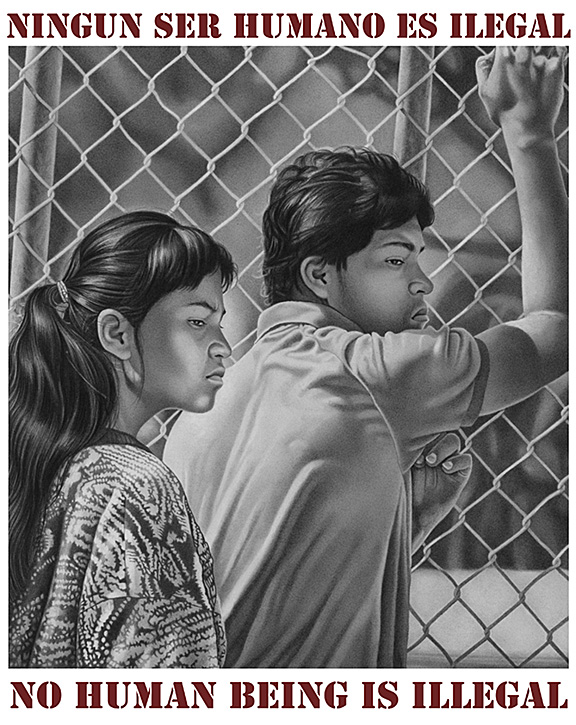
“My drawing was published as a bilingual street poster in conjunction with a 1988 drive conducted by the Los Angeles based Central American Resource Center (CARECEN), to secure the rights of undocumented Central American war refugees in the U.S.”
Ningun ser Humano es Ilegal (No Human Being is Illegal), by Mark Vallen (1988/2002?)
“This violent state repression consisted of dozens of murders and assaults, including an assault on a non-Native legal defence team.”
Chronology of Oppression at Pine Ridge, from Victims of Progress (1977)
“When World War II broke out, Greenland came under the ‘protection’ of the USA, which constructed military airbases in south, west, and north Greenland. In return for the ‘protection,’ the US got cryolite, a resource vital to the military industry.”
The Inuit of Greenland: A Brief History, by Malik (1975)
“…arrest everyone, throw them in jail, and they feel that’s the end of the problem, and I don’t, that’s no solution to any problem.”
“Jails are not a solution to problems” – Anna Mae Pictou Aquash interviewed by Candy Hamilton (1975)
“The longest war that the United States government has ever waged has been against the American Indians. The war has never ceased.”
Wounded Knee: The Longest War 1890-1973, from Black Flag (1974)
“Colonial expansion did not come about because of the need for markets for surplus production. On the contrary, surplus production came about as a result of colonial expansion.”
Capitalism, the Final Stage of Exploitation, by Lee Carter [AKA Maracle] (1970)
“On the other hand, there is no doubt that the majority of Zionists regard the Arabs in the same way as other colonisers have regarded other ‘native inhabitants’…”
Palestine, by Albert Meltzer (1948)
“Comrade [Attilio] Bortolotti, however, is still detained by Canadian Immigration Authorities who are trying to deport him to Italy on a specious technical pretext.”
Reaction in Canada, by Walter Brooks (1939)
“Everyone who dared raise his voice to stem the tide of the war-mania was shouted down and maltreated as an enemy, an anarchist and public menace.”
Woman Without a Country, by Emma Goldman (1933)
“Yet, England has in Palestine a base for expansion into Asia Minor and will not give up its policy of protection for Zionism.”
Bloodied Palestine, by Camillo Berneri (1929)
“…give them back their homes and lands that have been taken away from them by force…”
The Pacification of the Yaqui, by Librado Rivera (1927)
“Liberty is dead, and white terror on top dominates the country. Free speech is a thing of the past.”
“It seems that what has been chosen to be called Fate has a taste for being ironic and sarcastic. The first number drawn by Baker, according to ‘The Times’ of this city, designating the first ‘lucky one’ to go to defend ‘his’ country, corresponds to a mexican, Alejandro Duarte.”
The Roundup, by Enrique Flores Magón (1917)
“The destruction by Germany of a hundred odd American citizens who were packed around a cargo of ammunition, is less atrocious than the atrocities which the United States perpetrates upon its own peaceful Indians.”
Concerning Atrocities, by James Peter Warbasse (1915)
“For us there are no foreigners. We want all men, whatever their place of birth, whatever ethnic group they come from, whatever language they speak, to consider themselves as brothers and to group freely and cooperate together for the greatest well-being, the greatest freedom, the greatest civilization of all”
Our Foreign Policy, by Errico Malatesta (1914)
“… it is consoling, on the other hand, to see that the rich Yaqui region in the state of Sonora is under the control of the inhabitants of the area, the courageous, dignified and honorable Indians of the Yaqui tribe.”
The Social Revolution in Sonora, by Ricardo Flores Magón (1914)
“The SS Komagata Maru (also known as the Guru Nanak Jahaz) was a chartered ship featured in a dramatic challenge to Canada’s former practice of excluding immigrants from India.”
Komagata Maru (1914), by Hugh Johnston
“This tendency to look down upon the workers of the ‘far-off’ lands is foolish, for we venture to remark that the United States is just as far off from Japan as Japan is from the United States.”
The Yellow Peril, by Industrial Worker (1913)
“We find that the simplest article of modern manufacture may be the work of all the zones, of all the races, of all the creeds.”
‘Workers of the World, Unite!’ from Industrial Worker (1909)
“Exclusion is in the interest of the middle class.”
Japanese and Chinese Exclusion or Industrial Organization, Which?, by J. H. Walsh (1908)
“The upheaval is the culmination of weeks of increasingly hostile behavior by the citizens of Everett toward Asian Indian labor and is part of a series of anti-Asian protests that sweep the West Coast in the fall of 1907.”
White Mob Gathers to Expel Asian Indian Laborers from Everett on November 2, 1907, by Lisa Labovitch
“At the time of the riot, Bellingham’s lumber mills employed about 250 East Indian workers.”
White Workingmen Attack Bellingham’s East Indian Millworkers on September 4, 1907, by Emily Lieb
“The great mass of the people have neither home nor country to love or defend.”
Patriotism, by Lucy E. Parsons (1906)
“We have no fatherland, if we love all nations equally; we are not patriotic, if we fail to prefer a fellow-citizen to a Lapp, a French man or a Chinese man.”
Rebellion of the Soldier, by Manuel González Prada (1906)
“…many see in ‘foreigners’ the cause of economic distress… This is evidently a stupid error…”
The War Against Foreign Workers, by Errico Malatesta (1903)
“…I must express my emphatic dissent from the theory that the labor question can be brought to its solution by a mere diminution in the number of laborers.”
The Chinese Are Our Brothers, by James F. Morton, Jr. (1902)
“British industry is the work of the British nation — nay, of Europe and India taken together — not of separate individuals.”
The Coming Anarchy, by Peter Kropotkin (1887)
“The end which our enemies have in view is plain. Their object is to prevent good people from extending to us their sympathy while they themselves may rob us in the dark and murder us without pity.”
An Appeal for Justice, by Louis Riel (1885)
“Let’s get to work! We’re counting on all those who struggle for right against might, on all those who don’t live egotistically for themselves or their families alone, and who understand the beauty of sacrifice.”
John Brown, by Élisée Reclus (1867)
“The Knights of the Forest was a secret organization formed in Mankato, Minnesota, in 1862 or early 1863, with the stated purpose of eliminating all Native Americans from Minnesota.”
Knights of the Forest (1862-1863), from Wikipedia
“The insurrection of Harper’s Ferry has passed like a flash. The clouds are dark once again, but they contain electricity. After your flashes the thunderbolt will erupt, oh Liberty!”
The Servile War, by Joseph Déjacque (1859)
“I intended certainly to have made a clean thing of that matter, as I did last winter, when I went into Missouri and there took slaves without the snapping of a gun on either side, moved them through the country, and finally left them in Canada.”
Address of John Brown to the Virginia Court (1859)
“The Anti-Slavery Society of Canada, and a Ladies’ Society at Toronto, provide these Refugees with food, clothing, tools, or whatever they require, until they procure employment and can support themselves.”
Fugitive Slaves in Canada, from The Provincial Freeman (1854)
“…think not that you are safe and out of danger while you are under the wings of the flesh-devouring eagle of America, which protects the liberties of fugitives from Southern bondage as the wolf protects the lamb.”
A Warning Voice, from Voice of the Fugitive (1851)
“I’m on my way to Canada,
That cold and dreary land;
The dire effects of Slavery
I can no longer stand.”
Away to Canada!, from Voice of the Fugitive (1851)
“It removed access to the most basic of American constitutional rights, that of habeas corpus, from the enslaved (despite that same Constitution guaranteeing it, with the only exceptions made in ‘cases of rebellion or invasion [when] the public safety may require it’).”
The Fugitive Slave Act of 1850: Annotated, by Liz Tracey (1850/2025)
“Whilst they were packing up to go to Virginia, I was packing to go, I didn’t know where; for I knew that if I went back to Virginia, I should never get my liberty.”
Interviews with Ona Judge Staines (1845-46)
“We pronounce it the most bloody and heaven-daring arrangement ever made by men for the continuance and protection of a system of the most atrocious villainy ever exhibited on earth.”
On the Constitution and the Union, by William Lloyd Garrison (1832)
“It will relieve the whole State of Mississippi and the western part of Alabama of Indian occupancy, and enable those States to advance rapidly in population, wealth, and power.”
Andrew Jackson’s Speech on the Indian Removal Act – Annotated, by Liz Tracey (1830/2024)
“Since 2019, the Neighbors Not Enemies Act has been introduced each year in Congress to repeal the AEA in an effort to prevent its use against immigrants based on their nationality. The bill has never made it out of committee.”
The Alien Enemies Act: Annotated, by Liz Tracey (1798/2025)
Quotes
“In this way our settlements will gradually circumscribe and approach the Indians, and they will in time either incorporate with us as citizens of the United States or remove beyond the Missisipi. The former is certainly the termination of their history most happy for themselves. But in the whole course of this, it is essential to cultivate their love. As to their fear, we presume that our strength and their weakness is now so visible that they must see we have only to shut our hand to crush them, and that all our liberalities to them proceed from motives of pure humanity only.”
President Thomas Jefferson to Governor of the Indiana Territory William Henry Harrison (1803)
“Hence the Prince that acquires new Territory, if he finds it vacant, or removes the Natives to give his own People Room; the Legislator that makes effectual Laws for promoting of Trade… may be properly called Fathers of their Nation…”
Pennsylvania Assembly Member Benjamin Franklin, Observations Concerning the Increase of Mankind, Peopling of Countries, Etc. (1751)
Recommended Reading
Deconstructing Settler Socialism: Anarchism and the Internationals in the Wild West, by Gia Vogerl (2025)
Published by Historical Seditions and available wherever fine anarchist books are sold.
Also
Wahpeton Dakota Nation Community History
The Desautel Decision. by the Sinixt Confederacy
A History of Domestic Work and Worker Organizing
Other pages on this site
Anarchists & Fellow Travellers on Palestine
Anarchism & Indigenous Peoples
