
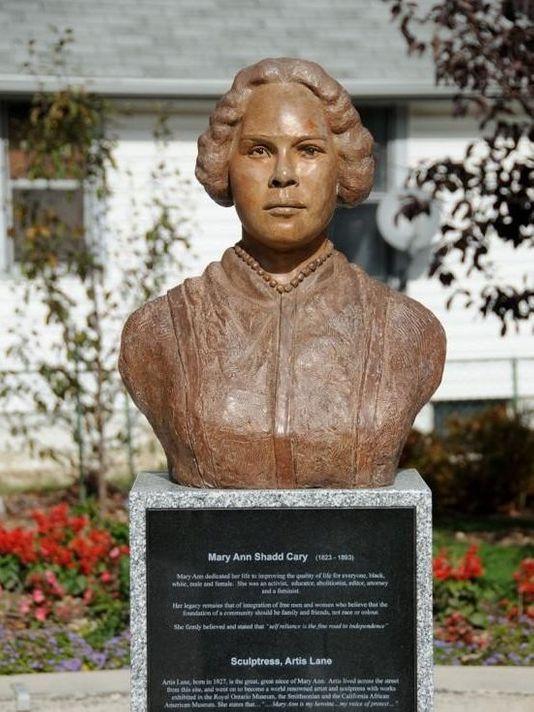
Mary Ann Shadd Cary statue at British Methodist Episcopal Freedom Park in Chatham, Ontario
From ‘The Provincial Freeman: Self-Reliance is the True Road to Independence’, March 25, 1854, Toronto, Canada, co-founded and (credited as) edited by Samuel Ringgold Ward (co-organizer of the first Black labour union in America), published and edited by Mary Ann Shadd Cary (the first Black woman to be a publisher or editor in North America)
A degree of attention has of late been directed to the condition of the Fugitive Slaves resident in Canada, but comparatively little information concerning them has reached the public. The presence in this country of the Rev. Samuel Ringgold Ward, who has been delegated by the Anti-Slavery Society of Canada to make the case of these Refugees more generally known, has caused a number of Gentlemen to form a Committee, for the purpose of raising a fund to afford them temporary relief, on their arrival in Canada, from the scene of their bondage.
The entire number of Fugitives in Canada may be estimated at from thirty thousand to thirty-five thousand, of whom from three to five thousand have annually escaped since the passing of the Fugitive Slave Law. On their arrival at Toronto, and other places along the Canadian frontier, that is, along a boundary of some seven hundred miles, they are usually destitute of every thing, having generally fled stealthily, and without making much preparation for flight.
They undergo numerous privations on their painful and wearisome journey, being in constant peril by the way, not only through the Slave States, but through the Northern, or nominally free. At any point, if overtaken, or discovered, or even suspected, they may be dragged before the Courts, and, upon a most summary process, sent back to endure a bondage of which the ordinary rigours are always increased in the case of Fugitives, to operate as a warning to others. Hence, during their flight, they are in a constant state of suspense, fear, and excitement; and when they reach the Canadian frontier, usually fall into a condition of bodily and mental prostration, which renders them incapable of immediate efforts, and makes them objects of compassionate interest.
Being strangers, destitute of the commonest necessaries, and in some instances, suffering from temporary illness and over fatigue, they require a helping hand. The Anti-Slavery Society of Canada, and a Ladies’ Society at Toronto, provide these Refugees with food, clothing, tools, or whatever they require, until they procure employment and can support themselves. This necessarily entails a very considerable expenditure, which these Societies are not in a position to meet to the extent to which their aid is needed.
It is not only an interesting fact, but one which should be emphatically dwelt upon, that the Refugee Fugitives require only temporary assistance. Labour of every kind is in great demand and the Society being kept duly informed of the parties who are in want of labourers, they seldom fail to procure employment on advantageous terms. In no instance within the last year and a half has the Society been called upon to extend relief for more than six days, except in cases of sickness. The fund sought to be raised is therefore not intended to be set aside to maintain able-bodied men in idleness for an indefinite period, but to enable the Canadian Society to respond to the large claims made upon it, to supply the more immediate and pressing demands of the Fugitives on their arrival and until they have sufficiently recovered from fatigue to avail themselves of the advantages of abundant good employment and food, wages, cheap land, equal liberty, and impartial laws, and the privileges and rights which are common to other classes of Canadians.
Canada being the nearest of the British Colonies to the United States, (the stronghold of Slavery) it is of no small importance to encourage the improvement and elevation of these negro refugees, because of the influence, direct and reflex, which would thereby be brought to bear upon American Slavery.
The black settlers of Canada are nearly all of them fugitives from Slavery. Their improvement would be a triumphant rebuke to those who once held them as chattles, and to those who hold that the slave requires to be prepared for freedom, for they would exhibit the spectacle of a people just escaped from the galling yoke competing as free men, successfully and honourably with other labour.
Further, as there exist in Canada some of the prejudices against colour, and as the progressive improvement of the coloured population is gradually undermining and destroying this feeling, their improvement affords a practical demonstration, not only of the equal capacity of the negro for self-advancement where he has a proper incentive to labour, but of the unreasonableness of the prejudice against him.
Lastly, his social elevation, by his own industry and enterprise, is even now triumphantly proving the fitness of the slaves for freedom, the righteousness and the practicability of immediate emancipation, (in so far as the slaves themselves are concerned) and the perfect capability of the negro to live and to advance under the same government, and upon terms of political and social equality with the Anglo-Saxon race, or any other of the one great human family.
At a large and respectable meeting held in Freemason’s Hall, the Right Hon. the Earl of Shaftesbury in the Chair, — after an Address from Rev. S. R. WARD, showing the condition of the Fugitive Slaves in Canada, and stating their need of temporary aid immediately upon their arrival in that Colony, — it was proposed by the Rev. C. B GRIBBLE, of St. Paul’s, East Smithfield, and seconded by the Rev. THOMAS JAMES, Secretary to the Colonial Missionary Society, and adopted:
“That having heard the statement of the Rev. SAMUEL RINGGOLD WARD, respecting the destitution of the Fugitive Slaves on their arrival in Canada, after effecting their escape from the United States; and, feeling that under such circumstances they have a claim on our sympathy, and need temporary assistance, this Meeting cordially approves of the object of the mission, and pledges itself to promote it; and that for the carrying out of the same the following Gentlemen be the Officers and Committee, with power to add to their number.”
PRESIDENT.
THE RIGHT HON. THE EARL OF SHAFTESBURY.
TREASURER.
GEORGE WILLIAM ALEXANDER, ESQ.
HON. SECRETARIES.
REV. JAMES SHERMAN, AND SAMUEL HORMAN-FISHER, ESQ.
COMMITTEE.
APSLEY PELLATL, ESQ., M. P., G. F. WHITE, ESQ., REV. T. JAMES, REV. J. C. GALLAWAY, A. M., JAMES SPICER, ESQ., REV. GEORGE SMITH, REV. THOS. BINNEY, ROBERT FORSTER, ESQ., E. N. FOWLER. ESQ., JOSEPH SOUL, ESQ., L. A. CHAMEROVZOW, ESQ., W. JONES, ESQ., J. TALBOT TYLER, ESQ.
It was moved by the Rev. J. Wemberley, Rector of Dorrington, seconded by the Rev. George Wilkins, and adopted:—
“That the best thanks of this Meeting be presented to the Earl of Shaftesbury, for his kindness in presiding on the present occasion.”
The following contributions have been already received:—
His Grace the Duke of Sutherland — £10
Her Grace the Duchess of Sutherland — £10
His Grace the Duke of Argyle — £10
The Most Noble the Marchioness of Kildare — £5
The Right Hon. the Earl of Shaftesbury — £10
The Right Hon. the Earl of Harrowby — £10
The Right Hon. the Earl Waldegrave — £2
The Hon. Arthur Kinnaird. M.P — £10
Sir Edward North Buxton, Bart. — £10
The Viscount Ebrington, M.P. — £1
The Lord R. Grosvenor, M.P — £2
The Lord Mayor of London, M.P. — £5 s.5
The Lord Calthorpe — £10
Dowager Lady Gray — £2
Lady Acland — £5
Lady Macdonald — £5
Also
A Conversation with Robyn Maynard, from Duke University Press (2025)
The newspaper that broke ground for Black Canadians, by Adrian Harewood (2025)
Lord Dunmore’s Ethiopian Regiment, by Andrew Lawler (2025)
The 1968 Rodney Riots in Kingston Jamaica Revisited, from Jamaicans.com (2024)
The Crisis in Haiti is the Result of Racist Colonialism, by Krys Cerisier (2024)
Dismantling the Haitian State (feat. Canada), by The Breach (2024)
Mining Blackness, by Fitsum Areguy (2024)
Lulu Anderson, by Bashir Mohamed (2023)
The Rodney Rebellion: Black Power in Jamaica, by Chinedu Chukwudinma (2022)
Black on the Prairies, by Omayra Issa & Ify Chiwetelu (2021)
General Tubman: St. Catharines, 1858, Part I, II and III by Rochelle Bush (2021)
How Canada helped kill an anti-imperialist hero, by Cassandra Kislenko (2021)
Dr. Barbara Althea Jones: A Fascinating Figure in McGill’s History, by McGill Libraries (2020)
Fitz St. John: A Longshoreman’s Longshoreman, by the ILWU (2020)
Defunding the Police Will Save Black and Indigenous Lives in Canada, by Sandy Hudson (2020)
The Struggle Against Anti-Blackness in Canada, by Robyn Maynard (2020)
Remember/Resist/Redraw #18: The Sir George Williams Protest (2019)
The Somalia Affair, by Richard Foot (2019)
Albertan rediscovers theatregoer’s fight against segregation 104 years ago, by Rachel Ward (2018)
Remembering the ‘Somalia Affair,’ by Ali Amad (2018)
Remember/Resist/Redraw #02: Chloe Cooley, Black History, and Slavery in Canada (2017)
Policing Black Lives: The Colour Line, by Robyn Maynard (2017)
Richard Pierpoint, by Zach Parrott (2016)
“’70: Remembering a Revolution” in Trinidad and Tobago, by Paul Hébert (2016)
Regina’s Radical University Students Hosted the Black Panthers in 1969, by Ashley Martin (2016)
Marie-Joseph Angélique, by Afua Cooper (2014)
Viola Desmond, by Russell Bingham (2013)
An Exchange Between Sam Greenlee and Lawrence Ytzhak Braithwaite (2007)
Institutional Racism, by Howard Adams (1988)
Go Do Some Great Thing: The Black Pioneers of British Columbia, by Crawford Kilian (1978)
The Black Man in a White Society, by Barbara Jones (1969)
A Black Woman Speaks Out, by Barbara Jones (1968)
From DuBois to Fanon, by C.L.R. James (1967)
Racism and Culture, by Frantz Fanon (1956)
The Domain of the Marvelous, by Suzanne Césaire (1941)
Hands off the Colonies!, by George Padmore (1938)
The Shape of Fear, by W. E. Burghardt Du Bois (1926)
The African Roots of War, by W. E. B. DuBois (1915)
Lynch Law in America, by Ida B. Wells-Barnett (1900)
A Piece of History, by Lucy E. Parsons (1895)
John Brown, by Élisée Reclus (1867)
Extradition Case of John Anderson, 1860-1861, from Wikipedia
Address of John Brown to the Virginia Court (1859)
The Servile War, by Joseph Déjacque (1859)
The Chatham Vigilance Committee and the 1858 Rescue of Sylvanus Demarest, from Wikipedia
The Narrative of Sophia Pooley (1856)
Negro Emigration & American Racism, from The Provincial Freeman (1854)
Negrophobia on Canadian Steamboats, from The Provincial Freeman (1854)
On the Constitution and the Union, by William Lloyd Garrison (1832)
Black Refugees of the War of 1812, from Wikipedia
