
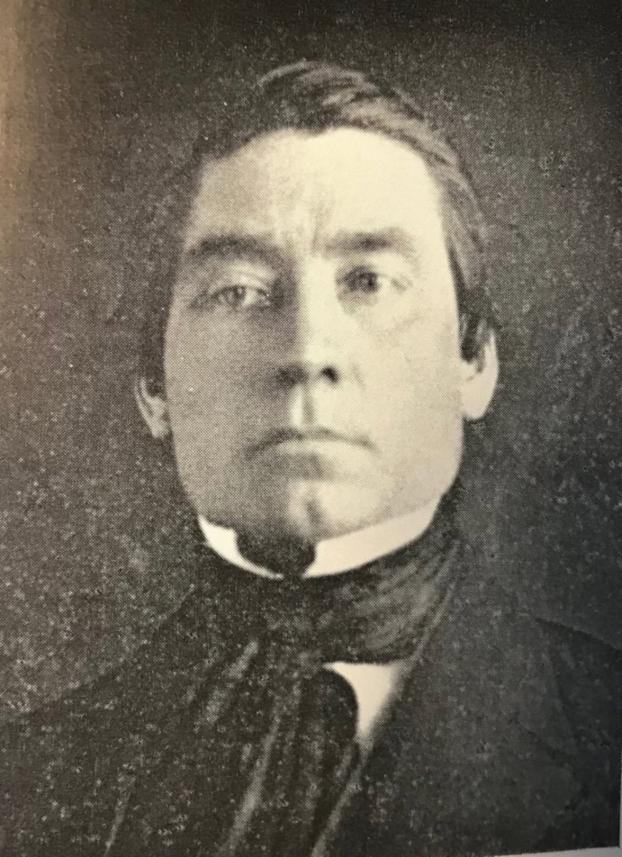
[Governor Alexander Christie responded to this letter by rejecting the existence of Indigenous rights. However, the Métis/Halfbreed community of Red River in 1849 successfully defended Pierre-Guillaume Sayer from charges of illegally trading in furs. James Sinclair acted as his lawyer inside the courtroom, while Louis Riel Sr. and other armed Métis assembled outside. The jury returned a verdict of guilty but recommended mercy, and Sayer was allowed to go free, breaking the Hudson’s Bay Company’s monopoly. The armed crowd outside yelled, “le commerce est libre!” -Ed.]
To Alexander Christie, Esq.,
Governor of Red River Settlement.
Red River Settlement,
August 29, 1845
Sir, — Having at this moment a very strong belief that we, as natives of this country, and as half-breeds, have the right to hunt furs in the Hudson’s Bay Company’s territories whenever we think proper, and again sell those furs to the highest bidder; likewise having a doubt that natives of this country can be prevented from trading and trafficking with one another; we would wish to have your opinion on the subject, lest we should commit ourselves by doing anything in opposition either to the laws of England, or the honorable company’s privileges, and, therefore, lay before you, as governor of Red River Settlement, a few queries, which we beg you will answer in course.
Query 1. Has a half-breed, a settler, the right to hunt furs in this country?
2. Has a native of this country (not an Indian) a right to hunt furs?
3. If a half-breed has the right to hunt furs, can he hire other half-breeds for the purpose of hunting furs?
4. Can a half-breed sell his furs to any person he pleases?
5. Is a half-breed obliged to sell his furs to the Hudson’s Bay Company at whatever price the company may think proper to give him?
6. Can a half-breed receive any furs as a present from an Indian, a relative of his?
7. Can a half-breed hire any of his Indian relatives to hunt furs for him?
8. Can a half-breed trade furs from another half-breed, in or out of the settlement?
9. Can a half-breed trade furs from an Indian, in or out of the settlement?
10. With regard to trading, or hunting furs, have the half-breeds, or natives of European origin, any rights or privileges over Europeans?
11. A settler having purchased lands from Lord Selkirk, or even from the Hudson’s Bay Company, without conditions attached to them, or without having signed any bond, deed or instrument whatever whereby he might have willed away his right to trade furs, can he be prevented from trading furs in the settlement with settlers, or even out of the settlement?
12. Are the limits of the settlement defined by the municipal law, Selkirk grant, or Indian sale?
13. If a person cannot trade furs, either in or out of the settlement, can he purchase them for his own family use and in what quantity?
14. Having never seen any official statements, nor known, but by report, that the Hudson’s Bay Company has peculiar privileges over British subjects, natives and half-breeds, resident in the settlement, we would wish to know, what these privileges are, and the penalties attached the infringement of the same?
We remain your humble servants,
James Sinclair, William Bird,
Baptist La Roque, Peter Garoch,
Thomas Logan, Henry Cook,
John Dease, John Spence,
Alexis Gaulat, John Anderson
Louis LeTendre de Batoche, Thomas McDermot,
William McMillan, Adall Trottier
Antoine Morran, Charles Hole,
Bat. Wilkie, Joseph Monkman,
John Vincent, Baptist Farman.
[Hudson’s Bay Company governor George Simpson once said that James Sinclair was “without exception, the most unprincipled man I ever had any dealings with in the Company’s territories, and [he] has through misrepresentation and low cunning very seriously injured the Company’s interests.” However, Sinclair later reconciled himself with the company, and paid the ultimate price for it when he was killed in an attack by Indigenous warriors in Washington Territory in 1856. -Ed.]
Also
Pemmican War (1812-1821), from Wikipedia
The Selkirk Treaty, 1817, by Adam Gaudry
The Sayer Trial at Red River 1849: Establishing Metis Free Trade, by Lawrence Barkwell
Declaration of the People of Rupert’s Land and the North-West, by the Provisional Government (1869)
1869-1870 Red River Resistance, by the Indigenous Peoples Atlas of Canada
The 1870 Reign of Terror Against the Métis of Red River, by Lawrence Barkwell
An Appeal for Justice, by Louis Riel (1885)
A Martyr, from The Alarm (1885)
The 1885 Battleford Hangings, from Saskatchewan Indian
1885 Northwest Resistance, by the Indigenous Peoples Atlas of Canada
A Reminiscence of Charlie James, by Honoré J. Jaxon (1911)
We Do Take Exception to This Term “Rebellion”, by Malcolm Norris (1962)
The Need for a Revolutionary Struggle, by Howard Adams (1972)
Maria Campbell’s speech to the Native Peoples Caravan in Toronto (1974)
Cultural Genocide, Intentionally Planned, by Rose Bishop (1975)
Medric McDougall: Metis Elder and Organizer (1988)
Overshadowed National Liberation Wars, by Howard Adams (1992)
We need to return to the principles of Wahkotowin, by Maria Campbell (2007)
mâmawiwikowin: Shared First Nations and Métis jurisdiction on the Prairies, by Emily Riddle (2020)
Louis Riel: Hero, heretic, nation builder, by Darren O’Toole (2022)
A Girl Called Echo Omnibus, by Katherena Vermette, Scott Henderson & Donovan Yaciuk (2023)
