
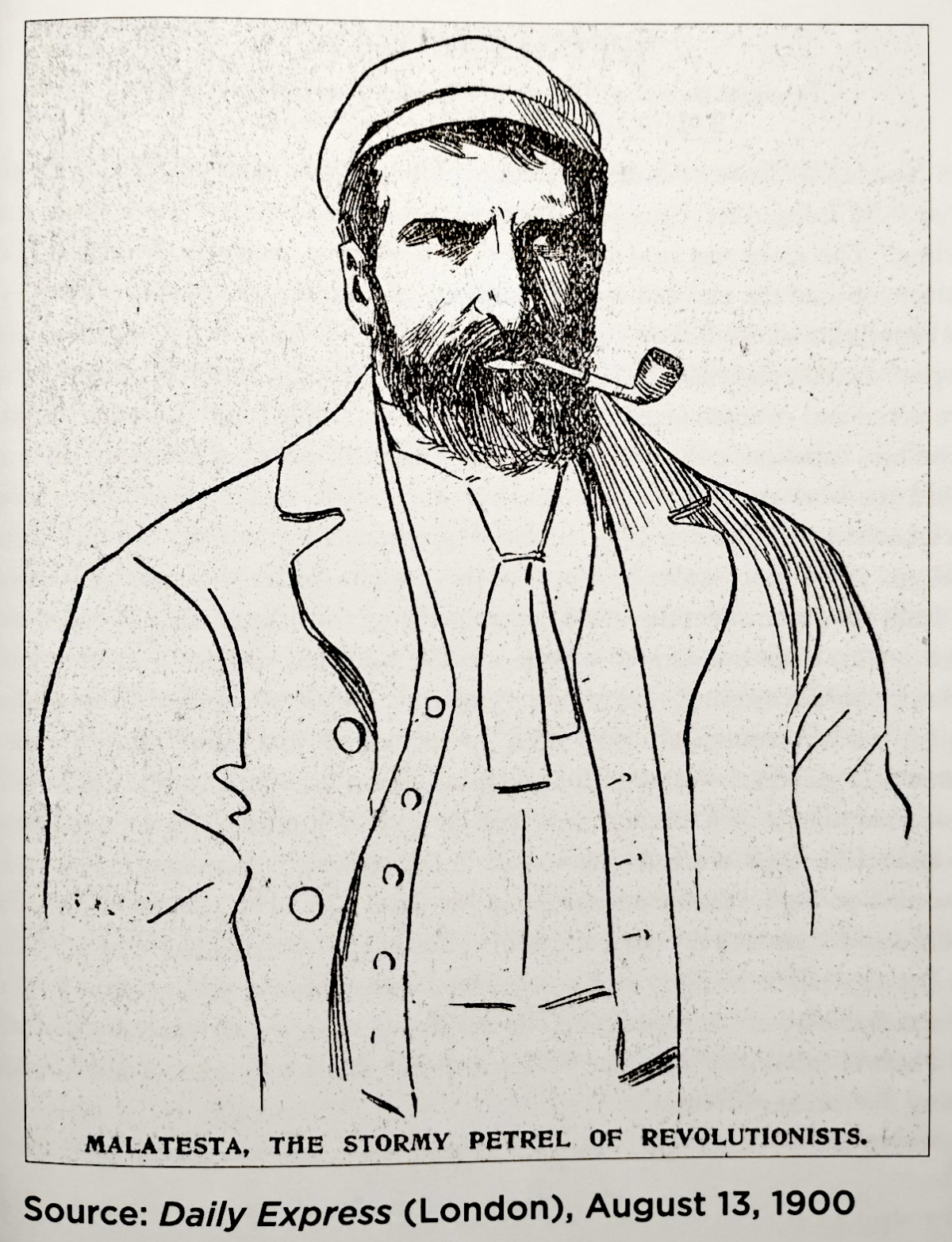
Translated by Andrea Asali from ‘La guerra contro i lavoranti stranieri,’ La Rivoluzione Sociale, London, January 27, 1903
Unemployment and poverty are all the rage in London; and part of the press takes the occasion to launch a cry of alarm against “the foreign invasion,” blowing on the malcontent that native workers already on their own feel against the proletarians from other countries who come here in search of work, chased from their native countries by hunger or political, religious, or racial persecution.
The phenomenon is not unusual, and is found during all time periods, especially those of recrudescent poverty, and in all countries, especially those with strong immigration.
The general sentiment among workers is that those who come from outside to seek work, come to take the “bread out of their mouth.” And this sentiment is so strong and so blurs a correct view of social phenomena, that many see in “foreigners” the cause of economic distress and believe that some good laws against immigration of foreign proletarians would resolve the social question, creating abundance for all… the natives.
This is evidently a stupid error, which is well explained by the fact that the damage, in terms of lack of work or decreased wages, each individual suffers or could suffer due to competition from immigrants, is immediate, direct, easily perceived damage; while the general damage that is caused by failure to acknowledge solidarity among workers of any origin and would be caused by a forced stop of immigration flows, is a complex phenomenon, poorly understood without a bit of intellectual effort.
Without considering political and moral matters for the moment, and limiting ourselves to strictly economic considerations, it is certain that the phenomenon of immigration, even if it creates temporary imbalances and therefore real disadvantages for individuals who are defeated by competition, does not, in terms of general and permanent effects, cause a lack of work or a lowering of wages. Rather, the contrary takes place. Countries which receive many immigrants are either countries that still have a lot of free land and can therefore absorb a lot of people without damage and instead to the advantage of those who are already there, as is the case in North America and Canada; or are countries that export a lot of manufactured merchandise, as is the case of England.
Now, for example, if England closed its doors to workers from other countries, those countries, either due to political retaliation or by the natural effect of economic competition, would remain closed to English merchandise. Therefore, even though the offer of labor in the labor market would be considerably lower than now, there would also be much less demand and unemployment would increase and with this wages would drop. If proletarians from countries with high emigration no longer had the chance to go abroad, wages in those countries would drop even more, and their capitalists would find themselves in a more advantageous position to compete with capitalists at high wages and to chase away the latter’s merchandise from the international market. The same English or North American capitalists would establish themselves where labor is cheap, as they are already starting to do, and would leave their compatriots without work.
In the conflict between property owners and proletarians, which is an inevitable consequence of the current social order, the interests of workers around the world are in agreement. Relationships of all types among the different countries have become so numerous and frequent, and isolation from the rest of the world so impossible, that the price of everything, including the price of the labor force, tends to rapidly equalize everywhere. Conditions for workers in one country are more or less bad based on how more or less bad conditions are for workers in other countries.
And given that emigration naturally goes from countries where people suffer more to countries where people live better; that emigrants upon changing countries get used to higher standards of living and learn to have greater demands; and that, by decreasing the supply of labor in countries that they leave, wages there increase, the general economic effects of migratory currents are favorable to the proletariat and to civilization in general.
But we understand that these considerations cannot win over starving people. When, as is happening now in London, the crisis is all the rage and hundreds of thousands of people are without work and go about the city in lamentable processions asking for handouts; when whoever has a job that gives him a crust of bread fears losing it and being reduced to suffer hunger together with his family and spending winter nights outside, then economic science loses its entitlements, and it is no marvel, nor a reason for reproach, if the unemployed, or those who fear becoming so, do not think about what they could have tomorrow, and look with antipathy, perhaps with hatred, at every new competitor.
And we even understand that the capitalists, while they take advantage of the immigrants’ poverty and ignorance to snag them into work under conditions they would not dare offer workers in their own country, seek to keep the latter calm by means of their press and agents, deflecting their righteous anger into a stupid and fratricidal fight against the “foreigners.” They are following the logic of their unfair situation, and we do not expect that they would want to point out the true causes of suffering and the true remedies to their victims.
But what we do not understand, what outrages us, is to see many who call themselves socialists, and hold among socialists an influential position such as members of parliament, speakers, and journalists, entertain the popular prejudice and even themselves contribute to distract the workers’ attention from the true cause of their suffering, inciting them, with more or less hypocritical methods, against their brothers born in other countries.
When “socialists” were truly socialists and not the vulgar vote hunters of today, they preached brotherhood among workers of all races; they recommended to welcome foreign comrades, to offer them solidarity and ask for reciprocity, and to do whatever possible to prevent them from falling victim to the capitalists and accepting wages lower than the current wage.
Today… today, to cite a few examples, the Labour Leader, organ of the “Independent Labor Party,” and more specifically of the socialist member of parliament Keir Hardie, praises a ministerial candidate because he wants the number of foreign sailors allowed on English mercantile ships to be limited by law, and the French socialist member of parliament Coutant proposes a law which establishes that the number of foreigners employed in factories cannot be over 10 percent of staff.
Is this not like telling workers that the cause of their poverty is foreigners and that the remedy is in excluding them?
In the study preceding his draft bill, Coutant says that “the government cannot lose interest in the French workers who contribute to all State taxes and whose earnings are the lifeblood for domestic trade, to the benefit of foreign workers who neither for trade nor for the State are elements of vitality.”
Oh, days of the International Workingmen’s Association, how far away you are!
How many times will we have to exclaim: poor socialism!
Also
No One’s Illegal on Stolen Land
What is Fascism? What is Democratic Colonialism?
Mapping Deportations: Unmasking the History of Racism in U.S. Immigration Enforcement
Errico Malatesta texts at the Anarchist Library
Inside the Somali-Led Resistance in Minneapolis, by Fatima Khan & Meghnad Bose (2026)
Anarchism and Revolutionary Defeatism, by K. C. Sinclair (2025)
San Francisco Had its Own Demagogue Who Capitalized on Racist Grievances, by Gary Kamiya (2021)
US Immigration History Timeline, by the Immigration and Ethnic History Society (2019)
Reaction in Canada, by Walter Brooks (1939)
Mussolini: The Great Actor, by Camillo Berneri (1934)
The Truth About Fascism on the March, by Errico Malatesta (1926)
Our Foreign Policy, by Errico Malatesta (1914)
Liberty and Love Rise and Fall Together, by Har Dayal (1914)
The Yellow Peril, by Industrial Worker (1913)
The War and the Anarchists, by Errico Malatesta (1912)
Japanese and Chinese Exclusion or Industrial Organization, Which?, by J. H. Walsh (1908)
The Chinese Are Our Brothers, by James F. Morton, Jr. (1902)
Our Program, by Errico Malatesta (1899)
The Anarchists and the Eastern Question, by Errico Malatesta (1897)
The Republic of the Boys and that of the Bearded Men, by Errico Malatesta (1884)
Letter to the Bulletin De La Fédération Jurassienne, from Errico Malatesta & Carlo Cafiero (1876)
The Inaugural Address of the International, by Karl Marx (1864)
Recommended Reading
Deconstructing Settler Socialism: Anarchism and the Internationals in the Wild West, by Gia Vogerl (2025)
Published by Historical Seditions and available wherever fine anarchist books are sold.
Anarchists on National Liberation
Anarchism & Indigenous Peoples
