
[As with every other text on this site, the republishing of this article is not to be taken as any kind of endorsement or encouragement of the views expressed or actions described by its author; rather the text is republished strictly to allow for an awareness of the historical record. -Ed. 2026]
From ‘Spain and the World’, December 3, 1938, London, UK
The great poet Heinrich Heine once wrote that to rouse the Germans it is necessary to poke them between the ribs with a lamp-post. Hitler’s ascendancy to power has proven that Heine was far from the mark in his belief that the Germans could be roused by a mere lamp-post between the ribs.
Since 1933, Germany has been turned into a slaughter house with Hitler, Goering and Goebels and their cohorts wading knee-deep in the blood of their victims. No, not only Jews, but thousands of political dissenters have been tortured and done to death in the hideous concentration camps or on the block. Yet not a voice of protest in Germany or a hand raised against the modern torquemadas who lord over that country. To be sure the continued persecution of the Jews and the clandestine and open extermination of other thinking Germans did at first rouse the indignation of the world outside Germany, but it was of short duration. The protests against the horrors of the Nazi regime made no deeper dent than a wagon passing through a stagnant pool. The wheels spread the slimy surface to both sides, the ill-smelling pool remained. Nothing moved in Germany, and public opinion outside also settled down to the fait accompli.
Heinrich Heine’s dictum unfortunately applies not only to the Germans. The peoples in the rest of the world also have to be poked between the ribs with more than a lamp-post. Especially is this true since the last world conflagration. Its frightfulness and all that has come in its wake have completely jaded human sensibilities to wrongs, injustice and outrage. The concentrated horrors of the Jewish pogroms were needed to awaken the world again to the savage methods resurrected in Germany from the dead past.
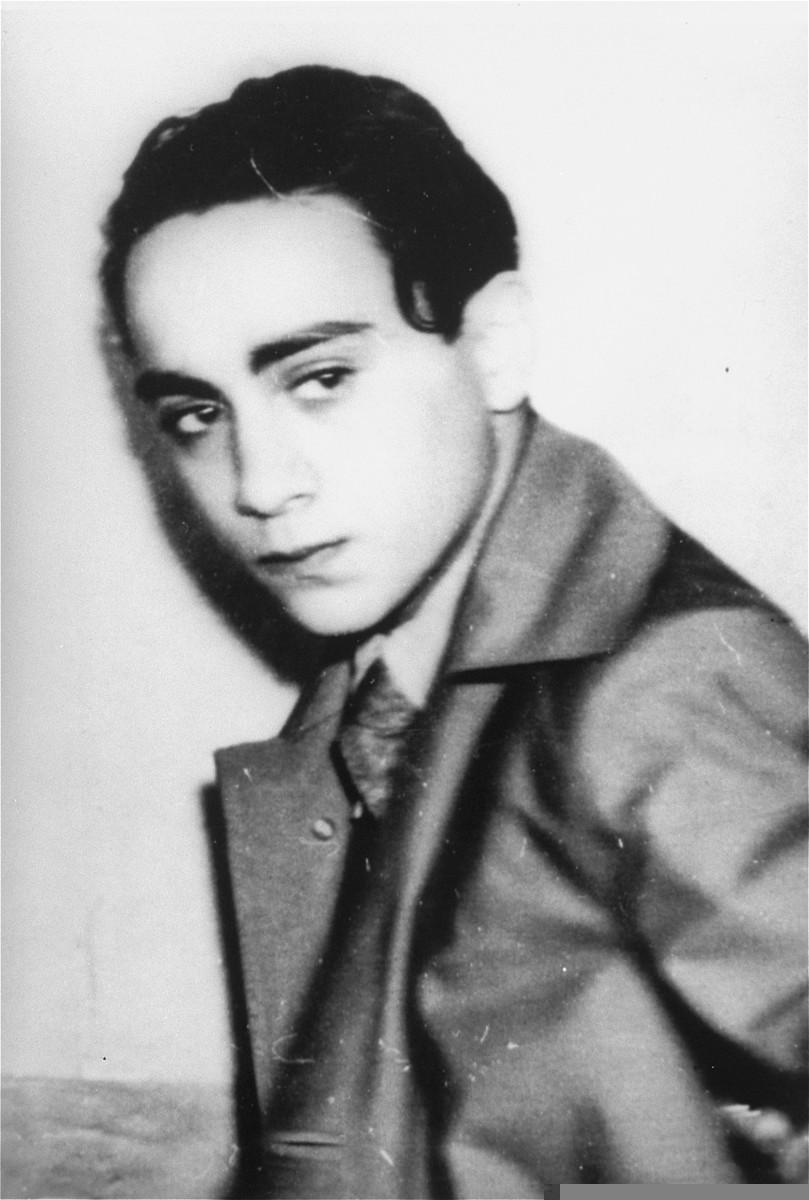
The new awakening to the sufferings of a whole people is indeed commendable. So is the ready response from all layers of society in every land to the great needs of the Jewish victims of Hitler and his cohorts. In the midst of it all it is probably understandable that public opinion should turn against the boy of seventeen who has dared to raise his hand against the ogre that is bleeding and oppressing the German people. Nevertheless the condemnation, derision and contempt hurled against Grynspan are indicative of considerable ignorance and lack of psychological perception of the forces that condition a political act of violence. To be sure the more humane have expressed surprise that a young creature, usually given to sports and idle amusements, should have been willing to stake his own life by his act. It was such a useless act, since his victim did not directly participate in the recent frightfulness of the pogrom, they say.
While I readily concede that the boy’s shot was worthy of a more important fry, I consider the charge of insanity lacking in understanding, and a very cheap method of explaining the intricate motivations of such an act. Besides, the history of tyrannicide, once acclaimed as the highest expression of courage and patriotism, and now considered out of date, proves that these who had risen against tyranny were nearly all of the most impressionable age. The wonder to me is not Grynspan’s act. Rather is it that so few inspired individuals now rise against so much oppression in the world.
The most important fact entirety overlooked is that the true murderers of Von Rath were really not the boy now in a lone cell in France and repudiated by his own people as well as the rest of the world. He had merely used the gun loaded for him by the blood-thirsty rulers of Germany and the relentless treatment of foreigners by the French authorities.
The only attempt made to interpret the act of Grynspan was by Henri Jeanson in “S.I.A.” now published in Paris. In a very penetrating article the author analyses the forces that have driven the boy to take the life of Von Rath and thereby to sacrifice his own.
I give below the substance of this article:
“In 1920, Hitler burst on the world — for it was in February, 1920, that the Nazi Party decided its programme and promised itself to expel the Jews from the German nation.
On the 25th March, 1921, Grynspan (Herschel Feibel) was born.
During the 15 years, 1921 to 1936, Grynspan underwent all the humiliations inflicted on Jews by the S.A. During these 15 years, Grynspan lived in an atmosphere of hate, of blood and of terror. His fellows were imprisoned, tortured and massacred.
In 1936, Grynspan achieved his rebirth — in plain fact he succeeded in escaping from his racial prison. He came to France — to France which has the reputation of a place of refuge.
For two years he lived with his uncle, Abraham Grynspan. He was peaceful and happy. He found work . . .
The German and the Italian Embassies rule over the Ministry of the Interior — and the Surete became their pawn. Refugees were searched out and ill-treated. They were beaten up. They were expelled. This man hunt was quite openly pursued every morning.
The outlaws were expelled — if one can so describe it. Political exiles had the choice between assassination or suicide — August, 1938, the police refused Grynspan his identity card.
There was no charge against him. He was involved in no wrongdoing. He lived quietly, honestly — but — he was one of the pestilent race!
Now, a marked man, where could he go, where hope to escape? How could he live? Where sleep? How eat? Grynspan had been turned adrift. He slept a night here, a night there, always hiding, frightened, a hunted creature, at the mercy of the first informer who found him out.
He had committed no crime, but was forced to live like an animal. He was treated like a murderer — although he was innocent. Why should he not have become a murderer, since, innocent, he was forced to behave like one?
While he was living in this condition, endeavouring to evade the Police, he learnt that his parents, driven from their home in Hanover, thrust back over the Polish frontier, were dying of cold and hunger somewhere on the German-Polish border.
Then this man whom the police had treated as a wolf, this man whom they had tried to make into a murderer — became a judge. He went to the German Embassy and shot Von Rath.
Grynspan was arrested, but that was not enough. His aunt and uncle were also arrested, guilty of having allowed the poor boy to sleep in their house. As in Germany, when dealing with a Jew, the whole family are considered as accomplices in any ill-doing.”
I can add little to this flaming indictment of the tormentors of Herschel Feibel Grynspan except that they and not he are the perpetrators of his act. They and not Grynspan should be branded with letters of fire as the murderers of Von Rath.
EMMA GOLDMAN.
Also
What is Fascism? What is Democratic Colonialism?
No One’s Illegal on Stolen Land
Emma Goldman texts at the Anarchist Library
Zines
Anarchists Debate Palestine (1906-1944)
Anarchists on South West Asia and North Africa (1912-2024)
An Anarchist on Palestine, by Albert Meltzer (1939-1996)
Further texts
Anti-ICE Protesters Convicted on Terrorism Charges for Wearing All Black, by Matt Sledge (2026)
I’m the Palestinian Who Has Been in ICE Detention for Almost a Year, by Leqaa Kordia (2026)
After the DC Shooting, by On the Nose / Jewish Currents (2025)
Clarity Contra Complicity [on Aaron Bushnell’s action], by K. C. Sinclair (2025)
Reaction in Canada, by Walter Brooks (1939)
The Refugee Problem, by Marcus Graham (1939)
Palestine: Idealists and Capitalists, by Vernon Richards (1938)
The Black Spectre of War, by Emma Goldman (1938)
Anarchists and Elections, by Emma Goldman (1936)
In The Land We Live In, by Marcus Graham (1935)
Mussolini’s War Upon East Africa, by Marcus Graham (1935)
Rampant Fascism in America, by Marcus Graham (1935)
Woman Without a Country, by Emma Goldman (1933)
Between Jails, by Emma Goldman (1917)
Teaching Liberty to Santo Domingo, by Emma Goldman (1917)
Frank Little, by Emma Goldman (1917)
Good Prospects for Anti-Militarism, by Emma Goldman (1916)
Observations and Comments on the Vote, by Emma Goldman (1915)
First Year of the War, by Emma Goldman (1915)
Our Moral Censors, by Emma Goldman (1913)
National Atavism, from Mother Earth (1906)
Some Early Anarchists on Zionism: From Bernard Lazare to Emma Goldman (1899-1939)
