
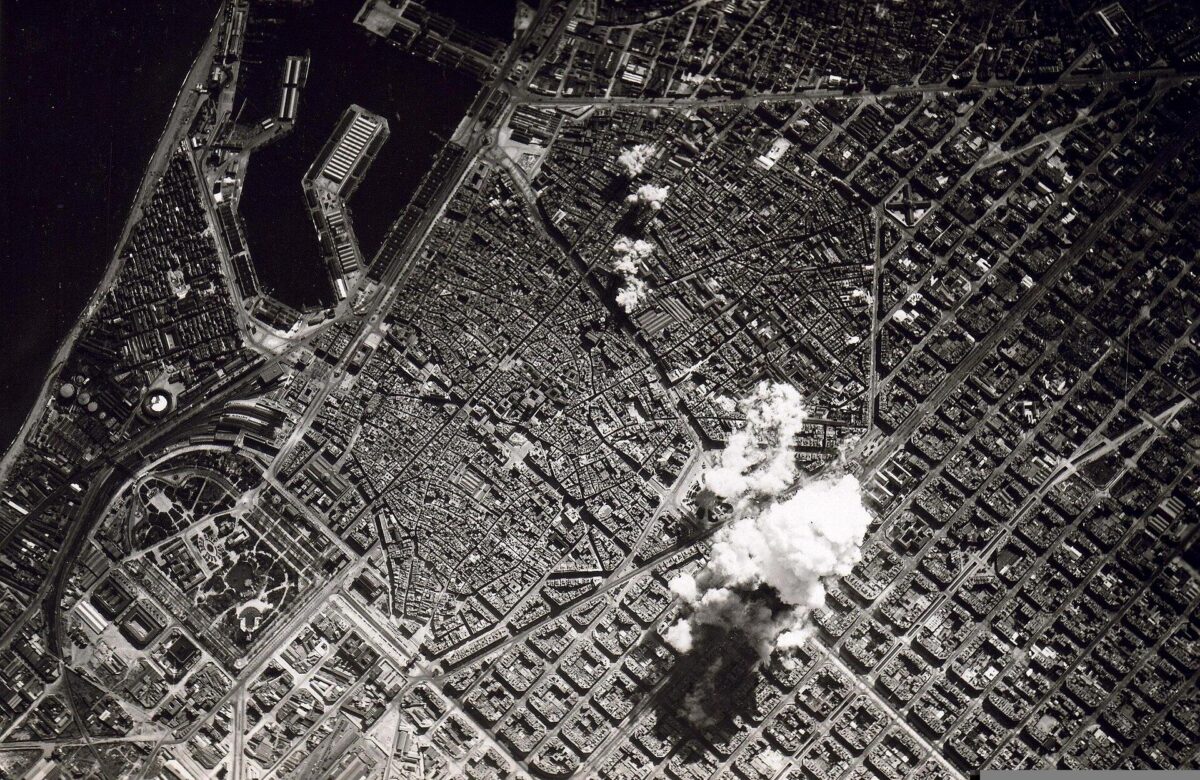
Aerial bombing of Barcelona, Spain, March 17, 1938, by the air forces of fascist Italy and Nazi Germany, leaving as many as 1,300 dead and at least 2,000 injured
From ‘Spain and the World’, September 30, 1938, London, UK
Those who produce and sell petrol.
The producing countries are, in the first place, the United States, Russia and Rumania, states which supply their own needs and export a large proportion of the production (the U.S.A., which imports about as much as it exports, furnishes to the Fascist powers alone more than half the world’s production), then Venezuela, Persia, the Dutch Indies, Mexico, Columbia, Iraq, Argentine, Peru and India, which export almost all they produce.
Who exploits these petrol wells? Excluding the U.S.A., four trusts share amongst themselves 86 per cent of the world’s needs. They are in order of importance (from 1934 figures): the Soviet Naphte Syndicate, the American Standard Oil, and two English companies. Royal Dutch Shell (of Dutch origin) and The Anglo-Persian (or Anglo-Iranian).
Those who supply petrol to Italy.
The suppliers to Italy are: Rumania, the U.S.A. (Standard Oil), U.S.S.R. and Iraq. In 1936, during the Abyssinian War, Iraq, thanks perhaps to the participation of Italian capital in the Iraq Petroleum Co., obtained 120 million tons for Italy; but after the conquest the Italian group renounced its participation in the Iraq Petroleum, a quarter of whose shares belong to the Anglo-Persian, another quarter to Royal Shell and a quarter each to the Cie. Francaise des Petroles and the allied Standard Oil Co.
Those who supply petrol to Germany.
Finally, Germany replenishes her supply through the U.S.A., the Dutch East Indies, Persia, Venezuela and the U.S.S.R.! A commercial agreement dated the 1st January, 1935, does not expire until 1939, and contracts for Russia to supply petrol to Hitlerian Germany, whose desire for war the Soviet Government is denouncing every day in heated terms and against which (provisionally?) Russia is directing all her diplomacy.
Those who transport the petrol.
Transport is guaranteed by tankers belonging, in some cases to private individuals (in a small proportion), in others to the above-mentioned trusts, and in other cases to governments. The Scandinavian countries in particular are fairly well specialized in petrol transport. Japan, Italy and Germany have only a small tonnage in petrol tankers. A few figures for 1934: Norway alone possessed 213 tankers for petrol transport, with a total tonnage of 1,507,000 tons; the three large anglo-american trusts possessed together a fleet of 563 ships totalling 5,288,000 tons; against this, Italy — the most supplied of the three Fascist States — had only 65 ships of a total tonnage 315,000 tons; the three Fascist powers together possessed a total of 116 ships totalling 582,000 tons.
Also
As US Bombs Iran, ICE Is Deporting Iranian Americans Into Danger, by Etan Mabourakh (2026)
US-Israel Strikes on Tehran Oil Depots Blanket City in Smoke, by Jon Queally (2026)
What is Fascism? What is Democratic Colonialism?
No One’s Illegal on Stolen Land
(Zine) Anarchists on South West Asia and North Africa (1912-2024)
Shipping Iron Ore from the Bell Island Mines to Nazi Germany, by Digital Museums Canada (2020)
How Texaco Helped Franco Win the Spanish Civil War, by Adam Hochschild (2016)
The Myth of Benevolence, by Milan Rai (1995)
Torkild Rieber (1882–1968), supplier to fascist Spain and Germany, from Wikipedia
Walter C. Teagle (1878–1962), supplier to Nazi Germany, from Wikipedia
The Morals of Extermination, by Lewis Mumford (1959)
New Phase in Oil Struggles, by Freedom (1953)
What Made Fascism Possible?, by Marcus Graham (1943)
The Yankee Peril, by Marie Louise Berneri (1943)
Standard Oil: Axis Ally, by Michael Straight (1942)
The Standard Oil Case, from the New York Times (1942)
Italo-Soviet Pact (1933-1941), from Wikipedia
American Imperialism versus German Imperialism, by Marie Louise Berneri (1941)
The Axis Versus “Democracy”, by Marie Louise Berneri and John Hewetson (1941)
This Is Not A War For Freedom!, by War Commentary (1939)
“What Are We Fighting For?”, by Vernon Richards (1939)
Capitalist Peace, by Ethel Mannin (1938)
The United Front, by Ethel MacDonald (1937)
Callousness or Indifference?, by Emma Goldman (1937)
Mussolini’s War Upon East Africa, by Marcus Graham (1935)
Our Foreign Policy, by Errico Malatesta (1914)
The War and the Anarchists, by Errico Malatesta (1912)
Imperialism: Monster of the Twentieth Century, by Kōtoku Shūsui (1901)
Excerpt from ‘Appeasement Revisited: The United States, Great Britain, and Germany, 1933-1940‘, by Arnold A. Offner (1977)
“Despite these relative declines, the United States still ranked first in value of exports to Germany in 1933, 1934, and 1938. The Germans bought the critical American products they most wanted-petroleum, fertilizer, copper, iron, and scrap steel. Indeed, during 1934-1938, sales of American motor fuel and lubricating oil nearly tripled in quantity — and in value, from $12 to $34 million — and constituted between 22 and 32 percent in value of the total of German imports of these items.
Similarly, in terms of value, during 1934-1938 the United States supplied Germany with 31 to 55 percent of its imported phosphate of lime (fertilizer), 20 to 28 percent of its imported copper and copper alloys, and 67 to 73 percent of its imported uranium, vanadium, and molybdenum. American export in 1937 and 1938 of iron and scrap steel rose from negligible quantities to 35 and then to 50 percent of Germany’s import of these metals; American export of wheat and corn in 1938 leaped from virtually nothing to 13 and 55 percent, respectively, of Germany’s import of these commodities.”
