
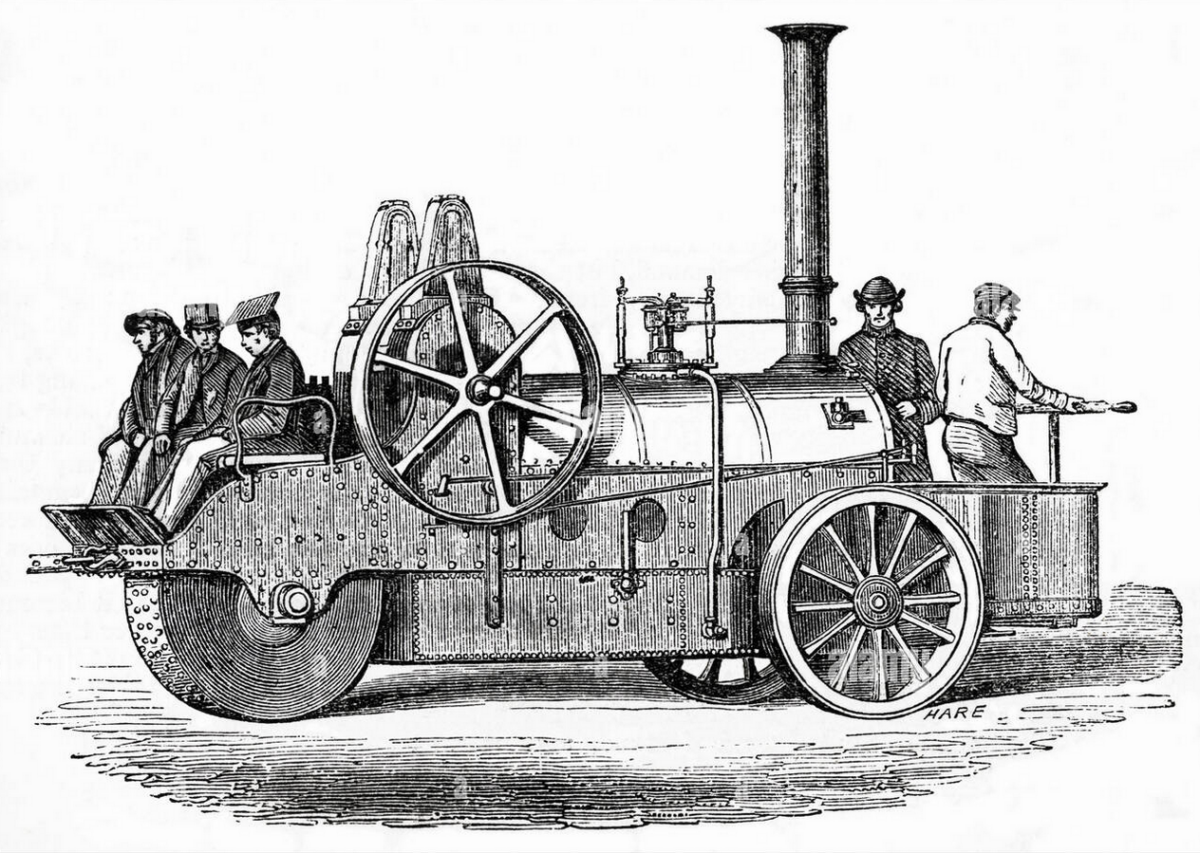
From ‘Freedom: A Journal of Anarchist Communism’, January 1901, London, UK
To the editor of Freedom.
A suggestive New Year’s Gift for the Disinherited of All Lands.
Comrade, — I have been an occasional reader of Freedom for many years, and as time goes on I am more and more moved to suggest, to the advanced guard of the Press, that they should commence a crusade against the part, complex and dangerous and powerful, machinery is playing in prolonging the reign of Big Capitalism and the agony of this night-as-well-as-day Civilisation. As one who has been watching Mechanicalism from an antagonistic standpoint for close to a quarter of a century, I venture to submit to your readers:
That whilst machinery — including railroads and steamboats — has done some very good things, it has done some very evil things; and that these latter far outweigh the former and hence all brave, honest and logical men should line up (like the citizens in “Erewhon“) and facing the champions of machinery, discuss this great question.
Therefore I would suggest that the beginning of the New Century could not be spent better than in sifting out the good and evil effects of Mechanicalism, and if you can find space in your paper I will open the discussion on the side of Anti-Mechanicalism. In the meantime, let me say that the steam engine and its satellites are good servants and bad masters, but not servants of all work.
That they can do some things extravagantly well (notably
common-carrying), some things indifferently well and some things they can not and never will be able to do. Unfortunately for poor, blind, stupid, suffering humanity, these last named are the most needful to the very life and wellbeing of the people, and hence I have seen somewhere that “the steam engine has cheapened the nick-nacks and luxuries of life to a far greater extent than what it has cheapened the prime necessaries of life; so that while brass buttons, screws, and penny pin are cheap today, the four pound loaf, the pound of butter and the dozen of eggs will persist in asserting their dignified dearness,” and will so do until the workers begin to see that their only hope of plenteous food lies in return to those proved methods whereby (see Thoreau) a man “can make a living with his left hand.”
I know that many Socialists and others, when challenged on these points, will say: We cannot get away with your condemnation of Mechanicalism as it is; but we will take the sting out of it by Nationalisation.
Well, granting for a moment that the nationalisation of machinery was realised, I presume that our Nationalisers would make nothing but goods of the best quality, and refuse to carry things detrimental or useless or adulterated or of inferior quality; then surely the manufacturing and common-carrying interests would at once shrink to at least half their present proportions.
Hence I ask my Nationalising friends: what are they going to do with that other half of the manufacturing and common-carrying slaves displaced by such Nationalising moralities and economies? These well meaning (but, I am afraid, superficial) Nationalisers cannot say that they intend to extend our manufacturing and common-carrying enterprises; for surely these are now out of all proportion greater than need be — if we had true co-ordination of all our national activities. If a community of say 100 members told off 50 of their number to run errands. wind bobbins, grease wheels, and other subsidiary work, surely the prime industry of agriculture would suffer, and diggers, drivers and greasers would go hungry.
In summing up the situation we are face to face with these two facts:
1st. That machinery, instead of reducing the sum of human labor and thus making life more effective and pleasant, has multiplied the volume and intensified the speed of work.
Some machines have robbed men of work; but the stupendous enterprises (notably ship-canals) that have been made possible by machinery are legion, so that one may fairly say today we have more work under machinery than ever we had before its advent. But the great mass of this added work is unworthy the notice of any self-respecting man who values health, life and the pursuit of Liberty. It may truly be said today of all mechanically driving and driven countries, that they have got plenty of work of a kind, they have got the quantity: but what of its quality?
2nd. That whilst the steam engine has been a means of de-centralising the suffering workers of Europe by scattering them in a haphazard sort of way over vast areas in the New World, it has centralised them in some of the most disgraceful and biggest cities that ever burdened and disgraced any civilisation. In this latter fact we have the greatest evil, wrought by Mechanicalism.
Let us hope that with the increasing intelligence of the workers, and the working of certain forces — absolute, unchanging — a condition of things so intolerable will arise at once in these great centres, so as to precipitate a Revolution that will force the peoples’ attention to the neglected MILLIONS of tillable acres in many lands.
If the workers want a “cut across lots” to the New Jerusalem, let them stop the Railroad and Steamboat Tyranny; and thus, foreign supplies being stopped they will be compelled to face the problem of making each country produce its own food.
This is my New Year’s Gift to the disinherited of all lands; and if any of your readers can show me a better they will have the thanks of…
PHILO PALHOMO
Also
Paradise (to be) Regained, by Henry David Thoreau (1843)
Walden, by Henry David Thoreau (1854)
Darwin Among the Machines, by Samuel Butler (1863)
“Timid” Capital, by Lizzie M. Swank (1886)
Useful and Useless Labor, by Lucy E. Parsons (1905)
The Destruction of Nature, by Anton Pannekoek (1909)
Manufacturing Psychology, from Industrial Worker (1910)
Man’s Liberation, by Marcus Graham (1925)
What Ought to be the Anarchist Attitude Towards the Machine?, by Marcus Graham (1934)
The Future of the Proletariat, by George Woodcock (1942)
The Tyranny of the Clock, by George Woodcock (1944)
Mankind and the State, by Marcus Graham (1946)
Reflections on Full-Employment, by Vernon Richards (1958)
Time is Life, by Vernon Richards (1962)
Ecology and Revolutionary Thought, by Murray Bookchin (1964)
The Butlerian Jihad of Dune (1965), from Wikipedia
On ‘Fifth Estate’, Anarchism, Technology & Bookchin, by Marcus Graham (1981)
Robotization: A Second Industrial Revolution, by John Mohawk (1983)
How We See It, by the Vancouver Five (1983)
Protect the Earth, by the Free the Five Defense Group (1983)
From Riot to Insurrection, by Alfredo M. Bonanno (1988)
Endless Struggle reviews ‘From Riot to Insurrection’ (1989)
Against Ecology, by Pierleone Porcu (1988)
The Environment is a Class Issue, by Reality Now (1988)
Into the Green, by Black Flag (1989)
A Eulogy to Opinion, by Alfredo M. Bonanno (1995)
The Coming Desert: Kropotkin, Mars and the Pulse of Asia, by Mike Davis (2016)
Militarism is the carbon bomb we can no longer ignore, by Nick Gottlieb (2024)
US-Israel Strikes on Tehran Oil Depots Blanket City in Smoke, by Jon Queally (2026)
