
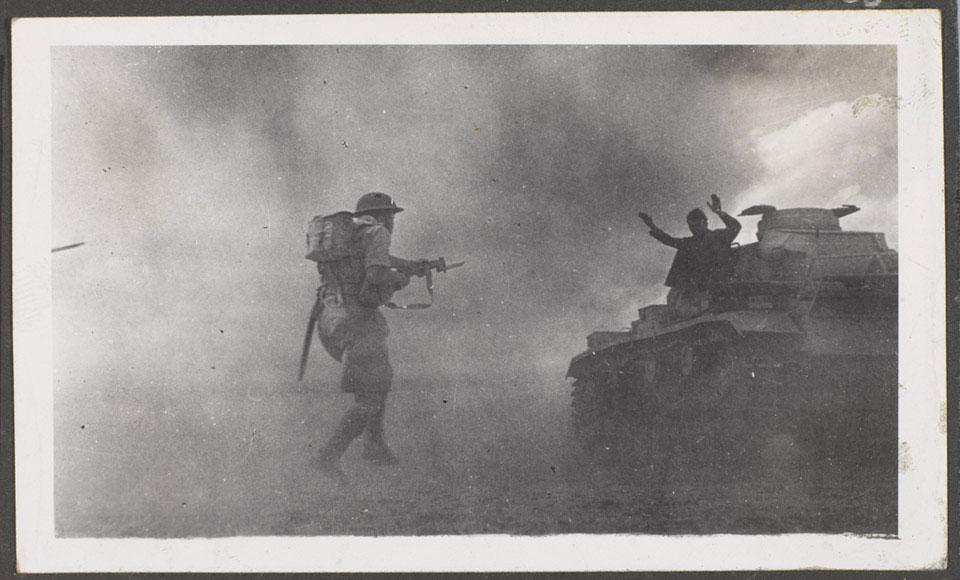
From ‘War Commentary’, June 1941, London, UK
With the outbreak of the “Battles” of Africa and the Balkans the Imperialist war entered upon a new phase. The present writer, being neither able to deduce the Future empirically by spiritist second-sight, nor, alternatively, to reduce it to a “dialectical” formula, proposes at this juncture merely to indicate the historical mise-en-scené of this historic battleground: we propose merely to give the historic background to the present military struggle for the command of the Eastern sea-routes.
In general, it may be stated with substantial accuracy that the building up of British supremacy over the Eastern sea-routes has been virtually equivalent to the rise of the British world-empire: to be sure, there was also a Western expansion, via the Atlantic, towards the Americas, but this has been, in general, subsidiary and subordinate to the main British drive towards the East.
There is the real British Empire; the Empire, not “the commonwealth” of “free nations”: the Empire of Kipling, where unlimited surplus value is extracted from “the lesser breeds without the Law,” not the Beaverbrook Empire of Amalgamated White “Democracies.”
The greatest of English imperialist statesmen — Disraeli — once stated that “the keys of India were in London.” Today, the large perspective, is, first and foremost, an Indian Ocean, an Oriental Empire.
Below, we trace the man stages in its century-long political and strategical evolution of “the expansion of England,” from its original humble status as an obscure island in the North Sea, to its present world-role as master of the Eastern sea-canals: in defence of which there is being fought today what may well be a decisive battle in world-history.
Above, we have used the phrase, “the expansion of England.” In this connection we recall the well-known aphorism of that early Philosopher of British Imperialism, Sir Charles Seely [John Robert Seeley], in his well-known book with the above title (1881) [1883], viz. [that is to say] that England acquired her Empire in a fit of ‘absence of mind.’ This famous phrase is, indeed, absolutely indicative of the cunningly-contrived mythology which passes muster today as the authentic record of British history. For never has there been a more deliberately calculated lie than the above-quoted one of the first apologist of British Imperialism. Never, in all history, was there more deliberation, more cunning, and less “accident” than in the sequential expansion of the British Empire: if “trade follows the flag,” equally and by the same logic, empire, and in time, Imperialism of the most modern type, has followed upon the rise of the British bourgeoisie and of British capital to political power, and to economic maturity.
Assuming, then, that the evolution of Britain’s Eastern sea-routes is the central drama of the conversion of the obscure mediaeval North Sea Island into the greatest world-power of the modern epoch, I propose to trace, firstly, the successive stages in the Eastern expansion of British power, secondly, her position today in face of her present challengers.
British sea-power, like the British Empire in general, arose in the mid-17th century as a result of the rise of British (merchant) capital to supreme political power over the British state: its original founder was Oliver Cromwell, the first British dictator in the capitalist interest, who incidentally, gave his class a useful example as to how to solve subsequent colonial problems: we refer, of course, to his conquest of Ireland, England’s oldest colony.
In 1656-7 Cromwell sent Admiral Blake into the Mediterranean, hitherto a mare incognita to the Atlantic seamen of Northern Europe. This initial occupation did not prove permanent, but, none the less, it served its primary purpose: henceforth, the English bourgeoisie were “Mediterranean-conscious.”
In 1688-9, “the Glorious Revolution” put Cromwell’s Whig disciples in permanent power as trustees of the dictatorship of British (merchant) capital. In 1704 Britain seized Gibraltar, the Western sea-gate of the Mediterranean, the “Dover” of Spain. From 1704-1941 Britain has “stayed put” in this strategic jumping-off ground for further Oriental expansion. Everyone, of course, knows that an act of aggression ceases to be such after a certain time has elapsed! — cp. [compare] the standing orders of the League of Nations! (N.B. [note well] — We have already reminded readers of “War Commentary” that the capture of Gibraltar by the sailors of Admiral Rooke set at nought the solemn precepts of the “Lord’s Day Observance Society.” The British rushed the fortress whilst the Spanish garrison was at Mass! Heaven has ratified their sacrilege!)
The wars of the 18th century have made Britain a world-power: in particular, the “Seven Year’s War”– 1756-63. Concurrently the East India Company set to work on the conquest of India, a task that they presently achieved under the leadership of Clive, that perfect type of a bold bare-faced imperialist brigand. The concurrent process of Indian and world expansion had its mutual interactions: the Pitt dynasty, which led England to world-power in the 18th century, owed its rise to the famous East Indian “interloper” — a polite synonym for “pirate” — Thomas Pitt, whose theft of the Indian “Pitt Diamond” laid the foundations of the family fortunes. By the end of the 18th century England was supreme in India, and the Eastern sub-continent had become supreme in the British Government’s political calculations: “the brightest jewel in the royal diadem [headband crown]” as it has remained ever since.
In 1798 General Buonaparte — the future Emperor Napoleon — forcefully reminded the British oligarchy of the paramount strategic importance of the Eastern sea-routes, for the Egyptian expedition of the great general was, in his own estimation, merely a first move against India, a modern version of the strategy of Alexander the Great.
British sea-power narrowly frustrated the greatest of modern strategists. It was no accident that Nelson, immediately after the Battle of the Nile, which dispersed the French fleet, sent a message overland to India to remove the impression that Buonaparte was coming. The British occupation of Egypt, subsequent to the French withdrawal, proved, it is true, only temporary, none the less, Malta, that Central Mediterranean stepping-stone to the East already taken by Buonaparte from the Knights of St. John, was retaken by the British, and has been kept — for a century-and-a-half — in trust for the Knights of St. John! “Honesty is the best policy.” The present Master of the Order of the Knights of St. John is a pensioner of Mussolini.
Throughout the 19th century British power in the East waxed steadily. China, the East Indies, the East African littoral, felt in turn the weight of the (British) “mailed fist.” Providence, which had winked at sacrilege in Gibraltar and Malta, evidently had more “White Man’s Burdens” in store for the British power.
From 1869 on, when De Lesseps opened up the Suez Canal, the acquisition of Egypt became a primary necessity for British Imperialist expansion. This major strategic necessity was accomplished in three successive moves: Disraeli acquired the Suez Canal shares — 1875; the same astute political strategist simultaneously saved Turkey from Russian expansion to the Mediterranean, and took Cyprus as an openly avowed stepping-stone to Egypt; both at the Congress of — 1878. Finally. Disraeli having died in 1881, the succeeding Liberal government of Gladstone conquered Egypt — at Tel-el-Kebir in 1883 (September). Never was the doctrine of “continuity in foreign policy” better illustrated. Not much “accident” about the British conquest of Egypt and the Suez route!
To bring us up to 1941, it merely remains to add that the British conquered the Sudan in 1898. A few years before they took Aden — “Bab-el-Mandeb” — “the Gate of the South” — and the Indian Ocean — significantly, Aden is under the jurisdiction of the Indian government: it links up with Colombo, Singapore, Hong-Kong, in a continuous strategic chain. (The Island of Socotra — opposite Aden — was taken by an amusing trick: a French gunboat was sent to “annex” the unoccupied island of France. The officers dined with the Governor of Aden. When they awoke from their orgy and arrived at their destination, the British flag flew over the island!)
Finally, the 1914-18 war “for the rights of small nations” added vast territories in the Near East — Palestine, Trans-Jordania, Iraq, to the British territory and/or “protection.” And on the very eve of the present war 100,000 square miles in S. Arabia, opposite “Italian East Africa” were annexed by a stroke of the pen as a “democratic” counter-poise to Mussolini’s East African aggression in Ethiopia.
Such, in brief outline, was the successive acquisition of the Eastern sea-routes, the life-line of the British World-Empire. Today, the great Island-Colossus is fighting a defensive war against its land-hungry Imperialist rivals, Fascist Germany and Italy (to be sure, at the time of writing Italy seems more or less out of it). Germany, however, is a horse of a different colour: in the present drive towards the East by the Third Reich we note the present fusion of two trends of thought, respectively: the military conception of Buonaparte and the political conception of the (former) second Reich when Hitler’s predecessor, the Hohenzollern Empire consciously aimed at a Great Empire Eastern via the creation of the “Berlin to Baghdad” line.
(As Islam — “Jewish Catholicism,” as I have elsewhere styled the creed of the Arabian prophet, is still a major force in these lands, we may expect Hitler to find that the Moslem peoples, despite their physical resemblance to the Jews are “honorary Aryans” for the duration of the conflict: his predecessor, the ex-Kaiser had already, prior to 1914, promised to defend Mohammed as jealously as Christ in return for the political support of Islam!)
As for the military strategy of the German High Command, we must always remember that Buonaparte is the “spiritual” master of the modern German Army, through the agency of his Prussian disciple General Clausewitz, the classic theoretician of “Prussian Militarism.” Subsequent history has strengthened the dictum of Buonaparte that Egypt is Britain’s “Achilles’ Heel.”
We have mentioned General Von Clausewitz. In the present connection, we may relevantly recall his famous aphorism, couched in the very spirit of Buonaparte: “War is the continuation of politics by other means.” The leaders and theorists of the Third Reich have fully assimilated this line of politico-strategic thought. In particular, the German geopolitic school, with powerful connections in both military and political circles, has always realized the vital importance of the Mediterranean in the event of a war against the Western Powers. (In the course of the Spanish War, Charles Duff frequently drew attention to the teachings of this Nazi school of thought in connection with German “intervention — or was it “non-intervention?” — in the Iberian Peninsula, cp. “The War in Spain”).
Finally, Hitler’s man-on-the-spot, the German explorer Max Grühl, has indicated the Red Sea littoral as the spot where the death-blow could best be dealt to the British World-Empire. (cp. “The Citadel of Ethiopia” p.1, cited in my book “Mussolini Over Africa”). There is little doubt that the political and military leaders of the Third Reich have taken to heart the suggestion. The Balkans were only a preliminary: it is in Africa that the German disciples of Buonaparte plan their knock-out blow to the elderly colossus which blocks their road, not only to “living-space,” but to World-Empire.
Can the successors of Pitt and of Nelson stop the new Buonaparte? — for the Führer of the Third Reich is, beyond question, the most dangerous rival that the British Empire has known since the Imperial Corsican. Not being a prophet, I cannot say. This much, however, can be stated with certainty:
The British Empire in the East was no accident, but, contrarily, was a strategic and economic necessity to rising British Imperialism. The Gibraltar-Suez-Aden sea-route is the jugular vein of the British world-power, whose spectacular rise has been largely due to its brilliant sense for key strategic positions. Once that is cut, the unwieldy Leviathan will infallibly bleed to death.
If we consider, as historical justice demands that we should, the evolution of British imperialism as the major political fact of modern history, then this conclusion necessarily confronts us: the German invasion of Egypt is no mere affair of outposts, it is the life-or-death of the greatest modern empire that is at stake: the culmination of an historic process that dates back to Cromwell and the dawn of British Capitalism. We are on the eve of a decisive battle in world history.
Also
Frank Ambrose Ridley section of the Marxists Internet Archive
What is Fascism? What is Democratic Colonialism?
2026 Strait of Hormuz crisis, from Wikipedia
German Court Rejects Palestinian Bid to Halt Arms Exports to Israel, by Mark Hallam (2025)
Three Genocides, by Eyal Weizman (2024)
2023+ Red Sea crisis, from Wikipedia
Mussolini’s Colonial Inspiration, by Matthew Wills (2022)
Recruited by MI5: The Name’s Mussolini. Benito Mussolini, by Tom Kington (2009)
The Myth of Benevolence, by Milan Rai (1995)
A U.S. Victory in the Middle East?, by Anne-Marie Fearon (1967)
A Time For Shame and Atonement, by Third Force (1956)
New Phase in Oil Struggles, by Freedom (1953)
Military Adventure in Kenya, by Albert Meltzer (1952)
‘Why Not Give It Up?’, by Albert Meltzer (1947)
British Army of Oppression Crushes Eastern Freedom, by Marie Louise Berneri (1945)
The Lebanon Crisis, by War Commentary (1943)
Italy After 1918, by Marie Louise Berneri (1943)
Anarchists Uphold the Empire, from The Word (1942)
Fascism: What Is It?, by F. A. Ridley (1941)
British Imperialists Treat the Negro Masses Like Nazis Treat the Jews, by George Padmore (1941)
For Anarchism, by War Commentary (1941)
Nine Months of War , by George Padmore (1940)
This Is Not A War For Freedom!, by War Commentary (1939)
“What Are We Fighting For?”, by Vernon Richards (1939)
The “Advantages” of British Imperialism, by Reginald Reynolds (1939)
Anarchist Tactic for Palestine, by Albert Meltzer (1939)
Capitalist Peace, by Ethel Mannin (1938)
Anti-Fascism: Capitalist or Socialist?, by Vernon Richards (1938)
Palestine and Socialist Policy, by Reginald Reynolds (1938)
Terrorism In Palestine: “Democracy” at Work, by Vernon Richards (1937)
Mussolini’s War Upon East Africa, by Marcus Graham (1935)
Mussolini: The Great Actor, by Camillo Berneri (1934)
Bloodied Palestine, by Camillo Berneri (1929)
Mussolini in Power, by Errico Malatesta (1922)
Our Foreign Policy, by Errico Malatesta (1914)
