
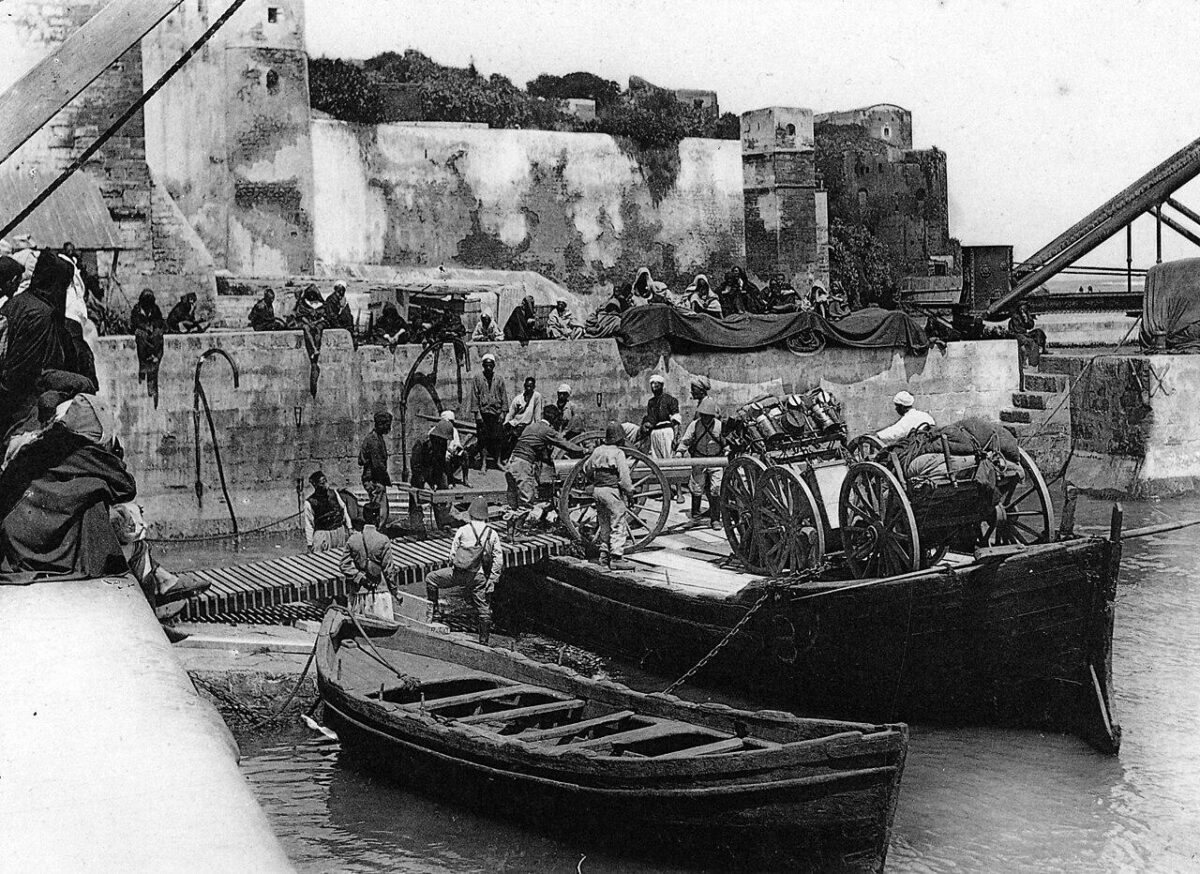
From ‘Kain’, September 1911, translated by Gabriel Kuhn
How much longer will we have to bear this? How much longer shall millions of strong men and their wives, brothers, friends, lovers, parents, and compatriots be fooled by diplomatic chitchat, while the media makes a game out of cannons and canister shots, out of human blood and human misery? How much longer will the masses accept the role of “It” in a special version of Blind Man’s Bluff?
For more than six years, hardened patriots have been talking to us about Morocco, and we are supposed to be excited about the fact that the western part of this land is “ours.” Ours? Who are “we”? “We” are the important Herren Mannesmann and their partners in speculation, and “our” enemies are those we are supposed to fight over this, namely the French (who have always been our enemies – or so we are told). But wait: are we really fighting “the French,” or rather some French speculators who want to make millions off their compatriots’ need for iron ore and mutton?
I admit that I understand nothing about colonial politics. I do not want to understand anything about it either. If domestic politics appear to be mad, then colonial politics seem to be utter and complete – and, let us not forget, inhumane – madness. Who does Morocco belong to? The French? The Germans? The Spanish? All of them? My opinion might appear bizarre, but I believe that Morocco belongs to the Moroccans.
The patriotic clamor with regard to Morocco has an ethical advantage over other heated colonial debates. There is much less hypocrisy involved. The interested parties do not hide the economic interests that drive them. Their raids are not sold as moral expeditions and cultural missions. Usually, the story unfolds as follows: warships land at the coast of countries whose inhabitants are called “savage” and “uncultured” because they work together peacefully, know nothing of import and export, and enjoy the abundance that the land has to offer. They know no misery and no exploitation.
Now, however, they are given European “culture,” namely firewater, guns, and tacky clothes to cover what has so far been natural. In exchange for these generous gifts, the blessed savages only have to surrender their land, their labor, their bodies, their wives and children, their natural resources, their freedom, their customs, and their naïve heathen religion – nothing else. Those who resist are killed, and those who obey become slaves. The moral justification for all this is provided for by the Europeans’ “superior culture,” proven by their effective modern weaponry. These are the colonial politics we are expected to celebrate as a moral duty.
Why all this perfidy and insanity? Because working the landowners’ domestic possessions does not bring as great a profit as the absurd import and export practices that guarantee capital return. In Fields, Factories, and Workshops, as well as in Mutual Aid, Peter Kropotkin has demonstrated convincingly that every country can satisfy its own demand for food if the land is worked properly.
However, this is not the case today. In Germany, there are enormous areas of unused land. While high import taxes have to be paid on even the most essential of goods, the export of grains and cattle is subsidized. Thanks to this, millions of Germans cannot satisfy their most basic needs. Thousands perish in misery, and hundreds of thousands are suffering. Meanwhile, the landowners do not even know what to do with all their riches and look for “markets” in faraway lands.
This is what all the fuss about Morocco is based on! Half a dozen businessmen on this side of the Vosges and half a dozen on the other are quarrelling about this beautiful country, and the national honor of two fatherlands is so affected that both sides wave their swords.
Who will eventually screw over the poor Moors? This will be sorted out in the chambers where the governments involved mix their diplomatic poison. If they do not come up with a concoction that suits all parties, then it is time for the last resort: the national passions of the people will be aroused by alcohol and propaganda until everyone wants to see blood, and then they are let loose against one another with murderous weapons.
Now the question arises: Who will do the fighting? The princes? The governments? The parliaments? The stock exchange speculators? No. It will be the soldiers. And who are the soldiers? The sons of the princes, of the ministers, of the parliamentarians, of the stock exchange speculators? No. The ranks of the soldiers are almost exclusively made up of workers and peasants. These are the people who will pay the price for possible victory. These are the people who are torn from the arms of their loved ones. These are the people who are taken from the workshops and fields, handed guns and sabers, forced to leave their homes, grouped in battalions and regiments, and sent against battalions and regiments that are made up of equally peaceful human beings.
Then they will be ordered to strike and shoot these strangers who are just like them, and to kill as many of them as possible. They will also be told that it is heroic to be struck and shot, and that they will be more useful to the fatherland (how many of them own even one square meter of it?) if grenades tear them apart than if they provide for their children and their parents, than if they were a man to their lovers and a friend to their companions.
The masses which comprise the armies have no influence on the decisions made by those in power. The opportunity for the masses to take power themselves by determined economic struggle has been lost over the course of forty years of fruitless parliamentarian bickering – at least in Germany. All of their energy has been wasted on the ridiculous bugaboo of electoral politics and vote counting. This has proven to be entirely useless. As a result, the masses are helpless and are condemned to wait for the outcome of secretive diplomatic bargains.
If there is to be a war, we cannot count on the passive resistance of the soldiers. We cannot recommend such tactics either: the few who took them up would probably end up dead. Once war has been declared, everyone will be marching, and there will be nothing that can be done. It is different, however, as long as war is only a looming danger. Then the question is: do the masses have effective means of acting against organized mass murder?
When the Socialist Congress met last year in Copenhagen, the French and the English proposed a resolution that demanded that socialists of all countries respond to the danger of war by proclaiming a general strike. The effect such an action would have is evident. A country where transport comes to a halt for just three days, where no goods are circulating, where no trains are running, where no lights are shining, where no chimneys are smoking, where the sick are not nursed, where the dead are not buried, where no mail is sent or delivered, where the poison of the newspapers disappears – such a country cannot breathe, and it will need its most powerful force, i.e., its people, for more important things than providing cannon fodder at its borders.
England, the most industrialized of all countries, is not yet contaminated by social democratic cacklers of the Marxist persuasion. Have we not recently seen in England what even a partial strike can do? It started with the seamen, spread to the waggoners, and eventually to the railway workers, and the most peaceful of all governments lost its head and intervened using the clumsiest means of all, i.e., military might, in a struggle in which not a drop of blood would have been shed without this savagery. In the end, the workers’ demands were met.
These demands were not very important in and of themselves, but the workers had forced the government to dance to their tune. And this in England, a country which all capitalists applaud for its exemplary economic institutions; but it was the economic structure of the class struggle that suddenly overcame all social democratic sophistry and allowed the true socialist idea to shine and inspire solidarity, determination, and truthfulness of such force that all of our hearts beat faster. If England were now called to war, could it even go? It will take a long time before everything in the country will again function according to the capitalists’ wishes.
Back to the Socialist Congress in Copenhagen: as a result of German opposition, the motion of the English and the French did not pass. One of their most radical, most clever, and most honest representatives, Mr. Ledebour, declared that German social democrats had to refuse the resolution, because it would make their domestic position too difficult. This means that calling for a general strike in Germany is pointless. The workers would not respond, because they have been blinded for decades by party propaganda; they can no longer see the necessary actions.
Those of us who want peace in Germany can expect nothing from the German workers. Their demonstrations and all-important declarations would not even cause a dog to leave the negotiating tables and money vaults. We have to look to France for help! The French have Hervé, Griffuelhes, Yvetot – men of a radical nature, full of passion and love for the people, men whose fire ignites the masses and whose words the masses heed.
In France, the government does not know what will happen if it calls the workers and peasants to war. There, the will of the people stands clear, strong, and tall against the deceptive tactics of the technocrats. Furthermore, a factor comes into play that causes only shame and nostalgic envy among us Germans: there exists a common spirit among the French, a people whose poets and artists still serve the cause of humanity.
There is no German Anatole France. Those who should represent the common spirit of Germany are fast asleep. German poets and artists, do you not finally want to blow the trumpet? Is it not blood of your blood that shall flow for Morocco? Do you not want to wake up at last and unite with the people, without whom your work is nothing but hot air? The spirit and the people must be united! May the day come soon when they will be united in Germany as well, united against the noblemen and against the stock exchange, against the diplomats and the priests and the hatemongering journalists!
Also
The Tragic Week in Catalonia, from Freedom (1909)
Revolution, Nation, and War, by Gustav Landauer (1912)
To the Anti-Militarists, Anarchists, and Free Thinkers, by Ferdinand Domela Nieuwenhuis (1915)
Erich Mühsam: His life, his work, his martyrdom, by Augustin Souchy (1934)
The Right of Peoples to Determine Themselves, from Solidaridad Obrera (1936)
Call to Moroccan Proletarians, by Ahmed Ben Thami (1936)
Cowardly Policy Brought Moors to Spain, by Spanish Revolution (1936)
What Can We Do?, by Camillo Berneri (1936)
Why Moors Help Franco, by George Padmore (1938)
García Oliver, Largo Caballero, and the Problem of Morocco, by Abel Paz (1996)
Carrying the War into Africa?: Anarchism, Morocco, and the Spanish Civil War, by Danny Evans (2020)
(Zine) Anarchists on South West Asia and North Africa (1912-2024)
Three Genocides, by Eyal Weizman (2024)
The Gaza War Has Not Distanced Morocco From Israel, Quite the Opposite, by Ignacio Cembrero (2025)
Morocco: Pro-Palestine Activists Denounce Increased State Repression, by Pauline Chambost (2025)
Anarchism and Revolutionary Defeatism, by K. C. Sinclair (2025)
German Arms Exports: No More Rules?, by Emily Sherwin & Marie Joslyn (2025)
German Court Rejects Palestinian Bid to Halt Arms Exports to Israel, by Mark Hallam (2025)
Anarchists on National Liberation
Anarchism & Indigenous Peoples
“Dissolve the army and immediately withdraw from Morocco.”
Fourth demand formulated by the workers at the CNT-FAI rally in Barcelona, May Day, 1931
