
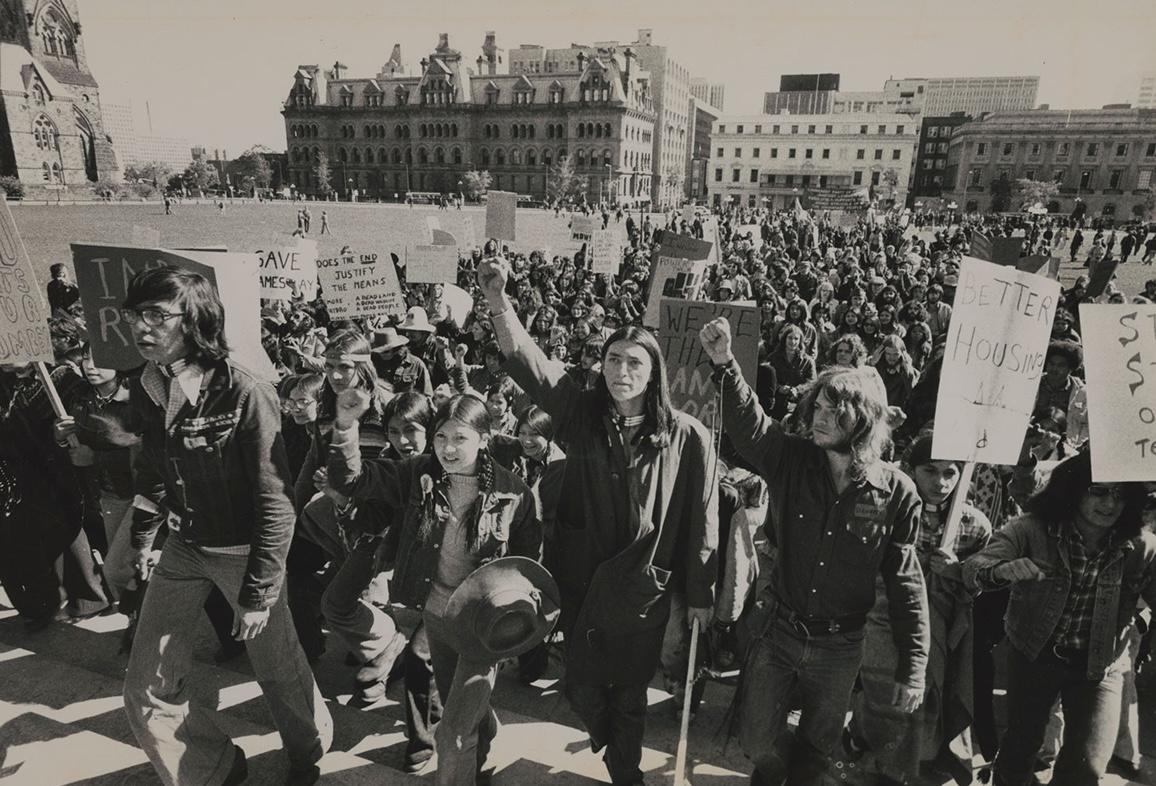
From ‘The Native Perspective’, August 1976, Ottawa
Put-down by the press, beaten by the police and ignored by Indian organizations the Native People’s Caravan of ’74 set up an ill-fated Indian Embassy in the Capital.
Today the Native People’s Embassy lies in ruins on the green banks of the Ottawa River, war-torn and strewn with memories of a short-lived Indian occupation.
Paintings on the walls keep alive the spirit of the battle in the absence of its warriors. The feelings of the young people who occupied that rambling building owned by the National Capital Commission still exude from a poem scribbled on the wall which reads,
I am like a tree
Standing tall and free!
The occupation was one of many minor revolutions that year carried out by young Indian people.
From inside the walls, now burnt black from the fire which totally devastated the building and drove out the occupants, can be seen the Parliament buildings and the Supreme Court of Canada standing dominantly and steadfastly on the Hill, symbols of both oppression and “Justice”.
The fate of Indian people lies in decisions made by these two institutions. From inside the walls they seem distant as freedom does to prisoners.
Peering through the glassless windows at Parliament you sense the feeling of alienation and frustration of the Indian youth who came, revolutionaries in their own right, to do battle and win justice and freedom for the Indian nations of Canada. For them, you sense, it must have been like “fighting windmills”.
The Native People’s Caravan evidenced the growing awareness of Indian youth that concrete actions were needed to change the “system” which views Indian people as outcasts, drug addicts, drunks and wastes of modern society. It is a reflection that Indian people are no longer looking inwardly for the problem which plagues Indian people. They are looking outside themselves, and in doing so, they are finding a sense of dignity in being Indian.
Organizers of the Native People’s Caravan of ’74 had two successful occupations under their belt when they decided to march from Vancouver, B.C., to Ottawa, Ontario for the fall opening of Parliament. The Ojibwa Warrior’s Society had held a park in Kenora, Ontario and Cache Creek Indians had blockaded a road in central B.C. when they met in Vancouver. At the outset they anticipated swelling their numbers to 5,000 or even 10,000 during their cross country trek.
Their original plan was to converge on Ottawa by September 30, 1974 in time for the opening of Parliament to demonstrate against the federal government’s treatment of Native peoples.
Louis Cameron, a Caravan leader, stated at the time that “the government ignores the pressing Indian problems of housing and medical care, while at the same time adopting policies which seem to be designed to drive the Indian from his land into the cities.”
This concern for urban Indians has continued to be the focal point of young people, particularly the American Indian Movement (A.I.M.), Canada Chapter. It was for this plight, also, that Nelson Small Legs, Junior, an A.I.M. leader in Alberta gave his life earlier this year.
The Department of Indian Affairs which has a mandate to protect Indian lands and Indian people has not developed a satisfactory or clear policy on its responsibilities to Indians who have migrated to the cities.
Many urban Indians find themselves stranded in an alien environment with none of the benefits given to them had they remained on the reserve. They are cut off from the benefits of the reserve, the Department, and sometimes, even of the province.
No Indian leader could argue with the cause of the young people, including those who came to Ottawa in the fateful summer of ’74. It was legitimate. So what went wrong? Was it all in vain?
Consistently bad press coverage followed the march from Vancouver culminating in accusations in Saskatchewan that the young Indians were going to tie bombs to their bodies and “attack Parliament”.
From that point the Ottawa police forces prepared for war.
When the young people eventually reached Ottawa, numbering between 400 and 700 they came unwelcomed, heralded by false rumours of ill-intent. Their cause muddied with slanderous press reports, but still high in spirit they organized a protest march on The Hill when Parliament convened.
Much to their disadvantage they found their numbers infiltrated by members of the Communist Party of Canada. Until four o’clock the march was peaceful.
The Ottawa City Police, numbering between 30 and 50 (or more) lined up across the street in front of the American Embassy. Another 50 R.C.M.P. stood between the Indian protestors and the Parliament building. Members of the Militia marched to the Hill to protect the Governor General’s representative, Chief Justice Bora Laskin. Even the House of Commons Guard was out in full force.
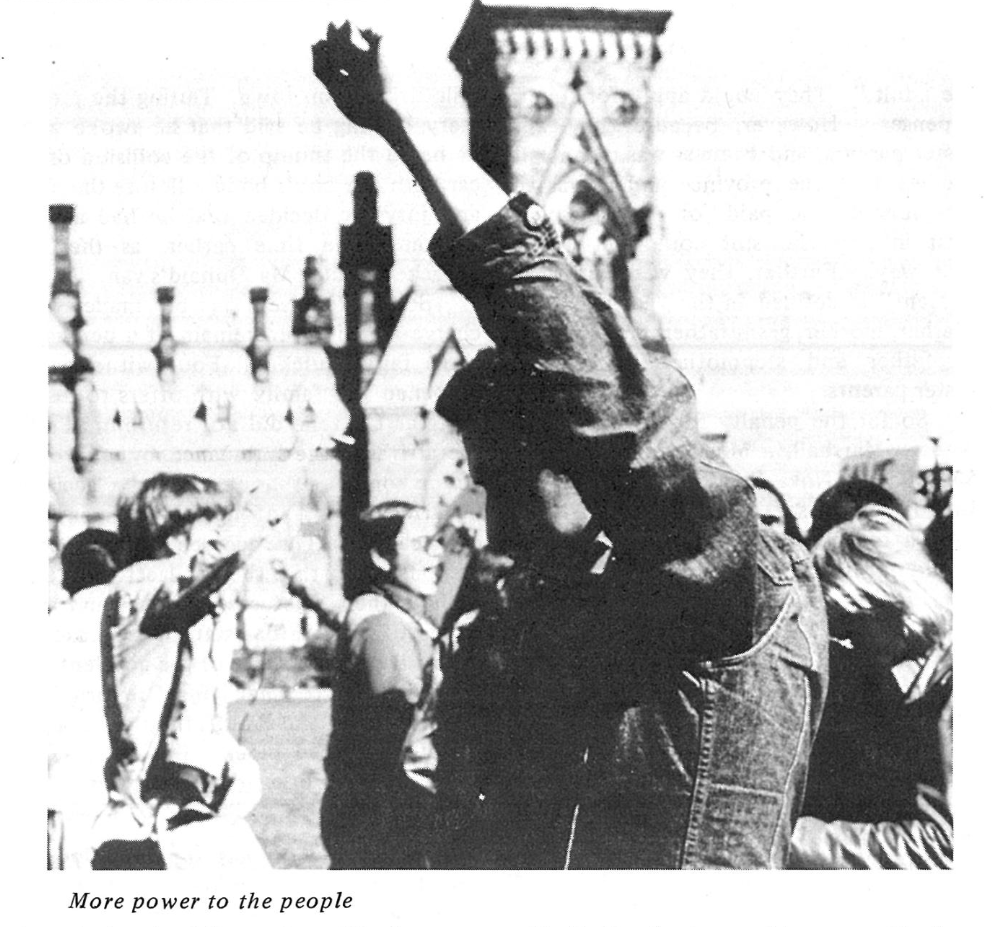
Outnumbered as they were by the police and military, the young Indian protestors kept their demonstration peaceful until a crowd behind them pushed them into the police ranks. Almost instantly a new tactical R.C.M.P squad, dressed in full riot gear, rushed from inside the Parliament Buildings and confronted the young Indians. A battle ensued in which Indian women, babies and youth were battered around by the police force with some hurt and some arrested. The Riot on Parliament Hill was never fully investigated to find out who started the pushing.
No charges ensued but the results of that so-called “riot” are phenomenal. The National Indian Brotherhood Cabinet Committee was formed as a direct result of the Hill incident.
Also resulting was a tightening of security on the Hill, with nine movie cameras operating on a full-time basis from various angles on the Parliament buildings including the Centre Block, the West Block and the East Block.
It is interesting to note, however, that the R.CM.P. “riot squad” has been used only once. . . against Indians. . . even though there have been numerous protests on the Hill by other citizen’s groups.
Earlier this year, 5,000 angry Quebec farmers protested violently on the Hill spilling milk on the Minister of Agriculture as well as the lawns and burning benches right in front of the police. There were no arrests in that “riot” even though extensive damage was done on the Hill and hundreds of feet of movie film documented the demonstration by the farmers. One wonders if the system of justice in this country has been developed exclusively for use against Indians!
Also
Native Alliance for Red Power – Eight Point Program (1969)
Trail of Broken Treaties 20-Point Position Paper (1972)
The Truth About the Anicinabe Park Occupation of 1974, by Linda Finlayson
Manifesto of the Native Peoples’ Caravan (1974)
Maria Campbell’s speech to the Native Peoples Caravan in Toronto (1974)
Anicinabe Park Occupation 1974: Interviews with Two Warriors (1976)
The Brave-Hearted Woman, by Michael Posluns (1976)
The Red Path and Socialism, by ᐊᓯᓂ Vern Harper (1979)
Marxism from a Native Perspective – John Mohawk (1981)
Marxism and Native Americans – Reviewed by Howard Adams (1984)
