
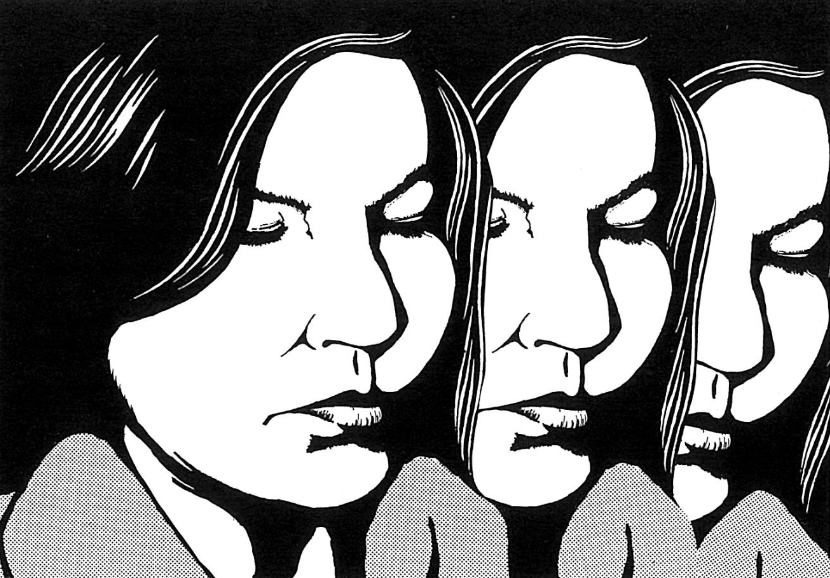
From ‘The Native Perspective’, September 1976, Ottawa
…Did Anna Mae Pictou Aquash receive justice? Stories of this nature (i.e. Julio Dixon, Panama, May 1976 issue) take time to research, check and double check and THE NATIVE PERSPECTIVE gratefully acknowledges the assistance of Marjorie Wallens, C.T.V. NEWS, Jerry Oppenheimer, WASHINGTON POST, AKWESASNE NOTES and CANADIAN PRESS WIRE SERVICE, for their contributions to “The Brave-Hearted Woman”.
Editor [The Native Perspective]
Nothing more reflects the chauvinism and the wilful ignorance built into the reporting on the siege of Wounded Knee by United States troops in the spring of 1973 and the subsequent events at Pine Ridge Reservation in South Dakota, U.S.A. than the sustained public attention on the role of a handful of men. The death of Anna Mae Pictou Aquash, Micmac from Shubenacadie, Nova Scotia, last February, has done more to force public attention in Canada on the real meaning of Wounded Knee ’73 than all the United States television and wire service coverage duly duplicated here while the siege was in progress.
On May 21, a report of the United States Civil Rights Commission summarizing a March investigation surfaced in Ottawa, concluding that “there is sufficient credibility in reports reaching this office to cast doubt on the propriety of actions by the Federal Bureau of investigation (F.B.I.) and to raise questions about their impartiality and the focus of their concerns.”
But on July 7, W.M. Wood of the Bureau of Consular Services of the Canadian Department of External Affairs wrote to the Canadian Friends Service Committee (Quakers) saying that the Canadian government was, in effect, continuing to rely on a May 28th press release of the FBI stating that the investigation into her death was still under way.
On February 24, Anna Mae’s body was found by a white rancher, Roger Amiott on the land he works near Wanblee on the Pine Ridge Reservation in South Dakota. Amiott was fixing fences during an unusual mild spell when he saw the body “right out in the open” below a 30-foot embankment and only 150 feet from a two-lane state highway. Without the break in the weather, Anna Mae’s body would probably have remained where it was found until spring time. Amiott returned to his house, half a mile away and called the local Bureau of Indian Affairs (B.I.A.) office.
“Not until three weeks later did the FBI return to carry out a search of the area.” And by then the immediate area had been plowed.
An autopsy was done the day after Anna Mae’s body was found, by Dr. W. O. Brown from Scottsbluff, Nebraska. Brown says that he does not remember just who asked him to remove Anna Mae’s hands for identification. The BIA police? The FBI? The tribal police?
Brown said, in an interview, that he saw no reason to do an X-Ray, a procedure he felt would be too time consuming and difficult with the poor facilities at the Pine Ridge Hospital. Earlier, a nursing assistant had pointed out to Dr. Brown that there was a bloodied area at the base of Anna Mae’s skull. Brown concluded that Anna Mae had died of exposure.
When a St. Paul pathologist not on the regular pay-roll of the BIA was brought in, he found a bullet had entered the back of Anna Mae’s head. Asked why he did not find the bullet, Dr. Brown laughed and said, “A little bullet isn’t hard to overlook. It certainly isn’t the first time.” He also said that he did not understand “why all the fuss is being made over the death of one Indian woman.”
Anna Mae was well known to police authorities at the time of her death. Her wedding at Wounded Knee had been broadcast by all three major U.S. television networks. On November 14, 1975, she was arrested together with Kamook Banks, Kenneth LoudHawk and Russel Redner after a widely publicized police siege on a motor home in Oregon.
The siege of the motor home was set off when troopers received a report from the FBI that Dennis Banks and Leonard Peltier were travelling in the convoy which included the motor home. Kamook Banks was eight months pregnant at the time, and had trouble responding to troopers’ demands that everyone lie on their stomachs. “Are you sure she’s pregnant or does she have an M-16 in there?” Troopers chuckle, driving off their chills. “Don’t talk, Indian.”
When the firearms and explosives charges arising out of the motor home incident came to trial on May 12, it took U.S. District Court Judge Robert Belloni exactly 12 minutes and 55 seconds to dismiss the charges against Anna Mae’s three co-defendants. The court had already ruled that most of the prosecution evidence was too tainted to be admissible. When the prosecutor said that he was not ready to proceed, charges were dismissed.
Anna Mae’s friends and family never believed that she died of exposure. Candy Hamilton, a legal worker at Pine Ridge, said the people of Oglala, a small town on the reservation, knew Ms. Aquash was murdered, “They tried to suggest she may have been drunk, but she never touched a drop of alcohol.” Anna Mae’s sister, Mrs. [Mary] Earl Lafford, pointed out that Anna Mae lived most of her life out of doors and knew how to take care of herself.
Carter Camp, one of the few Wounded Knee defendants presently imprisoned for his role in those events, was visited by the FBI who wanted to question him about Anna Mae. When he was insufficiently cooperative they told him that if he did not give them all the information he had they would tell his wife about his relationship with Anna Mae. They also tried to tell Carter that his wife was involved with someone else. Carter Camp’s own view of both matters, and the FBI’s credibility is indicated by the fact that this information was communicated in a recent letter from him to his wife.
After her arrest and release by the FBI last September Anna Mae told Candy Hamilton that, “It is coming out and it is very serious. I think that they (the FBI and other authorities) want to destroy the (Indian) nation if it will not subdue to the living conditions of a so-called reservation. And those who do not want those kinds of conditions for their children or for themselves, then I think they are definitely out to destroy that concept of freedom.”
Lew Gurwitz, a Boston attorney working with the Wounded Knee Legal Defense/Offense Committee, believes, “There is a strong possibility of complicity by the FBI into the death of Anna Mae Aquash. The FBI seems to be deeply implicated in Anna Mae’s death, if not in her murder at least in the cover-up of her murder.”
Anna Mae’s sister believes, “My sister’s death was an execution in retaliation for the death of the two FBI agents. It has been publicly announced that they (the FBI) will get every member of the American Indian Movement (A.I.M.) and my sister’s death was the start of it.”
Mrs. Lafford believes her sister was tortured for information before she was killed. Otherwise, “there’s no reason to mutilate her hands and cut off her fingers.”
“Nothing else will develop out of the case which killed Annie Mae Aquash, not while the FBI are involved.”
Mrs. Lafford’s estimate of the FBI’s integrity is widely shared. Not only by her family and supporters of the American Indian Movement. A report released by the U.S. Senate Select Committee on Intelligence, April 28, provided the most comprehensive and detailed account of FBI misconduct yet disclosed. Included in FBI activities were disruptions such as the American Indian Movement has experienced: “unsavoury and vicious tactics including anonymous attempts to break up marriages, disrupt meetings, ostracise persons from their professions, and provoke target groups into rivalries that might result in deaths.”
Outside the White House, it seems that the only people who rely on the FBI as an accurate source of information is the Canadian Department of External Affairs.
But none of this tells us anything about who Anna Mae Pictou Aquash was, how she lived, or really even, why she died. The sovereignty of the Oglala Nation that was re affirmed at Wounded Knee in 1973 had been sustained and preserved chiefly by the brave-hearted women of the Lakotah. It was they who pressed the demand for civil rights at Pine Ridge throughout the reign of terror which finally ended with the defeat of Dickie Wilson, former chief, last fall.
It was they who led the demand for his impeachment. And when the BIA intervened, it was the women again who went to the traditional chiefs and demanded that the warriors of all Native nations be called to support the sovereignty of the Oglala Nation recognized by the United States in the Treaty of 1868.
I first learned to understand the powerful role of the brave-hearted women of the Lakotah when two of their eastern sisters began to send to AKWESASNE NOTES what was to become of 100 hours of audio tape collected inside Wounded Knee. These sisters were sending out regular reports, including four solid documentary radio programs to alternate news services. This was the raw material from which they later edited “Voices From Wounded Knee”.
Which proves not very much. Except that the women’s story has always been available. Too many white media, and for that matter, not enough Native journalists were capable of listening and hearing the mothers and grandmothers cry with rage, with sorrow, and finally with strength born in their belief that it was to them that the Creation entrusted the sovereignty of their people.
In the three years since the siege at Wounded Knee ended, almost every opinion I have heard offered on those events, the subsequent trials and the role of the American Indian Movement — no matter from whom it came — tended to focus on the public testimony of a few men. When Judge Bogue dismissed the charges against Russel Means and Dennis Banks, condemning instead the unlawful activities of the FBI, the U.S. Army and Richard M. Nixon, many Native people and their friends rejoiced that a U.S. judge had finally said what the grandmothers have been saying for years. The brave-hearted do not often speak — but it is most often they who create the speaker’s role.
Also
The Six Nation Iroquois Confederacy stands in support of our brothers at Wounded Knee (1973)
Frank Clearwater and Buddy Lamont Killed at Wounded Knee, from Akwesasne Notes (1973)
Wounded Knee: The Longest War 1890-1973, from Black Flag (1974)
“Jails are not a solution to problems” – Anna Mae Pictou Aquash interviewed by Candy Hamilton (1975)
Indian Activist Killed: Body Found on Pine Ridge, by Candy Hamilton (1976)
Anna Mae Lived and Died For All of Us, by the Boston Indian Council (1976)
The Brave-Hearted Women: The Struggle at Wounded Knee, by Shirley Hill Witt (1976)
Repression on Pine Ridge, by the Amherst Native American Solidarity Committee (1976)
Who Gets Political Asylum?, by Sandra Montague (1976)
Chronology of Oppression at Pine Ridge, from Victims of Progress (1977)
Excerpts from Leonard Peltier’s Trial Statements With Regard to Anna Mae Pictou Aquash (1977)
Review of ‘The Life and Death of Anna Mae Aquash’, by Akwesasne Notes (1978)
Anna Mae Aquash, Indian Warrior, by Susan Van Gelder (1979)
Indian Activist’s Bold Life on Film, by John Tuvo (1980) Pine Ridge warrior treated as ‘just another dead Indian’, by Richard Wagamese (1990)
Anna Mae Pictou Aquash: Warrior and Community Organizer, by M.Gouldhawke (2022)
Mary Imelda “Hubba” Lafford (1943-2025)
No One’s Illegal on Stolen Land
