
[Republication of this article, or any other, does not mean endorsement or encouragement of the views expressed by its author. -Ed.]
From ‘A Murder of Crows: For Social War and the Subversion of Daily Life‘, March 2007, Seattle, Washington
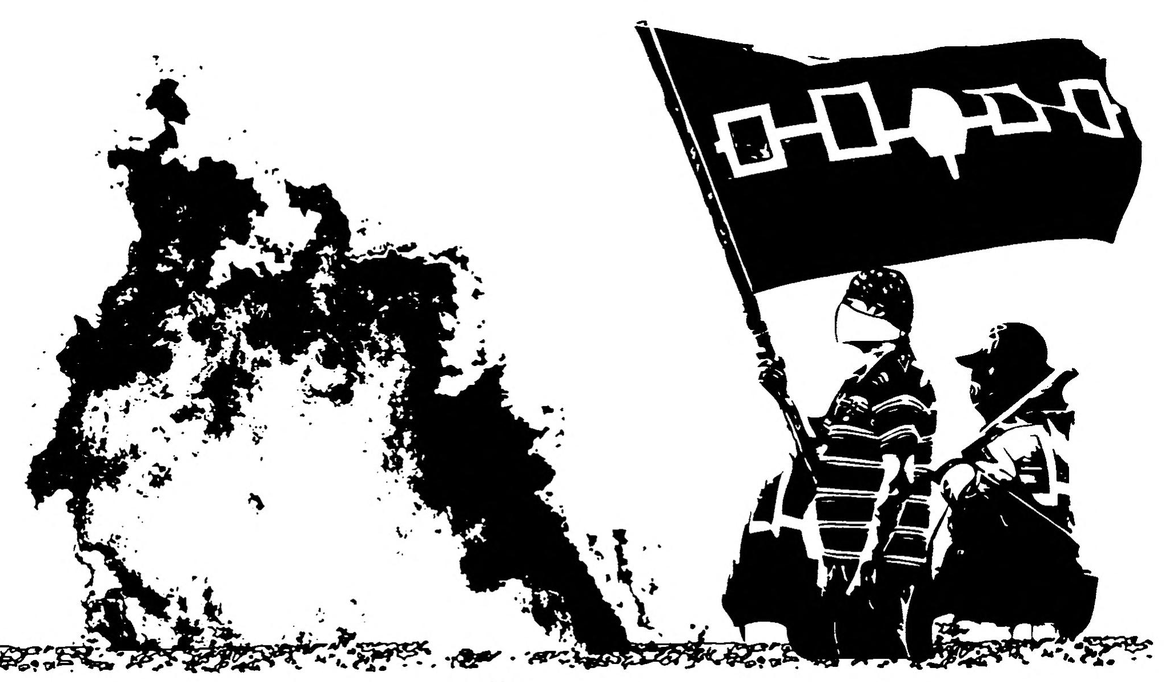
On February 28th, 2006, in Ontario, Canada, a small group of people from the native reserve known as “Six Nations of the Grand River” reclaimed a nearby piece of their land that Henco Industries was using for a housing development called the Douglas Creek Estates. Barricades and a banner reading “Six Nations Land” were placed at entrances to the site. At the time, Henco had plans for some 200 homes, though construction had only begun on less than a dozen. The project would have been a major expansion of the town of Caledonia, which is already within sight of the northeast edge of the reserve.
The reclamation site was raided by heavily armed police on April 20th and has been subject to numerous racist protests and assaults by residents of Caledonia since then. With blockades, sabotage, and physical force, the indigenous land defenders at the site have so far successfully beaten back all attacks. Natives from other reserves and indigenous nations across Canada traveled to the site to take part in its defense and initiated demonstrations and blockades in their own territories. Non-natives across the country have also participated in support activities for the reclamation and some have traveled to the site to offer their assistance.
From Vancouver, a small group of insurrectionary anarchists, of which I was a part, made a trip to the site. The resistance of Six Nations people to both development and the cops inspired us, and we wanted to familiarize ourselves with the situation, uncover prospects for solidarity, and further develop our own struggle against capitalism and the state.
A History of Repression and Resistance
While Canadian cities and towns in the surrounding area continue to expand rapidly, Six Nations of the Grand River, with the highest population of any reserve in Canada, hasn’t grown in more than a century. The reserve is the product of the American War of Independence, in which most nations of the Six Nations Confederacy allied with the British. Traditional land in New York state was lost to the Americans. As compensation, the British General and Governor of Quebec, Frederick Haldimand, granted six miles on each side of the Grand River in southern Ontario to the Confederacy in 1784.
Prior to this, in the Nanfan Treaty of Albany in 1701, the Confederacy had claimed some of the land in this area as hunting grounds, which the British were not to disturb. By the 1840s, most of the Haldimand Tract had been stolen by armed settlers and government agents, or sold-off by Confederacy chief Thayendanegea (Joseph Brant). This left only the reserve of today, which is about 5% of the original grant of almost one million acres of land.
In October of 1924, an Indian Agent and 20 Royal Canadian Mounted Police (RCMP) officers interrupted a Confederacy meeting at the reserve and decreed that they would now be governed by the Indian Act, the Canadian government’s repressive legislation against indigenous peoples. Books, documents and sacred wampum belts were also confiscated. The Canadian government’s elected band council system was imposed, and elections were held two weeks later, with only 52 people participating. In March of 1959, more than a thousand Six Nations people descended on the band council house and occupied it. Eight days later, the RCMP riot squad was sent in to crush the resistance.
In 1994, concerned with the potential contamination of the reserve’s water supply, land defenders from Six Nations camped out on an island in the Grand River to stop the construction of a sewer pipeline. In 2003, Six Nations people camped out and built a longhouse in the Red Hill Valley to stop the building of a highway ramp. Hamilton city police raided the longhouse and made 14 arrests, and construction crews destroyed the longhouse.
The 2006 land reclamation at Caledonia is a continuation of this history of resistance. It is also the continuation of the history of resistance of the Mohawk Nation, which is a member of the Confederacy. They have been at the forefront of the indigenous struggle in Canada, with various blockades, occupations and clashes with the police, the most significant being the 1990 Oka Crisis, an armed confrontation between Mohawk warriors and Canadian soldiers [and police] at the Kanehsatake and Kahnawake reserves in Quebec.
The rebellion of 1990 grew into a social insurrection when the Mohawks of Kahnawake, using only their fists, feet and rocks, beat back an attempted raid by the army. Solidarity actions spread to indigenous reserves and territories across Canada, with road and railway blockades, and sabotage against bridges and electrical towers. It also inspired non-natives throughout the country, including Vancouver’s Frances Street squatters who built barricades in the street to defend their homes from eviction by the police.
The Escalation of the Conflict
Although the 2006 Six Nations land reclamation at Caledonia started off relatively low-key, it began to escalate in March as a court injunction and ultimatum to leave the site were issued. On March 22nd, more than 200 people, led by clan mothers, gathered to defend the site from an expected police raid that never materialized. In the mean time, Ontario Provincial Police (OPP) built-up their forces and occupied a former school in Caledonia. Also, a few hundred residents of the town attended a protest rally against the Six Nations reclamation on April 4th.
On April 12th, a demonstration in support of the Six Nations land reclamation was held in Vancouver, organized by the International Indigenous Youth Conference Secretariat, Redwire Native Youth Media, and No One is Illegal-Vancouver. Police got pushy with the demonstrators as they made their way to the Main Street police station, and people responded by yelling at the cops.
On April 20th, more than 100 heavily-armed OPP officers raided the reclamation site and used pepper-spray and tasers while making 16 arrests. Land defenders fought back and un-arrested people as more than 200 natives flooded into the site from the nearby reserve. Two cops were reportedly injured and hospitalized, and a police van window was smashed as the cops retreated.
New barricades, consisting of burning vehicles, tires, and wood, as well as dumped gravel, were set up on the Highway 6 bypass and Argyle Street, which is the main road through Caledonia and the old highway respectively. A footbridge that goes over a railway line in the area was burned down and the remains were left to block the railway. Masked indigenous warriors with batons, baseball bats, and socks filled with rocks maintained patrols of the site to prevent another police invasion.
That same day, Mohawks at the Kahnawake reserve raised flags on top of the Mercier Bridge as a show of solidarity with the Six Nations defenders. Kahnawake Mohawk warriors said they were engaging in defensive vigils at entrances to the reserve “to ensure that no further violence is initiated by the Governments of Canada and Ontario upon our people.”
In the wake of the raid, spokespeople for government-funded Native political organizations such as the Assembly of First Nations, the Metis Nation of Ontario, the Union of Ontario Indians, and the Six Nations band council urged Natives from across Canada to stay away from the reclamation site.
The following day however, Mohawks at the Tyendinaga reserve in Ontario acted in solidarity with the reclamation by blocking a Canadian National railway line with a bus and burning material for about 20 hours, shutting down national freight and passenger service. Also that day, a solidarity demonstration was held on the Seaway International Bridge at the Mohawk reserve of Akwesasne, which is carved-up by the Canada/US border.
On April 22nd, Secwepemc Native Youth Movement members at the Neskonlith reserve in British Columbia responded to the police raid of the reclamation by setting up camp and posting billboards, banners and Unity/Warrior flags along the TransCanada Highway. The billboards proclaimed, “Stop OPP Terrorism” and “OPP out of Six Nations.”
On April 24th, there was a Vancouver solidarity demonstration for the Six Nations defenders. It was primarily organized and controlled by members of government-funded native institutions, who created a “security” team for the march in liaison with the police. The demonstration was attended by about 400 people at its height and ended at the entrance to the Lion’s Gate Bridge, stopping one direction of traffic For about an hour. Masked native youth seemed eager to confront the police and to take up both lanes of traffic, but the security team pushed people out of the opposing lane and acted as a buffer between the crowd and the cops.
In the Vancouver Sun newspaper, a Vancouver police spokesperson described the protest organizers as “cooperative” and said that no arrests were made at the event because the Vancouver Police Department “allow(s) democratic peaceful protests to take place in this city.” A handful of insurrectionary anarchists participated in the demonstration, distributing leaflets about the resistance at the reclamation site. Previously, anarchist comrades had put up posters around the city and talked to people on the streets about the reclamation.
On May 22nd, Six Nations people removed the blockade of Argyle Street only to be attacked by a crowd of racist Caledonians. A brawl erupted between the Caledonians, native warriors and OPP officers, in which the warriors came out on top. Land defenders then rebuilt the Argyle Street blockade and dug a trench in the road, using heavy machinery. That night, a vehicle was rammed through the gate of an electrical station on the edge of the reclamation site, causing major damage and cutting-off power to Caledonia and the surrounding area.
Also that day, members of the Cree Nation from the Poundmaker reserve in Saskatchewan blocked a highway bridge for two hours in solidarity. At night, Mohawks expressed their solidarity by holding a tobacco ceremony and setting aflame two cars on the Seaway International Bridge at the reserve of Akwesasne, closing the bridge and US-Canada border crossing for several hours.
The following day, Six Nations people again removed the blockade of Argyle Street. On June 4th, an OPP car was caught driving on the 6th Line road that leads to the Six Nations reserve. This was contrary to the OPP’s agreement to defer responsibility for the road to the Six Nations police force. Six Nations people surrounded the car, and the officers were forced to leave the immediate area. Soon afterwards, a barn and a security company vehicle near the reclamation site were set on fire. The security company vehicle was guarding the power station that had been previously attacked.
On June 9th, Six Nations people briefly seized a United States Border Patrol vehicle near the reclamation site; an Alcohol, Tobacco and Firearms (ATF) agent from the US and OPP officers were using it to engage in surveillance. Documents found inside the vehicle confirmed that the OPP used infiltrators to spy on the site and its defenders since the beginning of the reclamation. Arrest warrants were issued for seven people because of this incident and other confrontations that took place that day between Six Nations people, corporate journalists and a white couple in a car who were also spying on the reclamation site.
On June 13th, certain Six Nations people removed the barricades on the Highway 6 bypass and railway. This took place despite the objections of some land defenders and before a unanimous decision could be made on the matter, which would have been accordance with the traditional Six Nations decision-making process. On June 16th, the Ontario government bought the land in question from Henco. A few days later, the government revealed that the land had been bought for 12.3 million dollars.
David Martin, one of the 16 people arrested during the April 20th police raid, was sentenced on June 14th to one day in jail and a year of probation after he plead guilty to dangerous driving and fleeing police. On June 16, one of the seven people with warrants from the June 9th incidents, Audra Ann Taillefer of Victoria, British Columbia, was arrested by Six Nations police and handed over to the OPP. Another one of the seven people with arrest warrants related to the June 9th incidents, Ken Hill of the Six Nations reserve, was arrested on June 21st to face two charges of assault. Audra Taillefer was released that same day on $10,000 cash bail and an order to remain in Ontario but to stay away from Caledonia.
On June 28th, an unidentified Six Nations man was arrested and later released on bail by OPP officers in Brantford, near the Six Nations reserve. Many believe that his arrest was related to the June 9th incidents, but according to the OPP, the arrest was based on an unrelated warrant. A Six Nations reserve newspaper, Turtle Island News, reported that fires were set on a highway bypass in response to this arrest.
Reclamation spokeswoman, Hazel Hill said, “the arrest came as a complete surprise and people at the site were angry. We are supposed to be communicating with the OPP policing table, but for some reason they chose not to tell us and this is the result.” Turtle Island News also reported that organizers at the reclamation site were able to “calm people” and “douse the fires.” Apparently some involved in this reclamation are more than willing to cooperate and dialogue with the state.
At 4:00am in the morning on June 29th, the railway line at the reclamation site was barricaded once again for a short time. The media reported that railway equipment was damaged. Unfortunately, clan mothers and traditional chiefs strongly advised the blockaders to leave, and Six Nations police assisted with the removal of the barricades.
On August 8th, [while] holding one of their frequent racist protests at the edge of the site, Caledonians were hosed-down with water by land defenders. Also on this day, a judge called for an end to negotiations between the Confederacy and the government until the reclamation was ended.
Trevor Miller of Six Nations was arrested by native police on August 11th at the Grassy Narrows reserve on a June 9th warrant, but he has now been released. In addition, Erwin Ron Gibson of Akwesasne was arrested by Mohawk police at his reserve on September 27th on an OPP warrant related to the June 9th incidents. He was detained at a prison in Hamilton for a time and then released to face his criminal charges in court.
On January 3rd, 2007, Christopher Hill of Six Nations of the Grand River was arrested by Six Nations police on an OPP warrant for allegedly “assaulting a police officer” during the April 20th raid.
The assistance in making arrests of Six Nations land defenders that the OPP has been given by native police forces has certainly made their job easier and lowered the potential for retaliatory action. All native police forces in Canada operate under the authority of the Canadian government and enforce Canadian laws. It was the Oka Crisis that largely spurred the growth of native police forces on bigger reserves across the country.
From Six Nations to Vancouver
My comrades and I arrived at the Six Nations reclamation site in late May of 2006 and stayed for a few days. It was a profound experience to be within a zone liberated from the Canadian state and to meet some of the people behind it. Many people at the site appreciated our openness regarding the joy we found in the defeat of the police and racist Caledonians and their halting of the development. This was in contrast to the activists who showed up with a residual charity or volunteer mentality, or who saw the reclamation as a cause separate from themselves to which they offered their support.
Just as the reclamation brought people from the reserve together, it also provided an opportunity for us to meet many strong and passionate individuals who added much motivation to our own fight against oppression and exploitation.
Our inspiration from Six Nations also carried over to the July Ist Anti-Canada march in Vancouver, which was organized by anti-capitalist native traditionalists. During the demonstration, graffiti against colonization and development was spray-painted, and a cop received a paint-bomb to the neck. We continue to draw strength from the reclamation and are looking to develop solidarity projects with the land defenders, including those facing prison and criminal charges.
Sam G.
Vancouver (indigenous Coast Salish territory), Canada, February 2007
Solidarity:
Chris Hill
Wentworth Detention Center
165 Barton Street East
Hamilton, Ontario
For Six Nations legal fund, send checks marked “legal defense” to: Janie Jameson
RRI
Ohsweken, Ontario
NOA 1MO
Internet resources:
www.reclamationinfo.com
sisis.nativeweb.org
www.friendsofgrassynarrows.com
Also
Protect the Tract: Haldimand Tract Moratorium
Métis and RCMP Relations, from the National RCMP Research Council (2023)
Links to 1492 Land Back Lane (2021)
Wet’suwet’en / Gitxsan / Haudenosaunee / Mi’gmaq Strong (2020)
Audio interview with Wade Crawford from Six Nations of the Grand River (2010)
From Six Nations of the Grand River to Tyendinaga (2006-2008)
Mohawks Kick Cops Off Rez, from Wii’nimkiikaa (2004)
No More! On the Blockade at Grassy Narrows, by Chrissy Swain (2004)
Squatting in Vancouver: A Brief Overview (2002)
How to Become an Activist in One Easy Lesson, by Joe Tehawehron David (1991)
No Surrender – Howard Adams on the Oka Crisis (1990)
Lubicons Declare Autonomy, by Reality Now (1988)
The Brave-Hearted Women: The Struggle at Wounded Knee, by Shirley Hill Witt (1976)
Battleford Hangings, from the Saskatchewan Indian (1972)
The Indian Claims Commission is illegal, unjust and criminal, by Karoniaktajeh (1965)
The Last Speech of Deskaheh (1925)
The Sea-Serpent, by Tekahionwake & Sa7plek Joe Capilano (1911)
