
From ‘Nesika: The Voice of B.C. Indians‘, August 1974, Vancouver [MST territory], BC
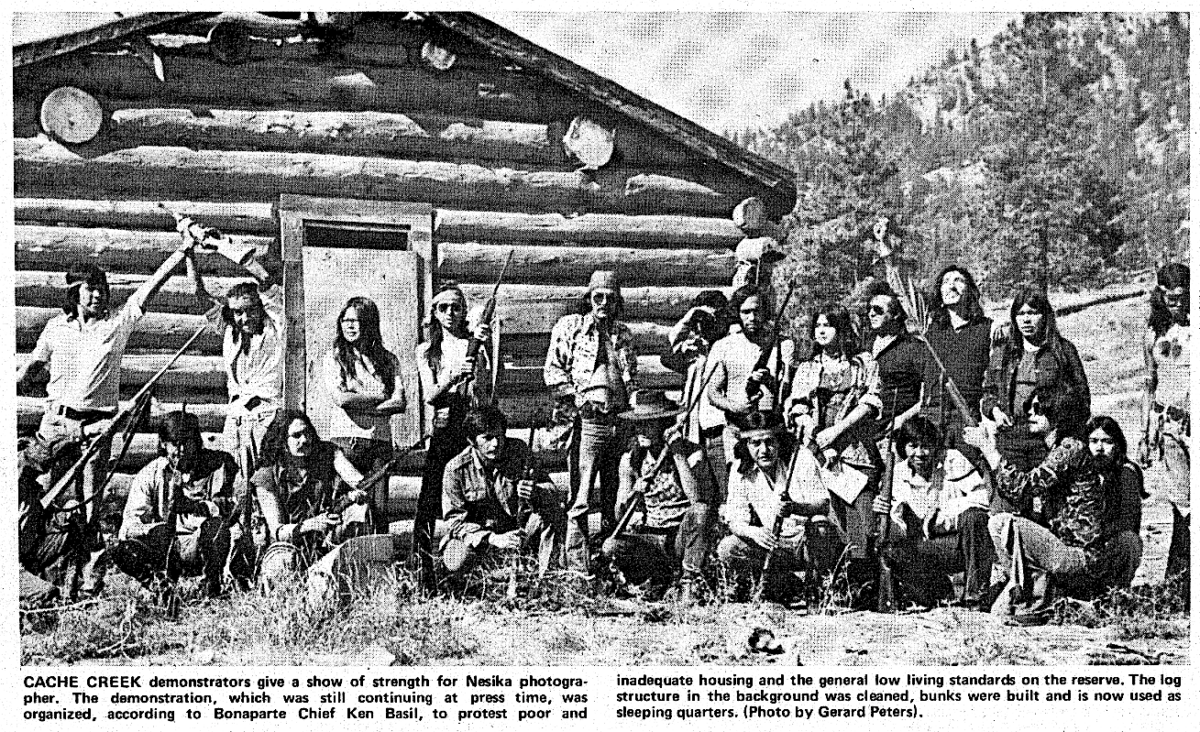
CACHE CREEK (Staff) — A visit to the camp at Two Springs on the Bonaparte Reserve revealed the occupants angered and upset by the media coverage given their armed stand.
The real issues, Ken Basil, leader of the group contends, were overlooked in favour of the dramatic. The group was concerned about how their actions would be presented to the public.
The armed blockade of Highway 12 and the demand of a $5 per-person toll hit the front page of Vancouver’s Sun and Province newspapers.
In an editorial headed “Drop the guns and talk responsibly” the Province said that “the worst aspect of the Bonaparte affair is that it seems to represent a decline from the integrity of the Indian reform movement.”
The militants say they are understanding of the view of other Indians who agree that the issue of housing is critical but do not agree with an armed stand.
Indeed, some who do not agree with the armed position taken by the camp have nonetheless been providing them with food and other supplies.
Basil has demanded that 20 houses be built on his reserve, 10 this year and 10 next. He said that the issues affecting the Bonaparte band are similar to issues facing Indians throughout the country.
Basil insists on new allocations specifically for housing from parliament so that if his demands for houses are met it would not deprive other bands whose housing situation would suffer as a result.
The government homes he describes as “fire traps built of lumber that soon warps so windows won’t open and doors won’t close. They are of inferior materials, lack insulation, plumbing, central heating and modern cooking facilities.”
In fact Basil might have been describing the house that the group is using as a headquarters.
“We have tried many ways of communicating our problems to both provincial and federal governments,” Basil adds, “but the only thing that gets any attention is the use of force.”
Also trying to communicate the need for a stepped up housing program for Indians is the National Indian Brotherhood. In their Declaration on Indian Housing (a policy paper compiled in April, 1974) they note that “As soon as the housing situation is improved, the quicker all the associated ills will find relief. Every delay in the improvement of these conditions aggravates the situation, resulting in the creation of additional problems.”
The NIB contends that a minimum of $400 million over the next five years is required to alleviate the housing situation. The publication further notes that “compared to the $727 million granted to Prince Edward Island for regional development, or to the $400 million-plus annual budget of the Canadian International Development Assistance program for developing nations, this Indian housing allotment would be no enormous sum. Only the most effective and efficient approach to the multitude of housing problems facing the Indian people will be successful.”
Chiefs of the Thompson River district which includes Bonaparte have stated that they support the Bonaparte demands but did not endorse the tactics the militants have adopted.
Forrest Walkem, chairman of the executive committee of the Union of Chiefs has said, “It’s too bad that’s happening. As far as the union and the Kamloops district council are concerned, we did everything we could to try and avoid the situation.”
“We’ve gone to Ottawa to put our housing proposals together and they’ve been failing on deaf ears.”
Members of the Two Springs camp declare that they are serious and will continue their stand until action is taken to fulfill their demands
They have demanded a meeting with newly appointed Minister of Indian Affairs Judd Buchanan on their grounds, though Basil has said he’d meet in Vancouver if he were assured safe passage without fear of arrest.
B.C. Indians Resume Highway Road Block
From ‘Kainai News: Canada’s Leading Indian Newspaper’, Standoff, Alberta, September 6, 1974
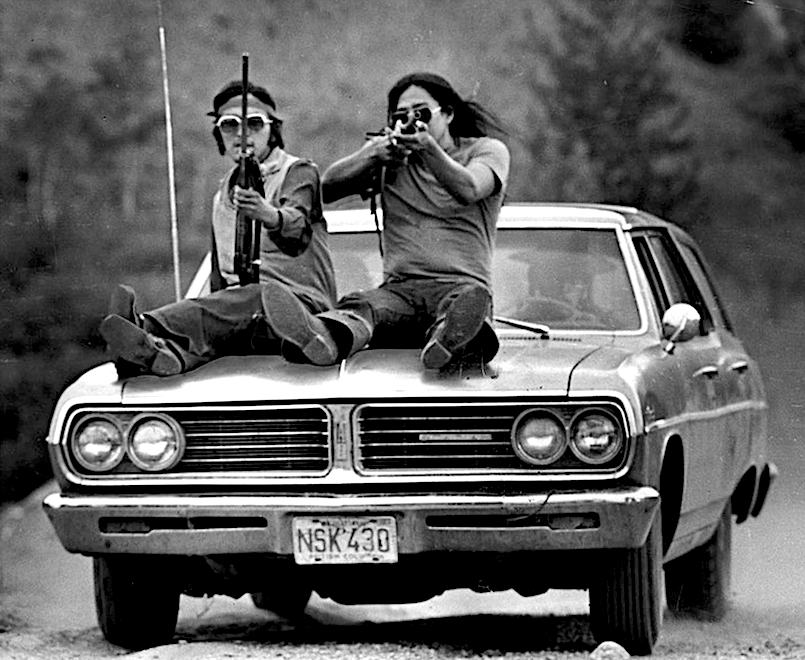 CACHE CREEK, B.C.: Members of the Bonaparte Indian Band resumed a blockade on Highway 12 thirteen miles west of here after more than two weeks delay following no action taken by the Department of Indian Affairs in meeting B.C. Indians housing demands.
Ed Burnstick, national coordinator for the Canadian Chapter of the American Indian Movement told news reporter, Cecil Nepoose from The Native People, “We have asked for legal help and we have all the reinforcements needed if anything should happen.” He said 3,000 AIM members are prepared to move into the area if called upon. Burnstick was called in to co-ordinate the blockage following a request from Chief Ken Basil of the Bonaparte Reserve.
Chief Basil’s demand asked for 20 new homes to be built on the reserve in the next two years. He said, “What we are asking is a small sum in comparison to some of the programs the government supports.”
Chief Basil said at a news conference he was willing to meet with Indian Affairs Minister Judd Buchanan in Vancouver to discuss their demands. The minister, however, refused to meet with the Chief.
Thirty Indians are now stationed at the entrance point to the Bonaparte Reserve refusing all entry by gunpoint to anyone, including the R.C.M. Police.
The B.C. demonstrators are now demanding that:
1. A native housing policy be established across Canada to meet Indian needs.
2. There be federal recognition of housing demands of Indian organizations and action be taken on these demands.
3. $400 million be spread across Canada to meet Indian housing needs within two year span instead of the proposed five years as planned.
4. A national housing committee be set up to select the housing contracts for the building of Indian homes.
5. Houses on the reserves be built according to national Housing Act standards.
6. Adequate training programs be provided to teach Indians the trade in building their own homes.
One fatality has occurred thus far, but not in relation to the blockade on Highway 12. Seventeen year old David Roberts, a Cree Indian from Moose factory, Ontario was fatally injured Thursday August 22 when a high powered rifle accidentally went off. He was among the demonstrators at Two Springs encampment, headquarters for the blockade.
In Memory of David Roberts, Cache Creek 1974, by Bert Roberts (1975)
From ‘Akwesasne Notes’, Early Winter 1975
I’d like to recollect the summer of 1974, especially the conflict at Two Springs Reserve, Cache Creek, British Columbia, and the armed road blockade of Highway 12 which runs through the reserve.
During the first takeover, the headlines in the Vancouver Sun stated, “Indian With Arms Take Over Highway”. It appealed to me deeply, knowing that my kind of people had reached that level of exhaustion.
I too was confused of all the muck-muck in the affairs of Indian people. My younger brother, Dave, and I were waiting patiently for a job putting together houses in a BCANSI [British Columbia Association of Non-Status Indians] housing program. We were to fly up north to some isolated spots where housing was needed. But the confusion in the city was running us down — we tried to pass time by inviting ourselves to Indian parties. Bars played an important part of this wasting time.
When we saw the headlines, we were pretty sick of last night’s parties. We thought of helping our brothers and sisters at Cache Creek. Messages were calling on all our people to join in the struggles at Cache Creek. Some people provided cars for transportation there. My brother and I were at the drop-in center on Nelson street when one of these messengers came to announce a car would be leaving soon.
In my thinking, I thought of Wounded Knee, which told about an Indian nation’s struggle to tell the world that they were still alive. The purpose was good and inspiring and spiritual. All this was in my mind about an armed takeover: the seriousness of it, the dedication, the ability to work as a team to make efforts, to see realistically, and so forth. Particularly in the spiritual sense, there was a need for strength and protection.
My mind could never be taken off that matter. It brought life into me. Because of the strayed path I had taken, I wanted to dedicate my life for a cause as my last desperate cry of being alive.
I thought of recent happenings back in Moose Factory, Ontario, the frustration of not being heard by my own people because I found another way to live. I guess my happiness over-thrilled me because of the revival of my spiritual sense. Also it led to the conflict of my relatives taking my younger brother with me because he wanted to back me up — he had seen the reality of what our late brother Arthur had gone through. Arthur had been led into being a peacemaker in a drunken brawl which ended up in him being shot at the top corner on the left side of the chest. He suffered a little bit before he passed to the spirit world.
All the ugliness of what my people have gone through brought a bleak picture in my mind and I wanted to cry, but I thought of facing the barrels of rifles bravely as I go down if I was to be hit — this was the chance for me to prove to the people I care of their well-being and to be heard by the ones who live so poorly as they drift helplessly with the society’s flow. Dedication was there, so my grandfathers understood my move.
When my younger brother and I were forced to flee from Ontario, I told of my ventures in the spiritual searching of finding myself. Dave was inspired. Along the way we went to our first powwow, but we saw so much commercialization. Finally, our journey across the land westward took us to Vancouver.
That was how we happened be Vancouver. I filled Dave in about the armed occupation of the highway. At the last minute, he made a decision to go. Along the way, I coached him on the situation of it, the seriousness of it all. Importantly, I told him of how warriors prepared long ago, and the stories of the deeds of younger men at Wounded Knee and the spiritual essence wasn’t left out, for without that it would be just a grudge fight for materialistic gain and nothing else.
We had only been in the camp a few days when tragedy struck.
Dave was accidentally shot through the heart by a hair-triggered rifle. He was my youngest blood brother. So innocent, but searching.
The night before, my brother and l and a sister sat around a campfire telling of past events. I was happy to see and hear my younger brother tell his part of the stories — in my thinking, he was bringing himself out more than usual. He made us laugh and practically cry throughout the night. He was good. He showed some type of leadership in that sense.
His passing made memories in my life. I really loved him. He and I were supposed to go to my teacher’s home in northern Alberta and he wanted to learn more of the Indian way of life.
Now he is up in the mountains overlooking the land. I’ll never forget the important part he played in my life. He understood. I dream of him and my other younger brother, Arthur, smiling at me. I know they are doing well in the spiritual world — I’ve been blessed by the grandfathers along with the Creator so I can see the whole purpose of it.
I stayed at Cache Creek until the well publicized Native People’s Caravan came and picked us up. You know, there was a lot of power in that caravan — grandfathers blessed us even at Parliament Hill where truth sprung up about this democratic country of ours. In every major city we entered, we were never ignored. Our aim was to bring out issues which are never dealt with at the people’s level.
All these proceedings I let dwell in me because of my belief. I knew suffering. I knew what every Indian family has experienced. I let it flow in me. Everyone had purpose in that caravan.
These things are of grave importance to me and to the coming of the purification of this earth. Sure, our people will suffer. Sure, someday we’ll reach our freedom. Sure, we’ll be together someday with the forces of nature. Be strong in the faith in the Creator — this strength will give us hope and the dirty part of us will be washed away so that once again we can have a clean living.
My father, James Roberts, and my older half-brother Roy, and my younger sister, Judy, and I hope to travel back to British Columbia to pay respects to our David. Any financial help to make that journey a reality will be appreciated by us.
Pray with we as we visit our late brother, David Roberts.
Bert Roberts
c/o Roy Quachegan
Moosonee, Ontario, POL 1YO
Also
Frank Clearwater and Buddy Lamont Killed at Wounded Knee, by Akwesasne Notes (1973)
Wounded Knee: The Longest War 1890-1973, from Black Flag (1974)
The Truth About the Anicinabe Park Occupation of 1974, by Linda Finlayson
Manifesto of the Native Peoples’ Caravan (1974)
Maria Campbell’s speech to the Native Peoples Caravan in Toronto (1974)
Anicinabe Park Occupation 1974: Interviews with Two Warriors (1976)
Standing Tall and Free, by Theresa Nahanee (1976)
The Brave-Hearted Women: The Struggle at Wounded Knee, by Shirley Hill Witt (1976)
The Red Path and Socialism, by ᐊᓯᓂ Vern Harper (1979)
Whose Land is It? – Interview with Wolverine (1997)
Secwepemc History of Resistance, by M.Gouldhawke (2005)
(PDF) B.C. Native Blockades & Direct Action – from the 1980s to 2006, by Warrior Publications
The 1995 Standoff at Ts’Peten, by Warrior Publications (2011)
