
From ‘Freedom: Anarchist Fortnightly’, May 29, 1948, London, UK
(From a Middle East Correspondent)
With the ending of the British mandate in Palestine comes the declaration of a Jewish State, to be known as Israel. The new State adopts intact the laws left by the old administration, with the exception of the control of immigration set out in the White Paper of 1939. It struggles to achieve national sovereignty, it transforms the Haganah into an Army, it legalises its own police, it has an organized religion to form an “Established Church” — in fact, none of the ingredients of Statehood are missing. All one can ask is what advance this represents?
Those who now pin their illusions on this newest amongst the States will, if they survive the present conflict, live to see yet a fresh illusion smashed. The survivors of the Irish 1916 rebellion who later declared with joy the establishment of the State later known as Eire, saw the steady decline of the dream of an Irish Republic. The Italians who fought with Garibaldi to form an Italian Republic saw — some of them — its steady decline through monarchy to fascism. Nationalism and Statehood have never brought freedom.
If any gleam of hope has ever been seen amongst the Zionist experiment, it was the fact that many colonists were able in their early days of struggle to dispense with the State and live their life without reliance on any central authority until their nationalism or religion got the better of their natural instincts.
There is only one difference between this national revolution and any others. The State of Israel proclaimed for the first time since Old Testament days cannot claim that all are present or that it has the support of any Jews other than “the Jewish people in Palestine and the Zionist movement of the world” as its inaugural proclamation stated, thus admitting to “the lost tribes of Israel”, namely, the non-Zionist Jews throughout the world, most of whom (possibly the majority of Jews) are completely assimilated save for religious customs they may or may not observe, and the clearest thinkers of whom are completely internationalist in their outlook.
Latest Socialist Premier
The Government set up in Israel is a victory for the social-democratic movement, whose stock was thought to be declining. The key posts are all in Socialist hands, and David Ben-Gurion becomes the latest Socialist Premier. The President is Dr. Weizmann, who, although not a Labour Party man himself, does in fact register a big victory for their policy in view of the hatred felt for him by the Jewish Fascist Party (I.Z.L.) as well as the opposition to him by the Revisionists and orthodox religious parties, in fact by all who supported either the American or Russian dominance and opposed Dr. Weizmann’s consistently pro-British policy, which is the line of the Labour Party and Labour Federation as well as of the Haganah which now becomes the official Jewish Army.
Forgotten Men
The Arabs have not declared a Government; they are in fact the forgotten men of Palestine, and nobody at present even pretends to represent them. The foreign Arab armies are doing that for them. The complete collapse of the Palestine Arabs is due to various reasons. The Mufti was foisted on to them by the Arab Higher Committee which was as obsessed by his “great name” as the British Conservative Party was by Churchill’s in 1945. In fact, the feudal Husseini family is not popular, and the Mufti’s pro-Nazi support during the war lost him most of the support he had before it; also he could not stand up to the rival claims of men like Abdullah. No Palestine Arab dared to oppose him openly before the fighting began, but when it started his name was not sufficient to evoke support.
The military hope of the Palestine Arabs was Fawzi Kawukji — a noted terrorist but conditions now are open warfare and he failed as a soldier. Moreover he, more than any other leading Palestine Arab, is hated by the other Arab kings and rulers.
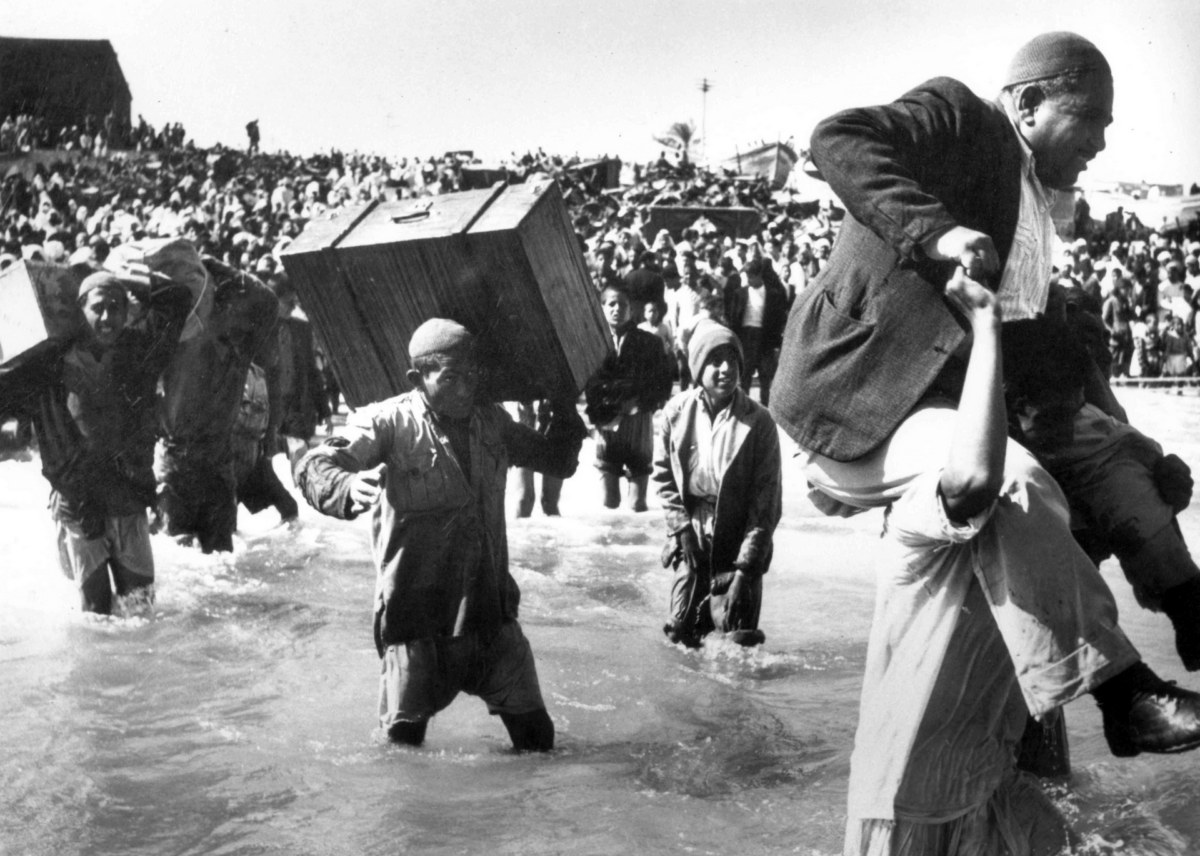
Many Palestine Arabs feel that whoever wins, they lose, and this may explain the frenzied rush to leave Haifa to the Jews, get out of Jaffa at any price, and to surrender Acre while new rifles were left unpacked. These places were defended by Palestine Arabs. The only advances made have been by the invading Arab armies, amongst which only the British officered, British supplied and British trained army of Transjordan has made any show.
King Abdullah is Whitehall‘s own little king. What game Mr. Bevin is playing with Adullah is not yet known. It may be that he hopes to enforce partition between puppet King Abdullah, who will be pro-British (or else!) and pro-British Jewish leaders such as Weizmann and Ben-Gurion. Thus, whoever wins, the Foreign Office has won. But this is a dangerous game as it may mean the coming to power of the Jewish Fascist movement (I.Z.L.) which would just as soon have relations with Russia. Hence Truman‘s immediate rush to recognize Israel before Russia had a chance to, and one of the reasons (other than Zionist electoral pressure) why he will keep on more or less supporting the Zionists, but not so much as to alienate the Arab rulers on whom American capitalism depends for oil.
Sitting on a Volcano
The Arab countries, other than Transjordan, have not distinguished themselves in the invasion. None of the governments really welcomed this war, but they were too committed to it to back out, and further, they did not dare face popular repercussions at home where the war is popular because it is against “the foreigner”, and in an Arab attack on the Jews the man in the street can visualize an attack on the British, the Americans, the Russians and more particularly Greeks and Armenians and every other well-to-do foreigner in Alexandria and Cairo. Basically they think of it as a war against the West. War does not strike them as particularly tragic, since World War II brought nothing but high wages in military establishments, plentiful work, and a big influx of soldiers and a stimulus of trade.
Nobody in the Arab world has any idea of war, other than the completely uninfluential people who inhabited the desert in which World Wars I and II were conveniently fought out. But a long war would bring disillusion, bitterness, and bring to a head the long smouldering discontent of the fellaheen against the Governments and the “effen-din“, for which anti-foreignism is only a temporary substitute.
Hope for the Future
On the Jewish side a long war would have the reverse effect; it would strengthen the reactionaries by the continual appeal to nationalism, and also the fact that anti-British sentiment arising out of the subsidy to Transjordan would be grist to the mill of the Right. The Socialists are far less rigidly nationalistic and, amongst them and in some of the left groupings, there is much more intelligent understanding of the Arab position, and also of the whole question of national sovereignty and statehood.
If the totalitarian state did not triumph, they might in later years have some considerable social significance. The League for Arab-Jewish Rapprochement may have difficulty in functioning but it has pioneered this idea of a libertarian approach.
There are in fact three different aspects of hope for the future. One, the possibility of revolutionary discontent in the Arab countries arising out of war causing the reactionary governments to over-topple. Two, the rejection of the idea of national sovereignty by some Arabs and Jews who have an intelligent idea of how to live together although for the moment they are silenced. Three, the fact that the Jewish people outside Palestine have, except for the Zionists, rejected the idea that the state of Israel belongs to them (the Jewish Socialist Bund, influential in many countries, has rejected the idea of Zionism altogether).
So, in spite of the weariness yet one more war induces, at least some hope for internationalist principles may be held in this case.
Also
Cinema, Revolution and Popular Education, by Viviane Saglier (2026)
The Capitalist’s Kibbutz, by Sam Adler-Bell (2020)
A Colonizing Anarchism, by JJ (2020)
(Zine) An Anarchist on Palestine, by Albert Meltzer (1939-1996)
The Cairo Mutiny; Bounty on the Mutiny, by Albert Meltzer (1996)
Palestine’s Struggle, from FighT bAck (1975)
(Zine) The Class Nature of Israeli Society, by Haim Hanegbi, Moshe Machover & Akiva Orr (1971)
Settler Colonialism in Southern Africa and the Middle East, by George Jabbour (1970)
Inevitable War in the Middle East, by Albert Meltzer (1968)
Zionist Colonialism in Palestine, by Fayez A. Sayegh (1965)
Les Kibboutz en Israël, de Socialisme ou Barbarie (1960)
A Time For Shame and Atonement, by Third Force (1956)
Chaim Weizmann and Israel, by Albert Meltzer (1952)
Military Adventure in Kenya, by Albert Meltzer (1952)
Palestine, by Albert Meltzer (1948)
Malaya, by Albert Meltzer (1948)
Middle East Notes: Civil War, from Freedom (1948)
Fine Day For The Race, by Albert Meltzer (1947)
Zionism, from War Commentary (1944)
National Independence, by Albert Meltzer (1942)
Our Policy, by Albert Meltzer (1942)
Palestine and the Jews, by Albert Meltzer (1942)
Anarchist Tactic for Palestine, by Albert Meltzer (1939)
The Arab and Jewish Ordeal in Palestine, by Marcus Graham (1936)
National Atavism, from Mother Earth (1906)
Some Early Anarchists on Zionism: From Bernard Lazare to Emma Goldman (1899-1939)
Anarchists & Fellow Travellers on Palestine
Anarchists on National Liberation
Anarchists & Indigenous Peoples
Albert Meltzer texts and photos at the Kate Sharpley Library
