
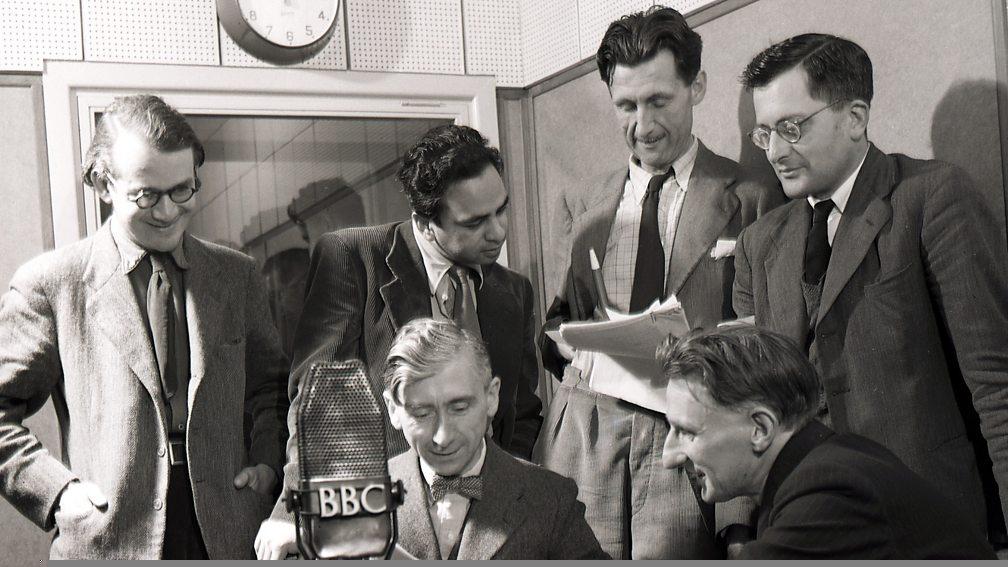
George Woodcock, Mulk Raj Anand, George Orwell, William Empson, Herbert Read and Edmund Blunden, 1943
Almost exactly half a life ago I wrote my first book on anarchism, Anarchy or Chaos [1944]. In many ways it was a naive book, and a few years afterwards I was so embarrassed with what, in my mid-thirties, seemed its juvenility, that I insisted on withdrawing it from publication. At sixty, I have returned to it, and, like my old friend Herbert Read considering the revolutionary writings of his youth, “I now envy those generous occasions.” Much in Anarchy or Chaos belongs merely to its decade but there are parts which, with a little rewriting, I still find worth reading, and it is as a mosaic of some of these redeemable fragments of the past that this essay emerges. I still believe in general terms what it says.
Politically, modern society is based on the system of government; economically, on the system of property concentrated in the hands of the few. Its political manifestation is the state; its economic manifestation is the capitalist system of production. Its tendency is centripetal, so that political power becomes more and more concentrated in the state, and economic power tends to progress from the system of many small capitalists to monopoly capitalism, which in its turn becomes state capitalism.
So the totalitarian state is achieved by the coalescence of political and economic power in the same body. But this identity of the state and capitalism is no new thing. For the state may be regarded as the translation into social terms of the economic form of society. It serves as the executive instrument of those who, by virtue of the economic power conferred by property, are the real ruling class of a country. And as property comes, through the growth and amalgamation of large business trusts, under the effective control of a class which grows progressively smaller and smaller, so the state itself becomes more and more concentrated until the apparent parallels of political and economic life meet in the totalitarian state.
Anarchism, which presents the extreme opposition to this contemporary development, is not a creed of terror and destruction, of social chaos and turmoil, of perpetual war between the individuals within society; it is not nihilism. On the contrary, it is the opposite of all these; a doctrine based on the idea of natural order within society, and of peace between individuals who respect their mutual freedom and integrity. It is the faith of the complete man, growing to fulfilment through social, economic and mental freedom. It is a social philosophy of individual aspirations.
Anarchism is the only logically complete doctrine of freedom, because it denies all external authority, all domination of man by man. It proclaims the sufficiency of the individual human mind and spirit, and the inborn tendency of men towards peace and cooperation when their natural feelings have not been twisted and frustrated by the oppression of authority.
Socially, anarchism is the doctrine of society without government. It teaches that the major economic and social injustices are intimately associated with the principle of government, which inevitably, in whatever form it takes, creates privilege, and a class hierarchy, and however much it may call itself democratic, must base itself on the coercion of the individual, at best to the will of the majority, most often that of the governing minority.
An authoritarian society — and every kind of society that bases itself on government is, in virtue of that fact, authoritarian — cannot survive if it does not create a governing class and a series of gradations of responsibility in its hierarchy which must inevitably destroy all forms of equality, whether of wealth, status or opportunity. The governing class, once created, will tend to harden itself into a caste and to gather to itself privileges which give its members substantial advantages over the other members of society. These privileges will first be granted in the name of expediency, but will be continued as a usurped right. Though rulers may set out with the most sincere intentions, the very necessities of maintaining the power they hold will force them to injustice, and the privileges they obtain will accomplish their inevitable corruption. The evidence of history on these points is unvaried.
True democracy cannot exist outside the imagination in a society based on coercion. Yet, even were democracy possible, the anarchist would still not support it, for democracy puts forward the will of the majority as the supreme law, and declares that society must be governed, and the individual, whether he agrees or not, be coerced by that will. Democracy, then, is not based on freedom and differs only in degree from despotism in its negation of the individual. To the individual whose life is frustrated by the law of the state, it does not matter whether that law is the will of one man or the will of a million. What matters to him is that through its existence he is not free and therefore cannot become complete.
The anarchist seeks neither the good of a minority, nor the good of the majority, but the good of all men considered as individuals. He believes that a society based on the great super-individual myth of the state must in the end enslave all its members in the interests not even of the majority but of the privileged few who form its ruling class. Anarchists have often been upbraided as impractical visionaries for their denial of the institution of government. But they contend that impracticality belongs to those who, in the face of the irrefutable historical verdict, still believe that some day a form of government will appear which will not involve the exploitation of the ruled and the corruption of the rulers. These attributes are as natural to government as venom is to the viper.
All anarchists believe that the institution of government and the state and all other coercive instruments of administration should be abandoned, and many believe they can only be ended by the direct action of the oppressed. This destructive side of anarchism has received undue prominence among its enemies and among some of its more irresponsible friends, and has given rise to certain misconceptions, some frivolous and some serious, which have been fostered deliberately by those in authority.
Of the more frivolous is the idea that the anarchist is a man who throws bombs and wishes to wreck society by violence and terror. That this charge should be brought against anarchists now, at a time when they are among the few people who are not throwing bombs or assisting bomb throwers, shows a curious purblindness among its champions.
It is true that a few individual anarchists have in the past, and particularly during the last two decades of the nineteenth century, used the weapon of terrorist assassination as a means of carrying on the social revolution. Some anarchists, therefore, certainly have thrown bombs. But so, also, have members of other political groups, and so have governments. And the difference in responsibility lies in this, that while the bombs thrown by anarchists killed those who were considered guilty of the oppression and murder of their subjects, the bombs thrown by governments in war can be numbered in their millions and have slain hundreds of thousands of men and women innocent of crime against their fellows. And it must be remembered that the practice of individual terrorism was virtually abandoned by the anarchists some forty years ago, when the advent of anarchist syndicalism opened up the possibility of the more satisfactory tactic of revolutionary mass economic action.
The anarchist believes that a political or governmental organization of society is incompatible with justice and liberty. He contends that society should be based on the free cooperation of individual men and women in fulfilment of their common functional and economic needs.
Here we reach a second and more serious misconception concerning anarchism, which has arisen among many people with a superficial knowledge of the movement; that anarchism is individualism carried to its extreme conclusion, and therefore admits of no organization of society. A certain support would appear to be given to this notion by the fact that a few anarchist intellectuals have preached this extreme form of individualism by which a man would live independent of all ties with his fellows and concern himself solely with the development of his own personality and his own happiness.
Where, however, anarchism has existed as a social movement, its exponents have always envisaged the necessity for organization, but a free organization rising organically from the needs of man. Anarchism does indeed preach the freedom of the individual man, but freedom cannot be isolated in society. An individual’s freedom is reciprocal, depending on the freedom of others, and therefore anarchism teaches that the concept of justice is as necessary as the concept of freedom, for without justice there can be no true freedom, just as without freedom there can be no real justice.
Furthermore, work in common achieves more in a shorter time than solitary work, and a sane division of labor provides both plenty and leisure where otherwise a man dependent on his own two hands would have to toil all his hours for a miserable standard of life. But the benefits of common work and common life cannot be enjoyed in full measure if the vital functions of production are not organized by the people who perform them.
This necessity for social organization has been argued by those anarchist theoreticians who have refuted the contentions of the ‘pure’ individualist anarchists. In 1872 [*] Michael Bakunin, the founder of the historic anarchist movement, wrote the following defence of participation in the First International:
To whomever might pretend that action so organized would be an outrage on the liberty of the masses, or an attempt to create a new authoritarian power, we would reply that he is a sophist and a fool. So much the worse for those who ignore the natural, social law of human solidarity, to the extent of imagining that an absolute mutual independence of individuals and of masses is a possible or even desirable thing. To desire it would be to wish for the destruction of society, for all social life is nothing else than this mutual and incessant dependence among individuals and masses.
All individuals, even the most gifted and strongest, indeed most of all the most gifted and strongest, are at every moment of their lives, at the same time, producers and products. Equal liberty for every individual is only the resultant, constantly reproduced, of this mass of material, intellectual and moral influence exercised on him by all the individuals around him, belonging to the society in which he was born, has developed, and dies.
To wish to escape this influence in the name of a transcendental liberty, divine, absolutely egoistic and sufficient to itself is the tendency to annihilation. To refrain from influencing others would mean to refrain from all social action, indeed to abstain from all expressions of one’s thoughts and sentiments and simply become non-existent. This independence, so much extolled by idealists and metaphysicians, individual liberty conceived in this sense, would amount to self-annihilation.
In nature, as in human society, which is also part of the same nature, all that exists lives only by complying with the supreme conditions of interaction, which is more or less positive and potent with regard to the lives of other beings, according to the nature of the individual. And when we vindicate the liberty of the masses, we do not pretend to abolish anything of the natural influences that individuals or groups of individuals exert upon one another. What we wish for is the abolition of artificial influences, which are privileges, legal and official.
This extract represents the attitude of most militant anarchists. They accept the voluntary limitations necessary for reciprocal freedom; what they do not accept are the limitations imposed from above by coercive bodies such as the state.
Instead of accepting the government of men, the anarchist wishes, in the words of Saint-Simon, to base society on the administration of things. It is on the economic plane alone, in the necessary production of goods consumed by men and in the provision of necessary social service, that he sees the need for organization, not from above but on a voluntary and cooperative basis, among the individuals whose work actually produces the necessities of a civilized life.
From this point the anarchist proceeds to the contention that the functions of the modern state, represented by its paraphernalia of legal codes, bureaucracy, army, and police, would be unnecessary in a society where common ownership had ended privilege and social-economic inequalities. All these appendages of the modern state are intended ultimately not for the well-being of all men and women, but for the protection of the ruling class and the property by whose virtue it rules. In a society without inequality of property, where every man’s needs were satisfied, there would be no incentive to crime, except among the pathological, who in any case are no subjects for prison or law courts.
Where property rights had vanished there would be no need for codified laws. Customs and not regulations are the natural manifestations of men’s ideas of justice, and in a free society customs would adapt themselves to the constant growth and testing of ideas in that society. Under a society of anarchy every man, once he had fulfilled his economic functions, would be free to live as he liked, provided he did not interfere with the lives of his fellows. A free people could be relied on to see that peace was maintained under such circumstances without the need for police or for magistrates.
The economic ideas of the anarchists have found a concrete expression in anarcho-syndicalism. Anarcho-syndicalism is both a technique of social revolution and a theory of the organization of a free society after that revolution. It advocates the organization of workers under capitalism in voluntary economic organizations, the syndicates, which differ from trade unions in being controlled directly by the workers themselves and in having as their purpose, not the winning of reforms under capitalism, but the achievement of radical social change by economic means.
The withdrawal of economic cooperation, in the form of the general strike, is the basis of the anarchist conception of the revolution, and in this economic struggle the syndicates would play the vital role of uniting the efforts of the workers. After the social revolution the syndicates would be the basic units of the network of economic and functional bodies intended to organize the satisfaction of the common needs of men and to replace the system of administration by authority and coercion.
Anarchism, it must be emphasized, is not a static and unchangeable social system. It is rather a dynamic philosophy which recognizes the importance of evolution in human society, and the consequent futility of any attempt to plan social advancement on rigid lines.
The anarchist, therefore, deprecates the idea that a just revolution can be planned and carried out through the seizure of power by a disciplined party organization. Instead he contends that the social revolution can arise only out of the spontaneous movement of the people against their rulers, and that in any ensuing struggle the role of the revolutionary would be to maintain in the minds of men the nature of the goal for which they strive. The anarchist may preach freedom, but he considers that the people must take it for themselves.
In the same way, although many anarchists consider syndicalism a practical means of organizing society after a hypothetical revolution, they recognize that it may not present a perfect social pattern. Indeed, they envisage no static blueprint of a future world. For, when men have been freed from social and economic oppressions, the evolution of human institutions will undoubtedly attain forms we cannot conceive. Proposals for future organization must not therefore be regarded as permanent and hence dead, but as the bases of future social evolution.
The anarchist does not expect to achieve a society without flaw. But he does think that anarchism offers the only possibility of a society based on freedom and justice, which will function efficiently and produce a degree of spiritual and material comfort far higher than most men enjoy today. Anarchism may seem utopian to those who are embittered by the corruption and injustice of modern society. But, as Oscar Wilde said, “Progress is the realization of Utopias.”
Anarchists do not advocate political freedom. What they do advocate is freedom from politics, freedom from the institution of government, freedom from coercion, freedom from the law’s interference in the lives of individual men and women, freedom from economic domination and inequality. The last is perhaps the most important, in that economic freedom, the satisfaction of man’s physical needs for food, clothing, shelter, and all the other material needs of a civilized life, is necessary before any man can begin to be free.
By the elimination of property, vested either in individuals or in corporate ruling classes, by the destruction of the state, by the substitution, for a society based on the mechanical and artificial institutions imposed by the dictates of property and governing interests, of a society based on institutions rising organically from the needs of men, the anarchist sees the need for the suppression of individual freedom brought to an end. Only a society based on control from above has need of coercion. A society based on cooperation can do without oppression and restriction because it is based on voluntary agreement among its members. Indeed, it must do without coercion, if it is to retain its cooperative basis, and avoid relapsing into a political institution controlled by a governing cabal.
Freedom is as much a necessity for society as it is for the individual men and women who comprise it. Restrictions on liberty naturally produce oppositions within a society. No political unit in the history of civilization has existed without carrying within itself the disruptive forces of discontent — precisely because no political unit has existed which did not base itself ultimately on the ability to force the individuals within it to obey the will of the controlling elements.
On the other hand, social units operated by cooperative and voluntary means have often succeeded in surviving over long periods without destructive internal strife. Their failure has resulted either from the attack of overpoweringly strong external forces or from the cooperative units themselves adopting the authoritarian pattern of external political bodies. (The decline of the English trade unions to the position of subordinate institutions of the state is a notable example of the decay of an originally cooperative institution which adopted a centralized authoritarian pattern.)
An examination of history, the real history of concrete human achievements and institutions as against the semi-mythical history of political institutions, shows that the development of the corporate and individual achievements of men is strongest and assumes its most significant forms in periods and places where political organization is weakened and least centralized. The vitality of human culture appears to run in inverse proportion to the strength of the state. Periods of political stabilization, when authority is held firmly by an efficient centralized government, when the state is deified and the free action of the individual is impeded, are most often periods of sterility, both in the development of organic institutions and the cultural achievements of individual artists and scientists.
Times of political disintegration, when social forms are in flux, when the power and efficiency of the government are weak, when the state is regarded lightly and the individual finds room and freedom for development, are periods of institutional and cultural growth. One need only compare Sparta with Athens, the Italy of Mussolini with the Italy of the Renaissance.
Note
Woodcock’s quote of Bakunin circa 1872 appears to be lifted from Malatesta’s ‘Anarchy’, specifically the 1900 English translation by Free Society. The Bakunin text quoted was written in 1871 and first published in 1872 in the Almanach du Peuple under the title ‘Organisation de l’Internationale’ and later re-published in 1913 under the title ‘Protestation de l’Alliance’ as part of Vol. VI of Bakunin’s Works in French, edited by James Guillaume.
-Ed., 2026
Also
War and the State, by Mikhail Bakunin and James Guillaume (1870)
Protestation de l’Alliance, 4-24 juillet 1871, par Michel Bakounine (1871/1872)
Anarchy, by Errico Malatesta (1891/1900)
The Durruti Column Responds to the Militarization Decree, by Buenaventura Durruti (1936)
For Anarchism, by War Commentary (1941)
The Future of the Proletariat, by George Woodcock (1942)
The Tyranny of the Clock, by George Woodcock (1944)
George Woodcock: A Muddled History of Anarchism, by Sam Dolgoff (1963)
Gabriel Dumont, by George Woodcock (1975)
George Woodcock, di Alfredo M. Bonanno (1995)
Durruti in the Spanish Revolution, by Abel Paz (1996)
George Woodcock, by BC BookLook (2016)
George Woodcock texts at the Anarchist Library
George Woodcock texts at Libcom
George Woodcock texts at the Kate Sharpley Library
Anarchists & Fellow Travellers on Palestine
…Gentile Canadian anarchist George Woodcock in 1947 (Freedom: Anarchist Fortnightly, Oct.18, 1947) naively described the Zionist kibbutz movement in Palestine as sharing principles with anarchists. He abstracted away from the funding of the movement by Western imperialists and the garrison role of kibbutzniks in the military defense of the greater settler project. Woodcock also reiterated the same Zionist/Lockean myth of settlers making the desert bloom as [Emma] Goldman had before him….
-Ed., Jan. 2026
For more on the kibbutz:
The Capitalist’s Kibbutz, by Sam Adler-Bell (2020)
