
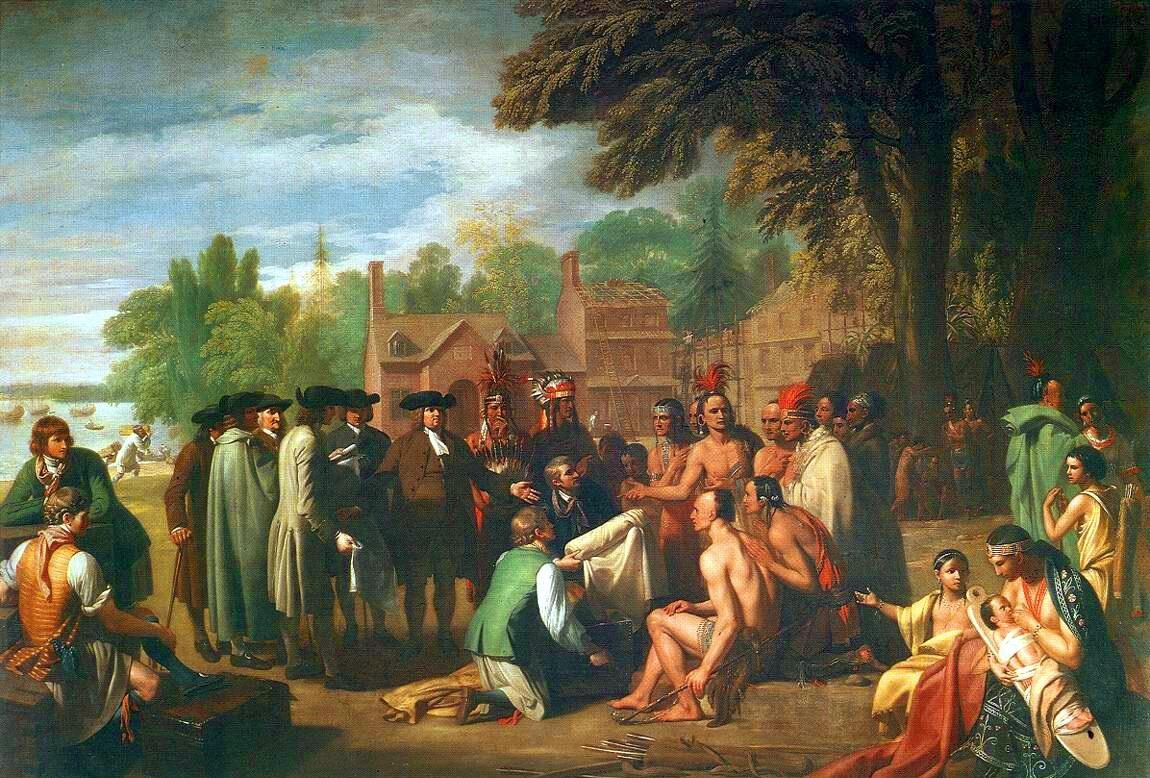
Penn’s Treaty with the Indians, a 1772 portrait by Benjamin West
From ‘The Liberator: Our Country is the World, Our Countrymen are all Mankind’, July 6, 1838, Boston, edited by William Lloyd Garrison
DEAR FRIEND: — Once have I spoken — again I ask to be heard. I am overwhelmed with a view of the injustice of my country to the suffering Indians!
‘The voice of our brother’s blood, crying from the ground,’ has come up as a memorial before me. I need not recur to the early settlement of our country, I need not trace the duplicity and fraud, with which our government and people have continued to oppress, to harass, and exterminate these rightful inheritors of our soil. Their history is before the world. And it is a melancholy reflection, that whole nations, powerful tribes of Indians, have gone down into forgetfulness, have become extinct, annihilated, before the oppressions of ‘the white man.’
Was there anything which rendered it impossible for them to have remained with us, to be partakers of the rich bounties and blessings of Heaven? We have heard much of the cruelties of the Indian. Who was the aggressor? Never was there before this nation a subject fraught with such immediate consequences to a portion of our fellow-beings, as is this of the Cherokee Indians.
Passing over the condition of the peeled and scattered tribes among us, and the harassed state of those upon our western frontiers, allow me briefly to allude to the distressing circumstances attending some of these nations. Already has our government expended an immense amount of treasure and of blood, in a harassing and exterminating warfare with the Seminoles. And what was the cause of their hostility?
Our countrymen demanded of them their soil, which, when they were unwilling to give, by force or by fraud, was sought to be obtained. Pretending that some of their number were fugitives from justice, when they had fled from the strong arm of oppression, to find freedom and safety with their more humane and hospitable brethren of the wilderness, our people demanded them and their children, to make them our country’s slaves. Driven to desperation, they sought the security of their own lives, by taking those of our fellow-countrymen.
It has eloquently been said, we have solved the great problem, ‘Can the Indian weep?’ When the last effective blow was struck, and they looked for the last time upon the graves of their ancestors, aged men and stern warriors, untaught to shed the tear of grief, ‘placed their hands upon their faces and wept like children.’
In the winter of 1836, 17,000 of the Creek Indians were removed beyond the Mississippi by contractors, who, it would seem, cared not so much for the convenience and lives of the Indians, as for the gold of the government. They were driven in an inclement season of the year, poorly fed, poorly clothed, and their naked feet left footprints of blood upon the frozen soil; while the aged, the infirm, and the sick, were left by the way-side, and in the wilderness to die.
In the summer of 1837, 600 Indians were transported up the Mississippi, on a vessel which was considered unfit for any other purpose. By an explosion of its boilers, 300 of them were made the victims of sudden death, and their survivors left to lament their loss.
And who are these Cherokees, who have come before our country and the world with their affecting ‘Appeal?’ That document for itself can answer. There have they erected a monument to the injustice of our country, which will remain through coming time. They are the civilized remnants of a once powerful nation. They have built houses; they have planted fields; they have erected school-houses and places of worship. Many of them have embraced the Christian’s hope; and ‘after their manner, so worship they the God of our fathers.’ All this has not secured to them the rights of men.
They must, almost unremunerated, be driven from their congenial soil into an uncultivated region; there to resume the habits of savage life, and thence again, when it shall suit the cupidity of our government, if they do not miserably perish, to be removed still farther into the wilderness.
How eloquently appropriate were some of the replies of the Seneca Chiefs, in the year 1790, to George Washington, on a similar, but far less distressing occasion!
‘Father, — You have said that we were in your hand, and that by closing it you could crush us to nothing. Are you then determined to crush us? Before you determine a measure so unjust, look up to God, who made us as well as you. We hope he will not permit you to destroy the whole of our nation. Father, — We will not conceal from you, that the great God and not men has preserved the Corn Plant[er] from the hands of his own nation. For they ask continually, Where is the land on which our children and their children after them, are to lie down upon? He is silent, for he has nothing to answer.
When the sun goes down, he opens his heart before God; and earlier than the sun appears upon the hills, he gives thanks for his protection during the night; for he feels that among men, become desperate by the injuries they sustain, it is God only that can preserve him. He loves peace, and all he had in store he has given to those who have been robbed by your people, lest they should plunder the innocent to repay themselves.
Father! Innocent men of our nation are killed, one after another, and of our best families; but none of your people who have committed these murders have been punished. These are to us very great things; we know you are very strong, and we have heard that you are wise; we shall wait to hear your answer, that we may know you are just.’
It is known that the agents of our government, failing to induce the Cherokee nation to sign away its right to the soil of its ancestors, framed a treaty, and bribed a few of these Indians to acknowledge the spurious contract. This the government has determined to consider binding upon them, while almost the entire people have twice solemnly protested against the validity of that instrument, and, under former treaties, ineffectually prayed for protection.
Being oppressed by the people around them, and knowing they can neither safely remain, nor, without endangering their lives, be removed by Government, more than 15,600 of them have come a third and last time to their only earthly tribunal, again to protest against the enforcement of that unjust treaty; again, in the name of justice and humanity, before the world, and in the presence of the Supreme Ruler of the universe, to ask protection.
Their urgent request has been again coldly rejected, in the face of our most solemn treaties with them. And these sufferers, when even upon their own soil, they can no longer ‘find a resting place for the soles of their feet,’ still hoping against hope, still trusting in the justice of this nation, still confiding in the righteousness of their cause, still relying upon the Divine Arm for deliverance and protection, these nearly 18,000 men, women, and children, have lingered around the graves of their fathers, unresistingly to suffer or to die! But the vials of this nation’s wrath are not yet fully poured out upon them. It is written on the records of our country with a pen of iron, and might I not add with the Indian’s blood, and it will not be erased, that their lives shall be the forfeit if they will not submit!
Already garrisons are stationed, and troops quartered amongst them, while a powerful army is in motion to enforce the conditions of that faithless contract, and take possession of their country. And it may be, that while we are pleading for them, our countrymen are conducting the fearful work of extermination and of death. Can there be found in the annals of the world, more than a parallel of this high-handed injustice and cruelty?
Under a view of these appalling facts, can Abolitionists — can Christians innocently remain silent? While they do not
forget their ‘sable brethren’ in bonds, have not their red brethren claims upon their sympathies! Ought they not to speak into the ear of this Republic in language it would hear, and more forcibly appeal to their fellow countrymen on behalf of these highly injured and too much neglected children of our great Parent; that if possible, they may mitigate the sufferings of the oppressed remnants of the Indian race, and yet a little longer, stay the uplifted arm of justice, which is fearfully impending over our highly favored, but greatly erring country?
I ask thy indulgence. My heart is full. I have remembered the treaty of William Penn with the Indians; of which Voltaire justly said, ‘It was the only one that was not ratified by an oath, and was never broken,’ but was to remain with binding force, so long as the sun and the moon should endure: and is still written, though not upon parchment, far more enduringly, in the living hearts of them and us. This was his beautiful and appropriate language. This the only great binding oath of that instrument.
‘I will not call you children; for parents sometimes whip their children. I will not call you brothers; for brothers sometimes quarrel. But I will call you, bone of my bone, and flesh of my flesh; for the great God made both us and you.’
I have not forgotten, that our fore-fathers, driven from their homes by the strong arm of persecution, a by word and a proverb among the nations of the earth, sought, over the waters of the ocean, an asylum in this western world. I have not forgotten, that the ancestors of these suffering people most hospitably threw open to us the doors of their wilderness; granting that protection we could not find under the government of a Christian king; entertained us as strangers from another world, who, under the guidance of the ministering angel of peace, had come to mingle with, and to bless them. And it cannot be, that when we have been taken up from the prison-houses, and have come to sit with honor among the nations, we should forget any of our suffering brethren, still confined in the prisons of affliction, or in the hopeless dungeons of despair.
What would a Woolman — what would a Benezet — what would the Founder and Lawgiver of Pennsylvania say, were they survivors to witness the injuries heaped upon their ‘red brethren!’ To see this brand of INFAMY, still standing out on the FOREHEAD of this GUILTY NATION in the face of the whole civilized world! But ‘the dead cannot speak!’ and, as the representatives of these great and good men, are we bound to plead the sufferer’s cause.
Others may be silent — we should speak; that, when this Republic shall be visited for its sins, we may be guiltless of the blood of these innocent men. We must speak — that we may redeem the pledge, made by our fathers, to them before the world, that we would remain the friends of the Indian while the sun and the moon should endure.
We will speak — that when they shall be driven wanderers into the wilderness, they may there be cheered and sustained, in their sufferings and their exile, by the prayers and — sympathies of the followers of William Penn.
Thine for the oppressed,
A FRIEND.
Note on Settler Fraud (2026)
Although William Penn did not break his 1682 Treaty with the Lenape/Delaware, two of his children did with their 1737 scam operation known as The Walking Purchase.
In 2006, the United States Court of Appeals for the Third Circuit rejected the Delaware Nation’s appeal regarding that scam and upheld that aboriginal title can be validly extinguished by fraud.
And they say colonialism is a thing of the past.
-Ed.
Indian Rights (1831)
Reprinted from the ‘National Observer’ in ‘The Liberator’, February 5, 1831, edited by William Lloyd Garrison
We sincerely sympathise with the deceived Indians of the Creek Nation; and we have not the smallest doubt — nay, we are perfectly convinced — that ALMIGHTY WISDOM AND JUSTICE, will shortly scourge this country by sword, pestilence or famine, or some other awful judgment for our criminal and inhuman conduct towards the Indian and the African, and our other multiplied crimes and corruptions as a nation.
He who does not believe this, is as ignorant of the past, the present and the future, as that ancient and besotted people were, to whom an illustrious teacher said — Ye know not, or perceive not, the signs of the times.
— National Observer.
Hanging by Wholesale (1862)
Reprinted from the ‘Portland Trans.’ in ‘The Liberator’, December 5, 1862, edited by William Lloyd Garrison
The Indian war in Minnesota being ended, three hundred of the red skins have been convicted, by a military commission, and condemned to be hanged. The execution of the sentence depends upon the action of the authorities at Washington. We hardly think they will sanction this wholesale hanging, though an example or two may be necessary. It is said that the people of Minnesota, to a man, are in favor of their immediate execution. They have suffered severely, and naturally seek revenge, but it should be remembered that revenge is unchristian, and that the Indians, atrocious as have been their acts, were not without provocation in the outset. We have not, as a nation, dealt so justly by the Indians as to be entitled to punish their misdeeds with unrelenting severity.
— Portland Trans.
Selling Indian Children (1862)
From ‘The Liberator’, December 19, 1862, edited by William Lloyd Garrison
The Alta California of the 5th of October says:
“Mr. August Hess, who has returned to this city from a prospecting tour through the lower part of Lake county, informs us that he saw a number of men driving Indian children before them to sell in Napa, Solono, Yolo, and other counties of the Sacramento basin.
In one instance, he saw two men driving nine children; in another, two men with four children; in another, one man with two girls, one of them apparently about fourteen years of age.
The age of these children varies from six to fifteen years. Rumor says that about one hundred children have been taken through Lake county this summer for sale. They do not follow the main road, but usually take by-paths. Rumor says, further, that hunters catch them in Mendocine and Humboldt counties, after killing their parents. If the children try to escape, and are likely to succeed, the hunters shoot them. One boy, in Berreyesa Valley, left a farmer to whom he had been sold, and went to another farmer; the purchaser took the boy, and swore he would hang him if he ran away again.”
Also
Dakota woman recounts more than 48 hours in immigration detainment, by Amelia Schafer (2026)
With Wounded Knee Medals, Admin Suggests There’s Valor in Genocide, by Johnnie Jae (2025)
Native incarceration in the U.S., by the Prison Policy Initiative (2023)
The Black Man in a White Society, by Barbara Jones (1969)
A Black Woman Speaks Out, by Barbara Jones (1968)
A Century of Dishonor by Helen Hunt Jackson (1881/1889)
Voting, Government, Slavery and War, by William Lloyd Garrison (1856)
Negrophobia on Canadian Steamboats, from The Provincial Freeman (1854)
Fugitive Slaves in Canada, from The Provincial Freeman (1854)
A Warning Voice, from Voice of the Fugitive (1851)
Away to Canada!, from Voice of the Fugitive (1851)
Declaration of Sentiments Adopted by the Peace Convention, by William Lloyd Garrison (1838)
Cheating the Indians!!, from The Liberator (1837)
On the Constitution and the Union, by William Lloyd Garrison (1832)
Fort Snelling & the Dakota War of 1862, from Wikipedia
No One’s Illegal on Stolen Land
What is Fascism, What is Democratic Colonialism?
