
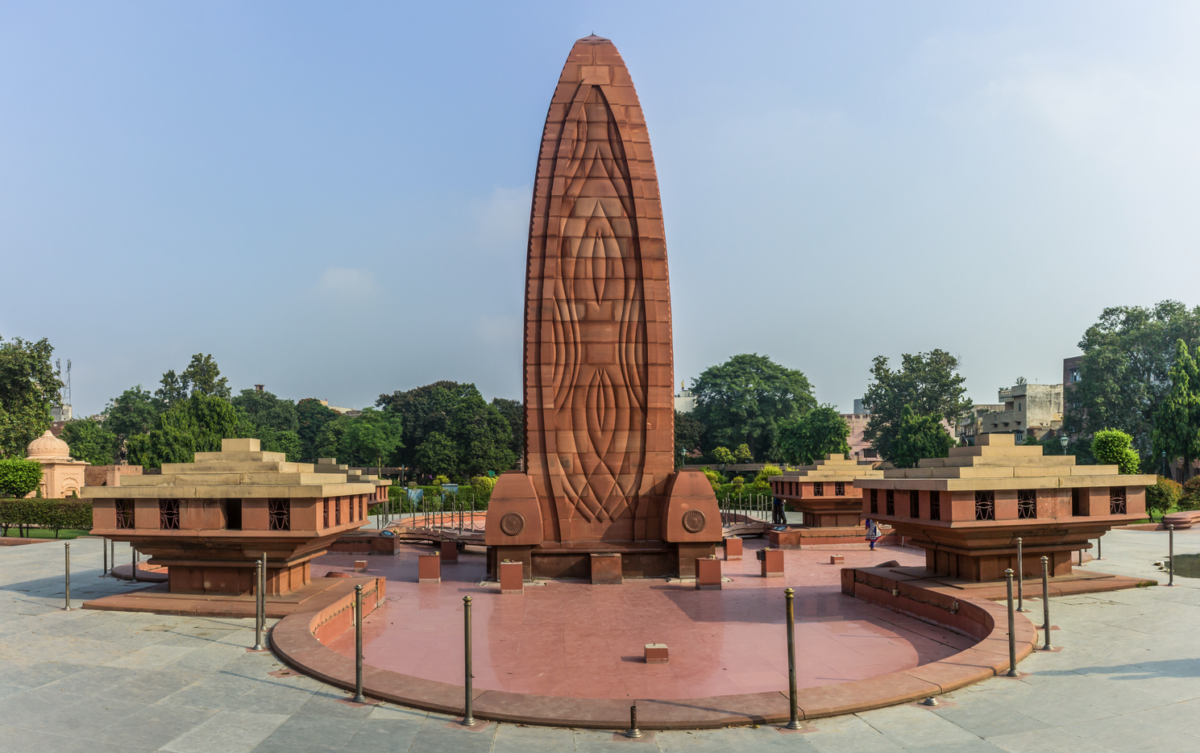
Martyrs memorial in Jallianwala Bagh
From ‘War Commentary’, November 1939, Whiteway Colony, England
“What are fighting for?” To this question those enthusiastic “democrats” who venture an answer, say “Freedom” or “to crush Nazism and its aims at world domination” or, to quote the Editor of the Times (Oct.10th) “to Liberate Poland and to put an end, once for all, to the intolerable strain of living under the perpetual threat of Nazi aggression”.
Anti-Fascists and the War
It is the aim of this article to show that the answer to the
embarrassing question “What are we fighting for?”, is not “Freedom” or the “defence of Democracy” but the “defence of one set of interests against another” or, more simply “a war between rival imperialisms”.
That many sincere anti-fascists believe in the “righteousness” of this war, quite independently of the propaganda served up by the Conservative and so called Radical Press, is not surprising. They say: “We, who have always shouted that Fascism must be crushed should, now that an opportunity presents itself, act in accordance with our principles”. Their actions are, therefore, governed not by reason but by their desire to prove to themselves and to others that they are consistent both in speech and in action.
There are others calling themselves Revolutionaries who believe that war creates a Revolution. The tragic consequences of the last war have apparently not taught them a lesson. Today the strategists are in good company with the British Government which has been doing its utmost to convince the British people that there will be a revolution in Germany before long.
They omit to add that in the event of a revolution in Germany they will crush it with the same ruthlessness that they propose to crush Nazism. Mr. Churchill, with his past experience, will see to that.
Finally, there is that vast mass of people with no opinions;
who are fed exclusively by the poisoned pens of the Capitalist Press, and the noble words uttered by their political leaders through that most effective channel of propaganda, the B.B.C.
All these categories of anti-fascists, referred to above, are either mistaken or misguided, for in no circumstance can this war be justified; in no circumstance can it bring peace.
The “Defence of Freedom”
On all sides attempts are being made to convince us that we are fighting to defend Freedom. The Government has, in fact spent £44,000 (according to official estimates) to have England plastered with those posters, “Your Freedom is in Peril. Defend it With All Your Might“.
But was our freedom threatened by Germany’s invasion of Poland? The Government’s answer, they say, was their declaration of war on Germany. Yet the Government has not declared war on Russia, which has swallowed up half of Poland. On the contrary, Britain has signed an agreement to supply Russia with tin and rubber in exchange for timber! Poland was just an excuse, as Czechoslovakia might have been, had England and France been ready.
The ex-lord of the Admiralty, Mr. Duff Cooper, stated, without even blushing with shame, that:
“It was not for Czechoslovakia that we should have been fighting if we had gone to war… It was not for Serbia or Belgium that we fought in 1914, though it suited some people to say so….”
If further proof of the sinister role of the Allies is required one can point to the fact that in order to “defend Freedom” they are doing everything in their power to win over to their side countries like Spain and Italy; countries in which Freedom is anathema. Mussolini, the man who most recently declared that Liberty was a thing of the past, and Franco, whose Spain is one vast concentration camp (even the Times, Oct.7th, declares that the “crowded prisons and camps tell of sorrow and misery. It is a dreadful problem”.)
As for Poland, the excuse for this war, independent observers have noted on many occasions that a fascism of a most brutal nature existed in that country, and as to anti-semitic persecution, Streicher and his jew-baiters could have learned much from Polish technique.
Neither is the internal policy of the Allies a very good advertisement for their avowed democratic traditions. From the Imperialist point of view, France is making good use of her coloured peoples to take the brunt of the fighting up to date. The News Chronicle describes the way Senegalese troops were used to clear the Wandt forest of land mines and traps for the advancing French troops (by way of comparison, it should be noted that on a previous occasion sheep and cattle had been used for the same purpose. Presumably a Senegalese soldier’s life is not worth more than that of a sheep).
On another occasion the rescue of a French airman who had fallen in no man’s land by an Algerian soldier. Thus one sees in the “front line of democracy” are coloured troops who, thanks to French Imperialism, knew very little about Freedom, and who care even less to fight to defend that which they have never possessed. But, in spite of the fact that they are not living under Nazism, they have no choice!
India, & Britain’s War Aims
The other member of the “democratic axis”, Britain, has already dragged the colonies into the war without even consulting them. India is a case in point. Apart from the messages of “loyalty” from the princes who are supported by British Imperialism to further its own ends, no messages of loyalty have come from the Indian people.
The manifesto of the Working Committee of the Indian National Congress, which was recently published, whilst not voicing the views of the revolutionary minority which
advocates unconditional freedom for the Indian masses (as opposed to the moderate bargaining attitude of the Working Committee) nevertheless, gives the point of view of an important section of Indian public opinion.
The manifesto declares that:
“The Governments of Britain and France declare that they are fighting for Democracy and Freedom against aggression, but their past history is full of betrayals and proclaimed ideals.
The last war meant secret treaties, Versailles and enlargements of empires… If the present war is for defending tho status quo, imperialist possessions, colonies and vested interests, then India can have nothing to do with it… if Britain fights for Democracy then she must necessarily end Imperialism and establish full Democracy in India…
The present crisis affects the future of humanity… India is the crux of the problem as she is the outstanding example of modern Imperialism… The true measure of Democracy is the attempt to end Imperialism and Fascism alike”.
Our democratic rulers have answered India’s moderate demands in such a way to shock even moderate opinion in this country.
As to Nazi methods and “Nazi concentration camps” which Hore Belisha, the war minister stated in a broadcast speech, we were fighting to crush. The Amritsar massacre in which it was officially stated that 379 Indians had been killed and 1,200 wounded by British troops under the command of General Dyer can compare “favourably” with the worst Nazi purges.
The destruction of whole Arab villages, the Palestine concentration camps, the shooting in cold blood of Jamaican workers, all these crimes are typical, not only of “Nazism” but of British and French Imperialism too.
In France, not even a frenchman is allowed to publicly discuss colonial questions. Meetings organised long before war broke out, in which these problems were to be exposed were banned by the police; authors of articles on this subject have been arrested and sentenced to as much as two years imprisonment.
So much for Freedom under Democracy… So much for the real aims of the Allies.
The Rise of Fascism
Apart from the moral support given to Fascism both in Italy and Germany by the rulers of this country in recent years, they have with France and America, also “democracies”, been responsible for the rearmament of Germany by supplying them with the raw materials required for the manufacture of the implements of war, besides the credits required for their purchase.
An article recently published in L’Oeuvre entitled “France’s contribution to German rearmament” states that during 1938 the mines of Lorraine supplied a monthly average of 500,000 tons of iron ore for export to Germany. The correspondent suggested that possibly that iron may “come back to us in the form of shells and shrapnel”. Bauxite (aluminum ore) was also supplied to Germany in ever increasing quantities. Exports of this mineral rose from 78,000 tons in 1935 to 87,500 in 1938.
Canada, which produces 102,000 of the world’s total production of 113,000 tons of nickel, supplied Germany with 20,000 tons of the ore in 1937. When the question was raised in the House of Commons, Mr. Chamberlain declared that he did not think is necessary to have conversations with the Canadian Government about it “for the time being”!
Britain has also had her share in Germany’s rearmament. As recently as August 22nd, the Daily Telegraph reports that “German agents are active in all parts of the country buying up huge quantities of scrap rubber, battery lead and scrap metal of all descriptions for export to Germany. Mr. Borovitch, managing director of Scrap Metal and Rubber Ltd. told the D.T. representative that it is safe to say that the greater proportion of our scrap exports go to Germany, particularly the scrap rubber”.
The same newspaper reported that large stocks of rubber had been bought up by German agents on the French market.(*)
It is significant that since the outbreak of war this country has been supplying Russia with large supplies of tin and rubber (Anglo-Russian trade agreement). It can be safely assumed that Germany is therefore still buying her rubber from this country via Russia! At the same time our Ministry of Economic warfare is proudly publishing figures of minerals and other commodities captured from Germany since war broke out. If this country had pursued a policy of peace, no raw materials for war production would have ever reached Germany. But then, Capitalism is International!
These are the facts. The conclusions should be obvious to independent minds, however much apologists of the war may protest. There can only be one answer to that question “What are we fighting for?”: Imperialism. And by participating in this struggle the workers of Britain and the Dominions and France are defending interests which are not theirs; interests which the revolutionary workers of the world have struggled to destroy for ever.
V. R.
(*) The same newspaper states that during the first three weeks in August, Germany bought in London 17,000 tons of rubber, 8,000 tons of copper and 2,000 tons of nickel.
Also
Imperialism: Monster of the Twentieth Century, by Kōtoku Shūsui (1901)
Liberty and Love Rise and Fall Together, by Har Dayal (1914)
Anti-War Manifesto, by the Anarchist International (1915)
Between Ourselves, by Emidio Recchioni (1915)
The Truth About Fascism on the March, by Errico Malatesta (1926)
Mussolini: The Great Actor, by Camillo Berneri (1934)
Mussolini’s War Upon East Africa, by Marcus Graham (1935)
Terrorism In Palestine: “Democracy” at Work, by Vernon Richards (1937)
Palestine: Idealists and Capitalists, by Vernon Richards (1938)
Anti-Fascism: Capitalist or Socialist?, by Vernon Richards (1938)
Hands off the Colonies!, by George Padmore (1938)
This Is Not A War For Freedom!, by War Commentary (1939)
Manifesto of the Anarchist Federation of Britain (1939)
Reaction in Canada, by Walter Brooks (1939)
Tribunals and Political Objectors, by Albert Meltzer and Vernon Richards (1940)
American Imperialism versus German Imperialism, by Marie Louise Berneri (1941)
The Standard Oil Case, from the New York Times (1942)
Standard Oil: Axis Ally, by Michael Straight (1942)
Anarchists Uphold the Empire, from The Word (1942)
Man-Made Famines, by Marie Louise Berneri (1943)
The Yankee Peril, by Marie Louise Berneri (1943)
Manifesto of the Anarchist Federation on War (1943)
The Issues in the Present War, by Marcus Graham (1943)
American Imperialism Exposed, by Marcus Graham (1943)
Mankind and the State, by Marcus Graham (1946)
Gentlemen, You Are Mad, by Lewis Mumford (1946)
The Muddy War, by Marie Louise Berneri (1948)
Letter in memory of Marie Louise Berneri, by George Padmore (1949)
Neither East Nor West, by Marie Louise Berneri (1952)
From the Militias to Militarization, by Vernon Richards (1956)
Reflections on Full-Employment, by Vernon Richards (1958)
Time is Life, by Vernon Richards (1962)
Malatesta: Life and Ideas, edited and translated by Vernon Richards (1965)
Lilian Wolfe: On Her 90th Birthday, by Vernon Richards (1965)
Lilian Wolfe: 1875-1974, by Nicolas Walter (1974)
Marie Louise Berneri poster (artist: Kree Arvanitas) from Open Road #6 (1978)
Against Imperialism: International Solidarity and Resistance, by Endless Struggle (1990)
Recruited by MI5: The Name’s Mussolini. Benito Mussolini, by Tom Kington (2009)
How Texaco Helped Franco Win the Spanish Civil War, by Adam Hochschild (2016)
The Specificity of Imperialism, by Salar Mohandesi (2018)
Maria Luisa Berneri Richards 1918-1949, by Antonio Senta (2019)
Shipping Iron Ore from the Bell Island Mines to Nazi Germany, by Digital Museums Canada (2020)
Mussolini’s Colonial Inspiration, by Matthew Wills (2022)
Anarchism and Revolutionary Defeatism, by K. C. Sinclair (2025)
