
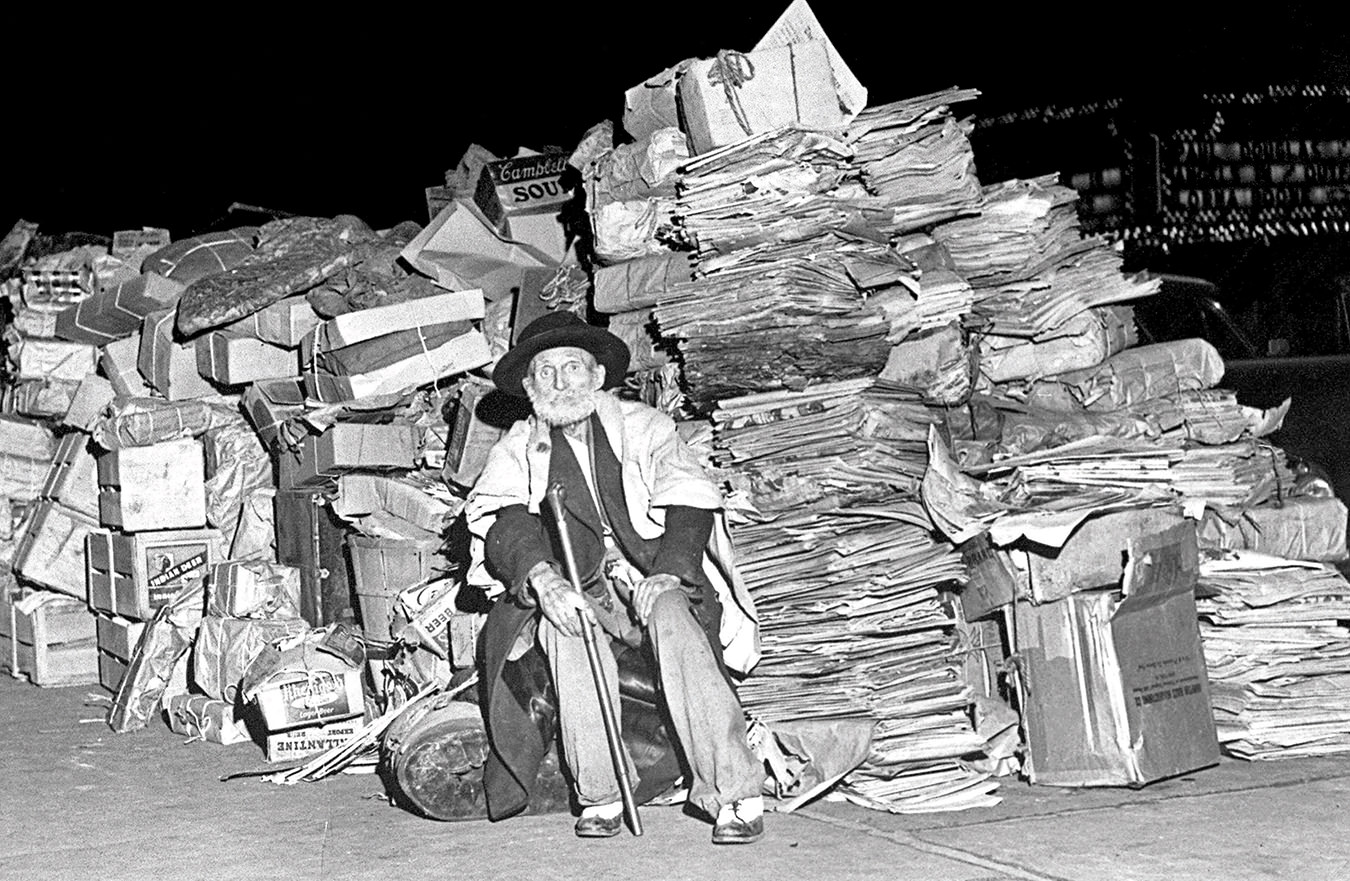
Honoré Jaxon evicted in 1951, on the streets of New York City with his archive, before it was sold by the city as waste paper, destroying invaluable documentation of Indigenous and socialist history
From ‘The Haymarket Scrapbook‘, edited by Franklin Rosemont and David Roediger (1986)
It should come as no surprise to readers of this book that the Chicago anarchists admired the Indians for their egalitarian way of life, were outraged at their fate, and applauded their struggles. Consider their reaction to the Riel Rebellion, as it was called — one of the great Indian rebellions in the history of North America.
In March, 1885, the Metis — the mixed-blood French-Indians of the Canadian Northwest — rose in armed rebellion against the Canadian State in defense of their land rights. Led by Louis Riel, a skillful politician and a charismatic visionary, they proclaimed their independence from the British Empire, with the intention of establishing a republic in the Northwest for themselves and the other Indians of the area. Immediately, The Alarm broadcast the sympathy and solidarity the anarchists felt for the Metis:
“They are struggling to retain their homes, of which the statute laws and the chicanery of modern capitalism seeks to dispossess them. May their trusted rifles and steady aim make the robbers bite the dust.”
Alas, the Metis were crushed in blood on the battlefield. Louis Riel was tried for treason and hanged on November 16, 1885. Six days later, the American Group of the Chicago International Working People’s Association held a memorial meeting in his honor. August Spies, Samuel Fielden, Albert Parsons and others spoke of their admiration and love for Riel. He was their brother, “a martyr to human freedom,” slain by “social order.”1
The Chicago anarchists had many martyrs to attend to. As time passed, it was likely that Louis Riel would retreat to the back of their minds. A most improbable thing happened, however, to keep Riel and the cause of the Metis at the center of their attention. Through a series of fantastic and fateful events, Riel’s secretary joined their ranks at the beginning of 1886. He was William Henry Jackson, soon to be known as Honore Joseph Jaxon. A remarkable man, his passion in life was the rights of the Indians, although he himself was white. He and his new comrades were worthy of each other.
As Jackson settled into Chicago, he became a popular leader in the labor movement. In a position to influence the workers about him, he was an insistent voice urging them to extend their solidarity across the color line to the Indians.
The atmosphere of the times made many workers receptive to his message. The bitter labor wars of the late nineteenth century coincided with the last of the Indian wars, such as the Riel Rebellion. The established press and respectable opinion-makers expressed their contempt for strikers, trade unionists and radical workers by comparing them to Indians.
All of them were viewed as savages who threatened American Civilization. Treated and feeling like outcasts, it is not surprising that many workers had a certain amount of sympathy for the Indians as fellow outcasts. Appealing to this sentiment, and building on it, Jackson won a warm response and support for his cause. His success is testimony to the extraordinary radicalization of American workers in the 1880s and the important role of the anarchists in that process.
William Henry Jackson (1861-1952) was born and raised a Protestant in Ontario, where French Canadians were despised, let alone the Indians. In 1882 he moved to the Northwest. It was there, in the next two years, that he overcame the bigotry of his background while coming to know the Indians about him. He was attracted to their way of life: It was “incomparably nearer to God than that of any average man. taken from, what we call civilization.” He admired them because they lived “free from selfishness, and from the grasping for property and riches as among the whites.” His most intimate associations were among the Metis and he came under the sway of Louis Riel. “The oppression of the aboriginal has been the crying sin of the white race in America and they have at last found a voice.”
Jackson was a talented linguist and a university-educated man; with his skills and passions, Riel took him on as his secretary in 1884. Early the next year Riel revealed himself as the prophet of a new religion and propelled his people into armed rebellion. Jackson faced the ultimate test of his new-found devotion to the Indians. But a man of his qualities could not have done otherwise: He accepted Riel as his prophet and followed him to the end. As a result, along with Riel, he was tried for treason. In his case, he was declared insane and locked away?2
In November, 1885, Jackson escaped from the lunatic asylum and fled to the United States on foot. As he made his way through North Dakota, Minnesota and Wisconsin, he arranged public meetings where he defended the right of the Indians to a republic in the Northwest, to be achieved by the force of arms if necessary. The general public received him, as he described years later, with “the anti-social disposition which I had of course discovered in the American bourgeoisie, from the moment of my escape into this ‘land of the free’. . . the pious disapproval of a movement which had disregarded sacred ‘rights of property’ created by a ‘civilized’ government for the guidance of a ‘savage’ people. . . ”
He was soon to find out, however, that there were other Americans who did not hold the rights of property in such sacred regard.3
In January, 1886, Jackson arrived in Eau Claire, Wisconsin. Here, the lumber magnates of the town refused him the use of the YMCA hall. A Knights of Labor Assembly came to the rescue: It invited him to address a public meeting under its auspices and to set forth, as he put it, “the true inwardness of the Metis struggle, and the why and how of its relationship to the struggle of the working people of the United States against the uncrowned masters of this alleged republic and ‘commonwealth.'”
Jackson was thankful for their offer and he did his best to oblige them. The Knights were pleased: They admitted him to membership and issued him a traveling card to facilitate his speaking tour.4
C. L. James, Eau Claire’s resident anarchist and a contributor to The Alarm, attended the lecture and approached Jackson afterward. James was a dignified, well-dressed gentleman and Jackson expected another dose of “the antisocial disposition” of “the American bourgeoisie”:
“I, of course, braced myself for the expected onslaught; and it may therefore be imagined with what a corresponding degree of astonishment I found myself listening to a criticism that I had not been quite radical enough! I had come to preach, but waked up to find myself invited to membership in the more outspoken congregation of Rabbi James!”
It was a “delicious surprise.” James recognized a man after his own heart and he invited Jackson to stay with him while he rested up and recuperated after his exhausting and trying experiences of the past year. Jackson eagerly accepted what proved to be “a very delightful hospitality in his home.” As he got to know James, he was impressed with his “breadth of view.” “Rabbi” James talked with him about anarchism and a host of other topics, ranging from the guerrilla tactics the Metis might use in the future to “a bird’s-eye view of the various phases of the economic struggle” in the United States. By the time Jackson was ready to move on, James had given him “an invaluable advance understanding of new struggles into which I was shortly to be plunged.”
James also did him another favor: He sent him on his way with a letter of introduction to Albert Parsons and other anarchists in Chicago. So it was that early in February, armed with a Knights of Labor traveling card and an inside track to the most dynamic group of revolutionaries in the United States, Jackson made Chicago his next stop.5
Chicago, 1886! Prepared by “Rabbi” James, Jackson threw himself into the whirl of events sweeping the city. Almost the first thing he did was to join the American Group of the IWPA. The Alarm records him at a meeting of the American Group as early as February 20. Needing an income, he deposited his card with a Knights of Labor carpenter assembly and went to work in the trade. Then he set about organizing the “Anniversary Celebration of the Recent Northwestern Declaration of Independence.” He rented the Central Music Hall for March 16th. Advertising himself as the secretary to Louis Riel and a spokesman for “The Provisional Government of the Northwest,” he promised an address that night titled “Why We Fought; How We Fought; Why We Shall Fight Again.”
His experience with the Knights of Labor in Eau Claire fresh in his mind, he made the rounds of all the Knights’ assemblies in Chicago seeking financial support and endorsements. At this very moment, thousands of working people were rushing to join the Knights in Chicago. The motto of the Order — “An Injury to One is the Concern of All” — was resounding throughout the city. No doubt Jackson quoted it meeting after meeting, inspiring the aroused workers of Chicago to a concern for the Indians of faraway Northwestern Canada. They did not let him down: He received a number of endorsements and enough money to cover his expenses.6
Jackson gave a defiant address as he promised. The resulting stir and the involvement of the Knights of Labor in the affair led some conservative Knights to worry about Jackson’s connection with the Order. One wrote to Terence Powderly, the head of the Knights, voicing their fears. They were afraid that Jackson’s defense of the Riel Rebellion and “his shotgun policy” might compromise the Order with the public. The letter did not mention Jackson’s anarchism. If the conservative Knights had known about it at the time, they would have been even more upset.7
The Chicago anarchists were proud of their new comrade. His advocacy of the shotgun added a needed American dimension to their cult of dynamite. Like C. L. James in Eau Claire, they knew a comrade when they saw one and they made him feel at home in Chicago. In the months before Haymarket, when the anarchists were at the height of their influence and the city was in the midst of a great social upheaval, how could a man like Jackson not have felt at home in Chicago? Although he talked of traveling to Detroit and cities further east to continue his agitation for the Indians of the Northwest, he decided to stay put instead. Here was his chance to help make a revolution along with his anarchist comrades. Here was his chance to participate in his second revolution — his second, no less, in two years!
The opposition to Jackson within the Knights of Labor was overwhelmed and drowned out by the explosive growth of the labor movement. And Jackson knew how to resonate with the rising tide of protest: A forceful speaker, a fiery leaflet-writer, an able organizer, he quickly became a popular figure. He learned German soon after arriving in Chicago, which put him on speaking terms with the largest and most radical group of workers in the city.
Within his own Knights of Labor assembly, he was elected an officer. For a period of time in the late spring and summer, he was the secretary of the United Carpenters Committee, the umbrella grouping of all the carpenters’ assemblies and unions in Chicago. It was while serving in this position that he directed a strike that became one of the legends of Chicago labor history. It was after Haymarket, when the employers were on the offensive, yet the strike was successful. It preserved the eight-hour-day for certain groups of carpenters. Not long after the strike was over, the Chicago Tribune, with its characteristic scorn, noted the appreciation the carpenters felt for Jackson: “Among the ignorant class, he has become little less than a demi-god.”8
The strike was famous not only because it was one of the few successful strikes in Chicago in the months after Haymarket. It was famous because of the strategy Jackson used to cope with the difficult situation. With his experiences and interest in guerrilla warfare, Jackson devised a paramilitary strategy that won the day. It is not known if he encouraged the strikers to think of themselves as Indian guerrilla fighters when he sent them out to do battle with the scabs. He probably did. Is it going too far beyond the evidence to suggest that the men were inspired by this image?
Whatever was on their minds at the time, the carpenters and other Chicago trade unionists learned an important lesson from Jackson’s winning strategy. After 1886, union-sponsored organized violence became common in Chicago. This was the legacy of the Riel Rebellion for the Chicago labor movement: Long after its goals were forgotten, its “shotgun policy” lived on. For years thereafter, Jackson himself was known as “the Father of Labor Slugging,” an honor that did not please him.9
There is almost no documentation, unfortunately, on Jackson’s activities as an anarchist once he decided to settle in Chicago. The Alarm would have been the best source, but it was one of the victims of the Haymarket bomb. There is evidence that Jackson was active, and even prominent, in the defense work for the Haymarket defendants. After the verdict was announced on August 20, George Schilling recruited him as the secretary of a new defense committee and as one of six labor leaders to sign an appeal for funds for a new trial. Jackson also visited the Haymarket defendants in jail. During the final days before November 11, 1887, he pleaded with Albert Parsons to appeal for clemency to try to save his life.
Jackson had intense personal reasons for his plea: His Metis comrades were dead on the battlefield or scattered to the winds; Louis Riel was dead; he didn’t know if he could bear to mourn for any more martyrs.10
Like all his anarchist comrades after November 11, 1887, Jackson faced an uncertain future. He had to take stock of his life. Within the short space of two years, he had suffered overwhelming losses. Deeply devoted to the memory of all the people he had lost, he searched for a way to honor them.
Ever since he had been Louis Riel’s secretary, his devotion to the Indians and his shame at their treatment in the hands of whites had made him regret that he was a white man.
Taunted by whites as an “Indian-lover” and a “traitor” to his race, an idea had slowly taken shape in his mind: He would not only identify with the Indians, and be identified with them — he would become one himself. Once he took the step, it would not be hard to convince people that he actually was an Indian; his straight black hair and his swarthy complexion would do the trick. What better way to honor Riel and the Metis than by transforming himself into an Indian?
During the turbulent days of 1886-87, Jackson had been too busy to do anything but dream about becoming an Indian. The idea remained tucked away in the back of his mind. But November 11, 1887 released him to give it full and careful consideration. That terrible day also gave him the incentive to do what he had only dreamed of doing before. The Haymarket Martyrs had died because of their love for freedom. He would honor them as well by liberating himself from the bondage of his white skin. And so, as the culmination of his life with the Metis and the Chicago anarchists, William Henry Jackson crossed the color line and started passing as a Metis. In 1889, to round off his new identity, he changed his name to Honore Joseph Jaxon.11
This is not the place to give an account of what Honore Jaxon did with his life. In brief: For the next thirty years he lived in Chicago, where he flourished as a Metis, a spokesman for the Indians, an anarchist, a trade union activist, and a crusader for an endless number of radical causes. Just to list all the organizations he served as secretary would take a page or more. A free man, thriving on voluntary poverty, his personality blossomed in the rich soil of freedom: He became one of the great eccentrics of his time. In 1919 he moved to the East Coast. He died in poverty in New York City in 1952, his passion for justice and the Indians burning brightly to the end.
Steven Sapolsky
1. The Alarm (Chicago), April 18, 1885; October 31, 1885; November 28, 1885.
2. Donald B. Smith, “William Henry Jackson: Riel’s Secretary,” The Beaver (Spring 1981), 10-19; Donald B. Smith “Honore Joseph Jaxon: A Man Who Lived for Others,” Saskatchewan History Vol. 34, No. 3 (Autumn 1981), 81-101. Many thanks to Prof. Smith for sending me copies of his articles and for sharing his enthusiasm for Jackson/Jaxon with me. Unless indicated otherwise, all information in my essay comes from his articles.
3. Honore J. Jaxon, “A Reminiscence of Charlie James,” Mother Earth, Vol. 6, No. 5 (July 1911), 144-146. March 6, 1886; William H. Jackson.
4. Ibid.
5. Ibid.
6 The Alarm, “Why We Fought; How We Fought; Why We Shall Fight Again,” Terence Powderly Papers, Microfilming Corporation of America, reel 14; W. H. Riley to T. V. Powderly, March 30, 1886, Powderly Papers, reel 14. Many thanks to Bryan Palmer for sending me copies of these.
7. W. H. Riley 10 T. V. Powderly, March 30, 1886, Powderly Papers, reel 14.
8. “The Versatile Jaxon,” The Saturday Evening Post, June 1, 1907, page 17; Richard S. Schneirov, “The Knights of Labor in the Chicago Labor Movement and in Municipal Politics, 1877-1887,” Ph.D., Northern Illinois University, 1984, 449-451.; Lloyd Lewis and Henry Justin Smith. Chicago, The History of Its Reputation (N.Y., Harcourt, Brace, 1929), 168-169.
9. Ibid.
10. The Labor Enquirer (Denver), September 11, 1886; Carolyn Ashbaugh. Lucy Parsons, American Revolutionary (Chicago, Charles H. Kerr. 1976), 168.
11. The impact of November 11, 1887 on Jackson is my hypothesis. It feels right to me, but I have no specific evidence to back it up.
Also
(Zine) No One’s Illegal on Stolen Land (1988-2026)
Anarchism, May Day and Colonialism, by K. C. Sinclair (2026)
Louis Riel: Hero, heretic, nation builder, by Darren O’Toole (2022)
When Louis Riel Went Crazy, by Katherena Vermette (2017)
We need to return to the principles of Wahkotowin, by Maria Campbell (2007)
A Thousand Supperless Babes: The Story of the Métis (2004)
Overshadowed National Liberation Wars, by Howard Adams (1992)
Medric McDougall: Metis Elder and Organizer (1988)
Anarchists and the Wild West, by Franklin Rosemont (1986)
The Haymarket Tragedy, by Paul Avrich (1984)
Cultural Genocide, Intentionally Planned, by Rose Bishop (1975)
We Do Take Exception to This Term “Rebellion”, by Malcolm Norris (1962)
The Haymarket Martyrs, by Lucy E. Parsons (1926)
Capitalism in Mexico, by Honoré J. Jaxon (1911)
A Reminiscence of Charlie James, by Honoré J. Jaxon (1911)
The Trial a Farce, by Lucy E. Parsons (1911)
A Rebel May Day, from Industrial Worker (1909)
Before the Storm, by Peter Kropotkin (1888)
A Martyr, from The Alarm (1885)
An Appeal for Justice, by Louis Riel (1885)
Anarchism & Indigenous Peoples
