
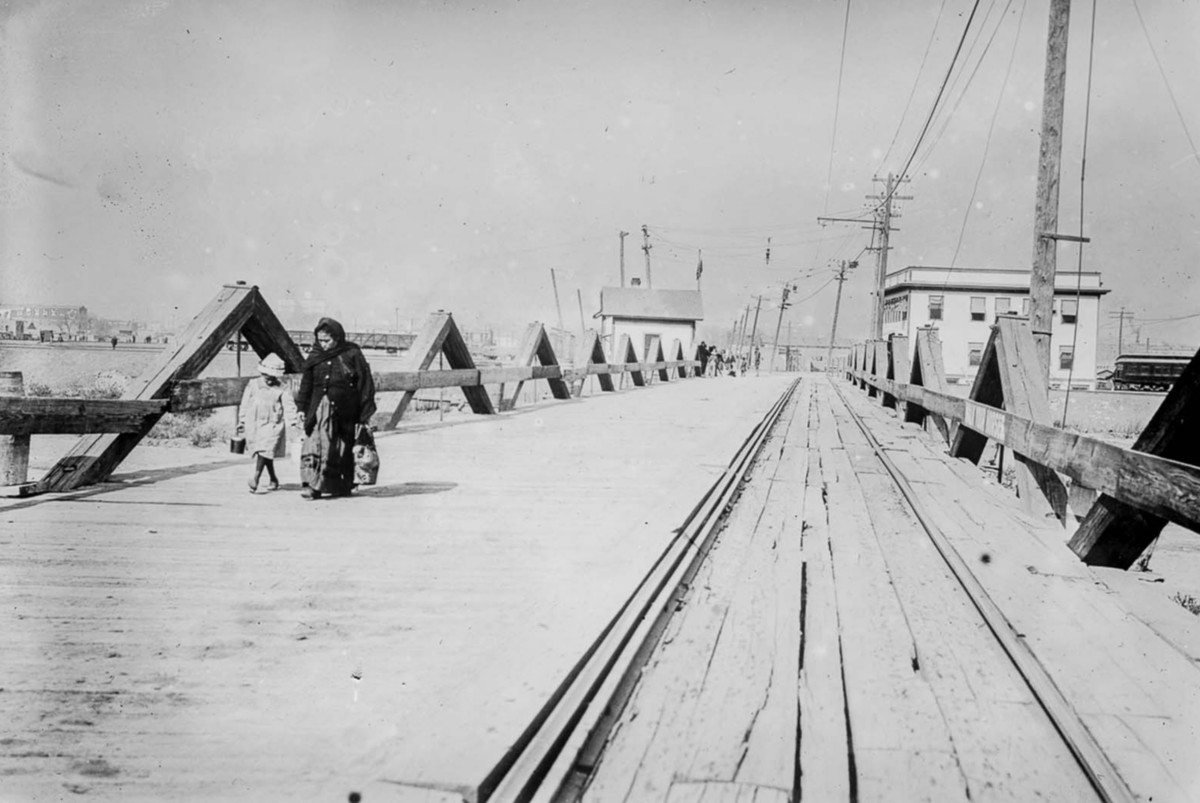
From ‘Regeneración’, English Section, June 10, 1911, Los Angeles, edited by William C. Owen
We begin our manifesto by saying that the Revolution has reached a point at which it must either degenerate into a mere political movement, from which the Mexican workers will profit nothing, or realize itself as a true economic revolution, which will place the Mexican people in possession of their lands and of the machinery of production, thus securing the well-being of all.
I may add that no one who keeps track of the hitherto victorious course of the Revolution, as we record it from week to week in “Regeneracion,” can doubt that if the Mexican people continue as they have been acting during the past few months they can bring about a true and most beneficial economic revolution. Surely it is not to the interest of any sincere worker to discourage them at this most critical moment! Surely we can leave that to plutocracy, which will spare no pains to dampen their enthusiasm!
Following this our manifesto calls attention to certain facts which I beg to impress on you. It says, and says truthfully: “Madero and Diaz have entered into a pact whereby the forces of Madero transform themselves into federal forces, that they may crush the heroic Liberal comrades who do not lay down their arms. It is said that Orozco or Villa are to be sent to smother the Liberal movement in Sonora. It is said that other Maderist leaders, joining hands with the federals, are to crush the Liberals of Central Mexico. It is said that other Maderist leaders, combined with the federals, are to crush the revolutionists of Veracruz and of Tobasco, of Campeche and of Yucatan, of Chiapas and of Oaxaca, of Guerrero and of Moreles, of Durango, of Sinaloa, of Tepic, of Jalisco, of Guanajuato, of the entire country. Is not that a tremendous treason to the revolutionary movement?”
Upholding Wall Street
I ask you if that last short sentence is not literally true. It is treason to the people’s cause that we are now engaged in fighting, and little would it become us at this crisis to waste our time and energy in discussing what the ballot might accomplish in times of peace and under conditions the very opposite of those now prevailing in Mexico.
To do so would be to play directly into the hands of the tyranny in Mexico and the American tyranny in Wall Street; and both would pay millions to whoever could assure them that the robbed and outraged proletariat of Mexico, whose cause we uphold, had lost courage and given up the fight. I am sure that both you and your organization will understand that we must speak plainly; that we cannot equivocate; that we must tell the truth, no matter whom it may offend; that we must fight on.
Most fraternally,
RICARDO FLORES MAGON
Peace!
From ‘Regeneración’, English Section, June 10, 1911, Los Angeles, edited by William C. Owen
More distant than ever is the day of peace. The Madero-Diaz pact has served solely to demonstrate two facts — that Madero is not the leader of the revolution, and that the people are not satisfied with a mere change of tyrants.
The people want something that is exceedingly definite — the abolition of hunger; and inasmuch as the electoral ballot is not made of flour but of paper it seeks something more substantial: Bread.
That, in a word, is the aspiration of the toilers.
As for the bourgeoisie, it is split up into various factions: Reyists, Maderists, Obregonists, “Cientificos,” Figueroists, Orozcists, and so on ad infinitum.
Clericalism, for its part, lifts up its head and presents itself boldly as the Catholic National Party.
Chaos has come; the much wished for chaos, from which there will issue something good for the poor people of Mexico.
Those who hoped that this revolution would be an opera bouffe revolt, ending in the enthronement of a new tyrant, are panic-stricken. “Anarchy reigns in Mexico,” say these poor-spirited ones, who do not know that Anarchy is order based on mutual aid.
What is happening in Mexico at the present moment is that passions of all kinds have broken loose; passions good and passions bad; the bad passions of the petty chiefs who are seeking to gain power that they, in their turn, may oppress; the good passions of the liberty lovers who seek to put an end to privilege, that they may establish equality on the firm basis of the economic emancipation of the proletariat.
(From the Spanish of Ricardo Flores Magon.)
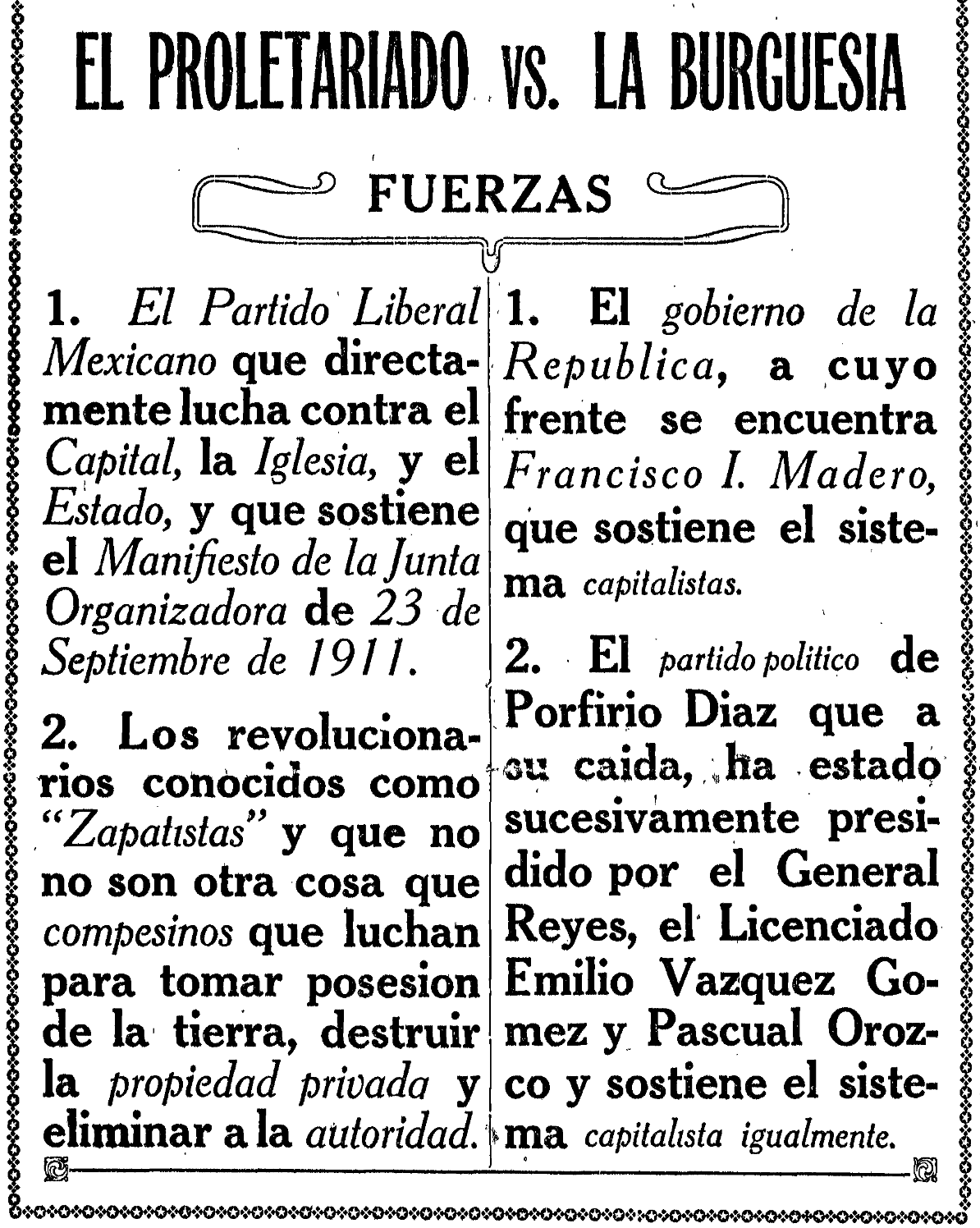 Regeneración of August 24, 1912, outlines the two opposing sides of the Mexican Revolution. The anarchist Partido Liberal Mexicano and the (original) Zapatistas on the one hand, fighting against private property and authority; and on the other hand, political and capitalist bosses such as Madero, Reyes, Vazquez Gomez and Orozco, looking to fill the vacuum left by Diaz and preserve the capitalist system.
Also
Reds Die For Freedom, by the Industrial Workers of the World (1911)
William Stanley, from Regeneración (1911)
Chicago Workers Show Sympathy, by Voltairine de Cleyre (1911)
Capitalism in Mexico, by Honoré J. Jaxon (1911)
Murderous Silence: Luigi Galleani and Cronaca Sovversiva, from Regeneración Sezione Italiana (1911)
The Mexican Revolution, by Voltairine de Cleyre (1911)
A Correction, by Peter Kropotkin (1912)
A Debate on the Mexican Revolution in Temps Nouveaux (1911-1912)
The Traitors!, by Ricardo Flores Magón (1912)
The Political Socialists, by Ricardo Flores Magón (1912)
The Mexican Comrades at McNeils, from Why? (1913)
The Social Revolution in Sonora, by Ricardo Flores Magón (1914)
The Pacification of the Yaqui, by Librado Rivera (1927)
The Scientific Background of Kropotkin’s Mutual Aid, by Daniel P. Todes (1993)
U.S. Socialists and the Mexican Revolution, by Dan La Botz (2010)
Mexican Workers in the IWW and the Partido Liberal Mexicano (PLM), by Devra Anne Weber (2016)
The Chaparral Insurgents of South Texas, by Aaron Miguel Cantú (2016)
La batalla de Oaxaca, de Laura Castellanos y Heriberto Paredes (2019)
Anarchism and Revolutionary Defeatism, by K. C. Sinclair (2025)
(Zine) No One’s Illegal on Stolen Land (1988-2026)
Voices of Mexican Anarchists (and their allies)
