
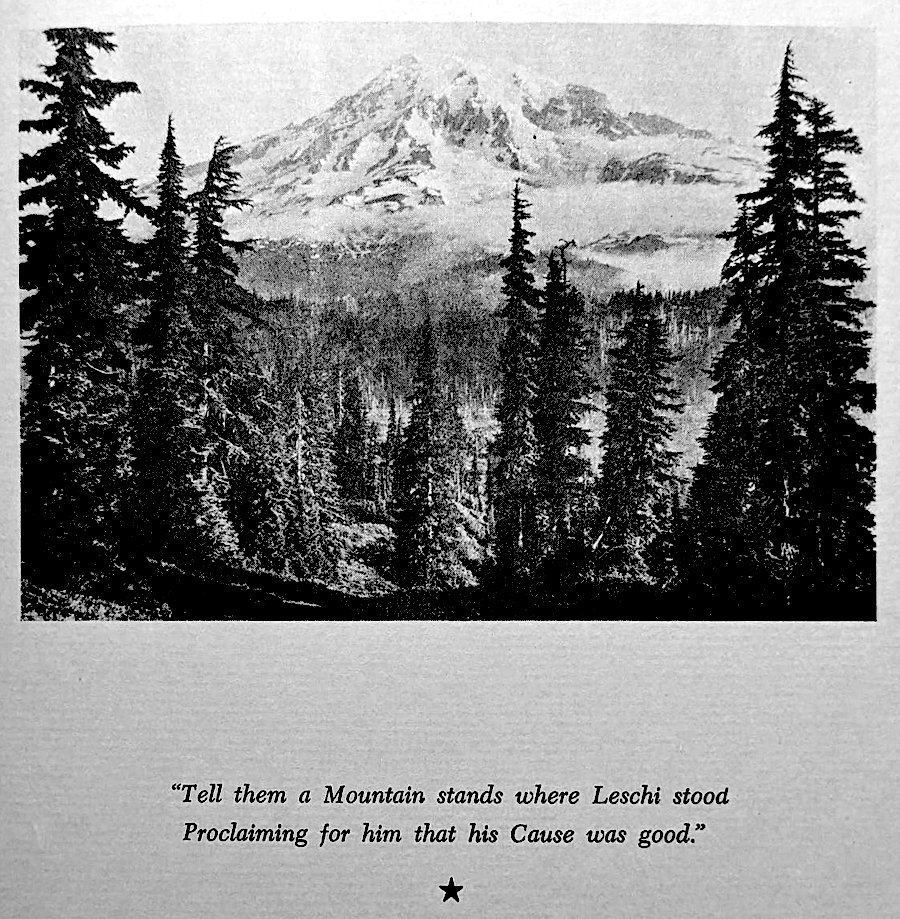
From Ralph Chaplin’s ‘Only the Drums Remembered: A Memento for Leschi’
From an email added by Arthur J. Miller himself to the A-Infos list in 2001; later reprinted in his 2011 book, ‘Upon the Backs of Labour’, published by Black Cat Press, Edmonton; the version republished here being based on the minor edits made for the 2011 book
With a little time on my hands, and nothing better to do, I went over to the Washington State History Museum here in Tacoma. I had heard that they had an exhibit on one-time Wobbly Ralph Chaplin, so I thought I would see how “history” records a guy who was once one hell of a man, and wrote “Solidarity Forever”.
“In our hands is placed a power greater than their hoarded gold,
Greater than the might of armies,
Magnified a thousand-fold.
We can bring to birth the new world
From the ashes of the old,
For the Union makes us strong.
Solidarity Forever!”
– Ralph Chaplin.
The exhibit was small and it had as much to do with Chaplin’s later life when he was a right-wing republican as it did about his days as a Wobbly. The only thing that caught my eye was an old publication of an epic poem Chaplin wrote about Chief Leschi. Next to the publication was a picture of Chief Leschi and a few words saying that Chaplin was inspired by him. Of course the words of the poem were not out to be read and I had to hold back my desire to take the publication off the wall and open it up and read it.
Here in the Northwest, few outside of the Native communities know much of anything about the real history of this land. The more “enlightened” non-Natives will tell you that Chief Leschi is the name of a school run by the Puyallup Nation. But who was Chief Leschi? Few of them could give you any answer to that question.
Among the “enlightened” ones there are those who know of Chief Sealth of the Duwamish and the famous speech that he is reported having given (though there are some who say the famous speech was written by a white man after Sealth died). Most call Chief Sealth, Chief Seattle, for whom the city was named. But it is common in these parts not to get names correct, nor to care much about that. The city I live in is named after Mt. Tahoma which somehow came out as Tacoma. The mountain was later renamed Mt. Rainier by non-Natives, for a white man that never even saw the mountain.
Chief Sealth was a man who wanted peace with the invaders at all costs. Today his people, the Duwamish have no land, for that is what peace came to mean. Chief Leschi of the Nisquallys, on the other hand after realizing that there was no honor in the invaders words, organized an armed resistance. After the Battle of Seattle (no not the WTO protests) where the resisters were bombarded by navy ships, Chief Leschi was captured and hung for the great “crime” of defending his people.
It is an historical fact, something that the good-hearted liberals never speak of, that those First Nations that fought back were left with a greater land base than those who did not fight back. Many of those that cooperated were left with no land at all like the Duwamish. The invaders did not respect noble words, they respected, or you may say they feared, direct actions of resistance. As long as the invaders knew that there were some who would back up their talk with action, there would be some gains to be made.
This is as true in modern history as it from days long ago. The struggle over Fort Lawton in Seattle is one good example. Down here in the South Sound there were the fishing struggles, and the seizure and occupation of Cascadia by the Puyallups. These are things that the museum will not tell you about.
If you go down on the first floor of the museum you will find more Wobbly stuff on display, but you will not find anything that deals with Wobblies of today. In that way, we Wobblies are dealt with in the same manner as are the First Nations. We are museum pieces of days gone by. Yes, we were good dreamers of noble things, but progress over took our dreams, or so they would have you believe.
The museum also has an exhibit on Woody Guthrie. Though there are many things to like about Woody Guthrie, his legacy here in the Northwest is not one of them. For up here he was a pimp for BPA, “Roll On Columbia, Roll On”. But his songs for the BPA did not speak of the many workers who died for BPA, neither do they speak of the land stolen from the First Nations, the lost fishing grounds of the River People and of the salmon. But who am I to point out reality in the face of a myth?
One of the events promoting the Guthrie exhibit is an event called “Hard-hitting Songs for Hard-Hit People: Joe Hill, Southern Working-class Heroes, and Woody Guthrie. The music of working-class people by scholars and performers.” I wonder, how does one become a scholar of “Hard-Hit People”? Are there college courses you can take that will teach how to become an “authority” on poor people? Like all other such Eurocentric authority, this is another case when we must “question authority.” For how do you explain what hungry feels like? Or what is it like to have “the Man” exploit your working years then cast you aside like needless waste when you grow too old to work?
I was once asked to speak at a college where the movie, “The Wobblies” was being shown. They wanted a real live Wobbly to show off, I guess like some type of museum piece, for a school-room “show and tell.” After the movie a college professor, an authority on labor, got up and rambled on about Wobblies and how we were idealistic dreamers of the past. Then he told me that I had five minutes to speak. I did not use up even half of that time. I got up and said, “Labor historians are to workers as anthropologists are to Indians. Don’t believe a word they say.” Then I walked out with the audience in shocked silence.
How could I tell them, in five minutes, the reality of toil? That Wobblies were not dreamers, but realists dealing with the reality of working people? And that we, Wobblies, continue to this day to organize and speak out around the realities of our class? We are not dinosaurs that went extinct, for there will always be Wobblies, of some short, as long as there are parasites exploiting the labor of working folks.
I hope that someday I will be able to read Ralph Chaplin’s poem honoring Chief Leschi, for it seems to me that such a poem written by a Wobbly is most fitting. There in that museum both Wobblies and the First Nations are simplified into exhibits of the past without much of a present or a future, I guess that is the only safe way for them to look upon both of us. But if I am a dreamer, my dream vision is of the time when the past crashes into the present to remake the future.
In The Spirit Of Total Resistance
Arthur J. Miller
Also
Industrial Workers of the World
Documents by Arthur J. Miller, edited by the IWW
(Zine) No One’s Illegal on Stolen Land (1988-2026)
Anarchism, May Day and Colonialism, by K. C. Sinclair (2026)
Fighting for the Puyallup Tribe: A Memoir, by Ramona Bennett Bill (2025)
Chief Leschi, by John Caldbick (2021)
Fitz St. John: A Longshoreman’s Longshoreman, by the ILWU (2020)
Leonard Peltier’s Statement for Ramona Bennett (2018)
Mexican Workers in the IWW and the Partido Liberal Mexicano (PLM), by Devra Anne Weber (2016)
Land, Labour and Loss: A Story of Struggle & Survival at the Burrard Inlet, by Taté Walker (2015)
The Fish-in Protests at Franks Landing, by Gabriel Chrisman (2008)
Sovereignty, by Monica Charles (2005)
Taking Back Fort Lawton, by Bernie Whitebear (1994)
Solidarity from Anti-Authoritarians, by Leonard Peltier (1990)
Proclamation of the Puyallup Tribe on the Repossession of the Cushman Indian Hospital Lands (1976)
Viewpoint of People Living on Puyallup River, by Ramona Bennett (1970)
Is the Trend Changing?, by Laura McCloud (1969)
Native Alliance for Red Power – Eight Point Program (1969)
Custer Died For Your Sins, by Vine Deloria Jr. (1969)
I am a Yakima and Cherokee Indian, and a man, by Sid Mills (1968)
The Last Indian War, by Janet McCloud (1966)
Washington Tribes and the National Indian Youth Council, by Hank Adams (1964)
Miners, Cowboys, and Indians, by William D. Haywood (1929)
Frank Little and the War, by Ralph Chaplin (1926)
Evolution of American Agriculture, by Abner E. Woodruff (1919)
The Deadly Parallel, by the Industrial Workers of the World (1917)
Selected texts and letters by Joe Hill (1910-1915)
Concerning Atrocities, by James Peter Warbasse (1915)
The Sea-Serpent, by Tekahionwake and Chief Sa7plek Joe Capilano (1911)
No One’s Illegal on Stolen Land
Anarchism & Indigenous Peoples
