
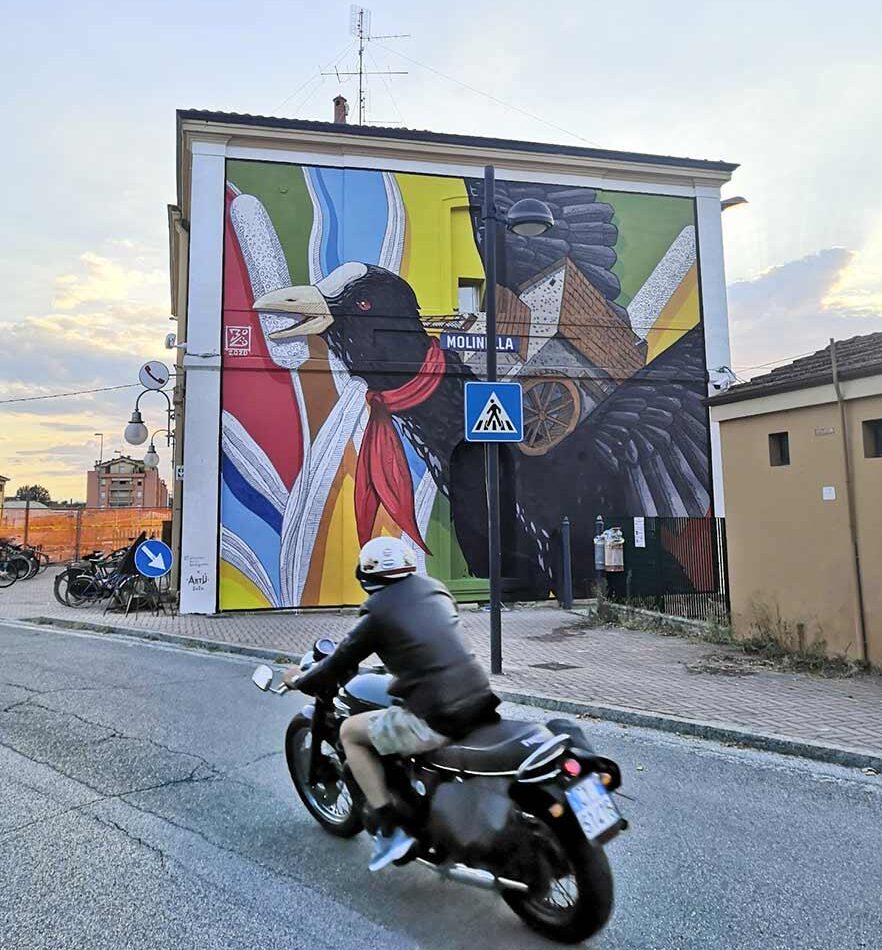
Partisan Coot mural in modern-day Molinella
From ‘The Raven: Anarchist Quarterly’, July-September 1990, translated by Gillian Fleming and Vernon Richards from the 1934 Italian-language pamphlet
While reading Carlo Rosselli’s book, Socialisme Liberal (Paris, 1930) I marked this passage (and I translate):
A pessimistic view of the masses implies in reality a pessimistic view of man since the masses are really no more than the sum of concrete individuals. If the masses are declared to be incapable of grasping the value of a struggle for liberty, even in just a crude and primitive way, then by the same token man himself is declared to be closed to every instinct which is not strictly utilitarian. Every dream of social redemption is cut off at the roots, and faith in democratic instincts is suffocated; that faith founded on the concept of a basic identity between human beings and a rational optimism regarding human nature.
I have never accepted without question certain Nietzschean attitudes on the part of certain individualists destined to finish up as secretaries in the Camere di Lavoro (Employment Exchanges) or worse, but, equally, I have never licked the boots of an ‘aware and evolved’ proletariat, not even in meetings. And I don’t understand the courtly language used by the communist high priests. In an article (I cite one among thousands) from Azione Antifascista, June, 1933, I read that Gramsci is a ‘proletarian spirit’.
Where have I heard that expression before? I search my memory. Ah, I remember! It was at Le Pecq when, dressed in my bricklayer’s labourer’s clothes, I was surprised by one of the communist overseers. ‘Now, Berneri, you will know what is the proletarian spirit!’ Thus did he address me. Between a sifting of sand and two pails of ballast I reflected on the ‘proletarian spirit’. And as always memories from the heart arose to help me clarify the problem. My first contacts with the proletariat: this was where I searched for the material which would provide me with a definition. I didn’t find the ‘proletarian spirit’. I re-found my old companions: young socialists of Reggio-Emilia and the surrounding areas. They were generous of heart, open of mind, tenacious of will. Then I got to know the anarchists.
Torquato Gobbi was my teacher; those misty evenings along the via Emilia, under the porticos which echoed with my efforts to resist his quiet arguments. He was a bookbinder, I a student at the lyceo, still ‘daddy’s boy’ and ignorant, therefore, of the real, big university of life. And after that, how many workers in my daily life! But if in one I found a tinder to spark off my own thoughts, if in another I discovered elective affinities, if to another still I could be open and intimate as with a brother, how many other arid ones I found, how many jarred upon me with their conceited vacuities, how many sickened me with their cynicism! The proletariat was ‘the people’: that semi-bourgeoisie in whose world I had lived, the student world in which I lived; in a word, the crowd. And the more intellectual and spontaneous of my worker companions never spoke to me of ‘proletarian spirit’.
It was from them themselves that I learned how slowly socialist propaganda and organisation advanced. Then where I was involved with that propaganda and organisation I saw the proletariat, which seemed to me, in general, how it still seems today, an enormous force which is ignorant of itself; which takes care of its interests in an unintelligent way; which fights only with reluctance for idealistic motives or long-term ends, which is weighed down by an infinite number of prejudices and crude ignorance and infantile illusions.
The function of élites seemed clear to me: to set the example of boldness, of self-sacrifice, of tenacity; recall the masses to themselves on the question of political oppression and economic exploitation, but also on that of the moral and intellectual inferiority of majorities. So that to paint the bourgeoisie and proletariat with the brush of a simplistic demagogy as portrayed in the caricatures in the Socialist Avanti! and the orators of political meetings seemed to me to be in bad taste and harmful.
There was, and unfortunately still is, a socialist rhetoric which is terribly non-educative. The communists contribute, more than any other avant-garde party, towards perpetuating it. Not content with the ‘proletarian spirit’ they have come up with ‘proletarian culture’. When Lunaciarsky died some communist newspapers said that ‘he incarnated proletarian culture’. Just how a scholarly writer of bourgeois origin (and erudition is culture’s capitalism) could represent ‘proletarian culture’ is as much of a mystery as ‘Marxist gynaecology’ — a term which scandalised even Stalin. The anarchist journal Le Reveil of Geneva, fulminating against abuse of the term ‘proletarian culture’, observed:
The proletarian is, by definition, and very often in reality, an ignorant person whose culture is necessarily extremely limited. In every field the past has bequeathed an inheritance of inestimable value which cannot be attributed to any one particular class. The proletarian claims, in the first place, a greater participation in culture, so it is a form of wealth of which he no longer wants to be deprived. Bourgeois thinkers, writers and artists have given us works important to our emancipation. But self-styled proletarian intellectuals have often cooked us indigestible dishes.
‘Proletarian culture’ exists, but it is limited to an occupational savoir-faire and an encyclopaedic smattering of knowledge backed up by desultory reading habits. A characteristic of proletarian culture is to be relatively ignorant of progress in the sciences and arts. Among the self-taught you will find fanatic disciples of Haeckel’s monism, Büchner’s materialism, and even to classic spiritism, but you will not find any among really cultivated people. Any theory will start to become popular and find its way into ‘proletarian culture’, which is greedy for luxuries. Like a popular romance it is full of princes, marquises and receptions in drawing rooms. The more popular and sought-for a book like this is by the self-taught the more it is indigestible and abstruse.
Many of these people have never read The Conquest of Bread or the dialogue Among Peasants, but they have read The World as Will and Representation and The Critique of Pure Reason. A cultivated person who is, for instance, concerned with the natural sciences and has no knowledge of higher mathematics will be careful not to pass judgement on Einstein. But a self-educated person, on the whole, is crudely rash in his judgements, and, in general, enjoys speaking in a difficult way.
For the half cultivated it isn’t a frightening prospect to start a magazine, not to mention a weekly. He will write about slavery in Egypt, sun spots, the ‘atheism’ of Giordano Bruno, ‘evidence’ of the non-existence of God, and of the Hegelian dialectic. But of his own workshop, his life as a workman, he won’t say a word.
The self-taught person ceases to be one of a kind as soon as he succeeds in forming for himself a real culture. But in those circumstances his culture is no longer working-class. A cultivated worker like Rudolf Rocker is like a black brought to Europe as a baby and bred by a cultivated family or college. The origin, like the skin colour, doesn’t count. No-one would see in Rocker the former saddler. But when Grave emerges from his vulgarisation of Kropotkin he reminds one, with regret, that he was a cobbler.
So-called working-class culture is, in short, a parasitic symbiosis of real culture, which is still bourgeois or half-bourgeois. It is easier for a Tita Ruffo or a Mussolini to emerge from the proletariat than a scientist or philosopher. This is not because genius is the monopoly of one class, but because 99 per cent of the proletariat, having left primary school, is denied a systematic culture by a life of work and brutalisation. Education and training for all is one of the finest tenets of socialism and from a communist society will rise natural élites. But at present it is grotesque to talk of the ‘proletarian culture’ of the philologist Gramsci or of the ‘proletarian spirit’? of the bourgeois Terracini.
Socialist doctrine is the creation of bourgeois intellectuals. This, as De Max remarks in Beyond Marxism ‘is less a doctrine of the proletariat than a doctrine for the proletariat’. The main activists and theorists of anarchism, from Godwin to Bakunin, from Kropotkin to Cafiero, from Mella to Faure, from Covelli to Malatesta, from Fabbri to Galleani, from Gori to Voltairine de Cleyre, were from aristocratic or middle class backgrounds. Proudhon, with his working class background, is of all anarchist writers the one most influenced by petit-bourgeois ideology and sentiments. Grave, a shoemaker, fell into the most bourgeois type of democratic chauvinism. And it is undeniable that the syndicalist organisers of working class origin, from Rossoni to Meledandri, provide, proportionately, the greatest number of examples.
Russian populism and Sorelianism are two forms of workerist romanticism, the formal inheritor of which has been demagogic bolshevism. Gorki, who is one of the writers who lived the longest and most completely among the working class, writes:
When they [the propagandists] spoke about the people I sensed at once that they saw them differently from me. That surprised me and made me diffident towards myself. For them the people were the incarnation of wisdom, spiritual beauty, goodness and kindness of heart, unique, almost divine, depository of all that is beautiful, great and just. This people was certainly not the people I knew.
Arturo Labriola, from whom I take the above quotation in his Al di la del capitalismo e del Socialismo (Beyond Capitalism and Socialism, Paris 1931), follows it with these recollections:
To this I could add my personal experience. I was born into a milieu of artisans-artists who lived in direct contact with the working classes and were themselves of the working class. The workers I knew from the first years of my life were men in every way worthy of compassion, instinctive, credulous, inclined to superstition, orientated towards materialism, at the same time affectionate and naive with their children, incapable of drawing from their own life as workers a single line of thought [that could be said to be] particular to their class. Those who, divesting themselves of the superstitions and the prejudices of their class, came to socialism, saw it only from a material viewpoint, as a movement aimed at improving their lot. And naturally they expected such improvement from the hands of their leaders who changed from being idols to traitors according to the situation of the moment, without any merit or blame on their part. It is undeniable that socialism did improve their lot in every way; and I dare to say that my first impulse in the direction of socialism came from the great compassion which the misery of the wretched inspired in me and from my experience of the benefit which the movement gave them.
Malatesta certainly did not see the proletariat through the rose-coloured spectacles of Kropotkin, and Luigi Fabbri wrote in one article, referring to the insurrectionary period after the [First] war: ‘Too many people, among the poor, too many workers seriously believed that the moment was about to arrive when they did not have to work or when only the masters would have to work’. Whoever thinks back on the history of the workers’ movement will see the prevalence of a very understandable moral immaturity, but one that gave the obvious lie to the inflated exaltors of the masses.
The gimmick of calling avant-garde groups and working-class elites ‘proletarian’ is one to be discarded without further ado. The demagogues flatter the crowd but hide from it the truths essential to any real emancipation. A ‘working class civilisation’, a ‘proletarian society’, a ‘dictatorship of the proletariat’, these are terms which must be ditched. There is no such thing as a ‘working-class consciousness’ as the typical characteristic of an entire class. There is no radical opposition between ‘working-class consciousness’ and ‘bourgeois consciousness’. The Greeks did not fight for glory as Renan claimed. And nor does the proletariat fight for the ‘sense of the sublime’ as Sorel tried laboriously to argue in his Reflections on Violence.
The ideal worker of Marxism and socialism is a mythical personage. He belongs to the metaphysics of socialist romanticism, not to history. In the United States and Australia it is the workers’ unions which call for restrictive immigration policies. The worker (see Mary R. Beard’s A Short History of the American Labour Movement, New York, 1928) has played only a miserable role in the emancipations of the blacks in the United States and black workers, even today, are excluded from almost every American trade union organisation. Movements boycotting fascist dictatorships, colonial outrages, etc. are thin on the ground and unsuccessful. Strikes of class solidarity or with strictly political aims are extremely rare.
This utilitarian attitude, this feebleness, this general inertia, is particularly true of the industrial proletariat.
Every now and again, when I happen to read or hear the industrial proletariat being exalted as the revolutionary and communist elite, I remember personal experiences of mine or am led to make psychological observations. I am led to suspect that in those who assert what seems to me to be a myth, there is either the infatuation of a ‘provincial’ recently moved into a big industrial centre or some kind of infatuation with a type of occupation. When I read Gramsci’s l’Ordine Nuovo, especially in its first phase as a newspaper, psychological reflections led me to reject its continual exaltation of big industry as the creator of unity/homogeneity, of communist maturity on the part of the office workers, etc.
For instance, I imagined Gramsci arriving in Turin from his native Sardinia and enchanted by the workings of the industrial metropolis. The big demonstrations, the concentrations of specialised workers, the feverish vastness of the rhythm of trade union life of the industrial city — these, I told myself, fascinated him. Russian bolshevik literature seemed to me to be a copy of the same psychological process. In a country like Russia where the masses were extremely backward, Moscow, Petrograd and the other industrial centres must have seemed like oases of the communist revolution. Inspired by Marxist industrialism the bolsheviks must have become infatuated with the factory, just as the Russian revolutionaries of Bakunin’s time were led to become infatuated by Western culture.
In Italy the industrial mystique of those connected with l’Ordine Nuovo seemed to me, therefore, as basically a reaction similar to that of futurism.
Another aspect which might offer an explanation was that of the natural tendency of industrial technicians — a tendency shared in all specialist areas — to see in ‘industry / the alfa and omega of human progress’. And in this context it seemed to me significant that there were a lot of engineers among the leaders of the Communist Party.
I am still of this view and find fresh confirmation in the attitude of some of the republicans influenced by communist ideology.
A typical example is that of A. Chiodini, who in the February 1933 number of Problemi della Rivoluzione Italiana criticising the rural and southern-orientated policies of Giustizia e Liberta declares:
The industrial proletariat is the sole objective revolutionary force in society. Because only the proletariat is in a position to free itself from the closed class mentality and rise to a dignity of class, a collective force which is aware of its historical task.
The Italian revolution, like all revolutions, can only be the work of homogeneous forces capable of being motivated by long-term ideals.
Now the only homogeneous force which is able to fight for a concrete ideal of liberty and which in order to carry out the fight for a long-term aim and not for a fixed time limit is the working class. Today it is this class which, having come through so many ordeals and tragedies, is entitled to assume the role of the leading revolutionary class.
That the industrial proletariat is one of the main revolutionary forces in a communist sense is too evident to need any discussion. But on the other hand it is evident too that the homogeneity of that proletariat lies more in things than in spiritual matters and moreover in that agglomeration of individuals which, in a very large majority are wage earners without any real differences, either actual or perceived.
The particularism of the industrial worker is too obvious to permit of those generic and generalised exaltations which many Marxists make.
The corporationist egoism of the United States has led to a real political xenophobia and the typically industrial corporations have always shown themselves to be among the most persistent in urging the government to restrict the immigration of workers. The same applies to New Zealand. But let us limit ourselves to Italy. The industrial workers have always favoured industrial power. Gaetano Salvemini’s book Tendenze vecchie e necessita nuove del movimento operaio italiano (Old Tendencies and New Necessities for the Italian Workers’ Movement, Bologna, 1922), provides a wealth of examples. The following strike me as the most typical.
In 1914 the workers in the sugar industry, 4,500 of them — a very small number, that is — were the subject of protective measures by the reformist socialists, who urged the government to take import control measures on sugar without taking into account the damaging effect on the industry of the high price of the raw material. This action hurt the pockets of all Italy’s consumers, forced to pay a higher price not only for sugar but also for jams and conserves. Not only this, but it cut down internal demand for the latter, inhibiting exports and therefore cutting down the possibility of employment for the workers in the industry.
Thus, the sugar workers should either have urged the protection of both industries or free trade in sugar, since they could then have been absorbed by the development of the jams and conserves industry. This was in the general interest. But how expect the sugar refinery workers, who got ‘high wages, unlike other workers’ (Avanti!, 10 March, 1910) to sacrifice their privileged position?
Another example: before the (first) war there were 37 lignite mines in Italy which, in 1913, produced 700,000 tons of combustible fuel. During the war, the cost of foreign coal having risen astronomically, it became worthwhile to exploit even the very poor strata. The number of mines under exploitation increased to 137 but production did not grow by more than 400,000 tons, part of which came from a more intensive production of the old mines. After the war the cost of foreign coal dropped, demand for lignite diminished.
The new-found miners, almost all of them peasants from the surrounding areas, were threatened with being sacked or with reductions in wages. There were big demonstrations, their slogan: No sackings! And a socialist deputy, president of a cooperative mining consortium, put pressure on the government to keep up production of lignite to wartime figures — indeed, to push them up to four million tons per annum. He also called for the railways to convert a certain number of locomotives for lignite burning and pay the firemen more to compensate them for the extra work involved, to oblige the use of lignite by law by all public services wherever lignite could harmlessly replace coal; to get the government to subsidise the companies which undertook to build electric power stations fuelled by lignite, and to exempt those same companies from prosecution for excess profits in wartime.
In other words, this socialist deputy was asking that millions should be spent simply to keep in work a few hundred miners, most of whom could have gone back to their fields.
It needs to be pointed out that the miners’ protests in the coal basin of the Valdarno were led by organisers of USI. The above example is therefore doubly interesting and has to be carefully considered because it highlights an area (protectionism) neglected by the anarchists involved in the syndicalist unions and it shows the kind of problems that would reappear for us in a revolutionary period (the tendency of specific categories of worker to try to keep industries going which are no longer profitable to the national economy).
What has been the attitude of the anarchists involved in the CGL and USI to the collaboration between socialists and bosses? When the leaders of FIOM [Italian Metal Workers’ Union] gave priority to the interests of 30,000 steel workers living in the sheltered world of protectionism and state subsidy over those of 270,000 metal workers who had everything to gain from having cheap raw material at their disposal, what was the attitude of the FIOM anarchists? It seems to me that the anarchists who made up part of the workers’ organisations have not had a clear perception of their role as educators. It would have been a classist work of education to recall that the millions given for the protection of the parasitic industries were extorted to a great extent from large numbers of other Italian workers.
The anarchists allowed themselves to be bypassed by the socialists who, for demagogic reasons relinquished that just and beautiful intransigence of the days when electoralism, bureaucracy and collaboration with the bourgeoisie were not yet triumphant. To the Ligurian industrialists who were sacking 3,000 workers and threatened to sack another 20,000 within a month if the government refused to stop lowering subsidies to the merchant navy, the socialist Avanti!, then edited by the reformist Leonida Bissolati, replied:
The workers know that the millions given to protect the shipping industry have been extorted in great part from large numbers of other Italian workers; so they refuse to countenance the continuation of a state of affairs in which the workers of one area have their bread paid for by the hunger of the workers in the rest of Italy. (Avanti!, 24 January, 1901.)
To what a degrading state collaboration between workers and bosses had sunk in the industrial areas is shown by the fact that so-called revolutionaries provoked unrest to obtain from the government work for the war industry. In Unita of 11 July, 1913, Salvemini writes:
The Chamber of Commerce of Spezia, run by syndicalists, republicans and revolutionary socialists, has been organizing a general strike.
To protest against the killing of some worker? — No.
To protest against an iniquitous class sentence passed by a judge? — No.
In solidarity with some group of striking workers? — No.
To fight some illegal action on the part of the political or administrative authorities? — No.
Why then? — To protest against a government which is threatening to take away from the Spezia shipyard the overhaul of the cruiser Andrea Doria.
It goes without saying that at the first occasion the subversives of Spezia will stage on their own doorstep some ‘solemn protest meeting’ against ‘unproductive’ public expenditure.
It is worth noting that at the head of this … revolutionary protest movement was a cooperative made up of metal workers (Giornale d’Italia, 24 April). And it is also worth noting that the unrest in Spezia took place at the same time as the Administrative Council of the firm of Ansaldo was complaining in its annual report that it did not have enough orders. At the same time workers in the Orlando dockyard in Livorno demonstrated to demand that the State find work for this dockyard (Avanti!, 14 May, 1913). And the Neapolitan deputies lobbied [Prime Minister] Giolitti for ‘new orders for gun-carriages, cannons, fuses and shells’ so that there would be no further dismissals of metal workers (Corriere della Sera, 24 May). And the clerical-moderate-nationalist newspapers were campaigning for the Government to order four big new battleships from the shipyards.
During the Settimana Rossa (Red Week) the industrial centres stayed closed. During the interventionist agitation the industrial complexes were among the least active areas where anti-militarist campaigns were concerned. During the post-war unrest the industrial areas were the slowest to respond. No industrial centre rose up against fascism in the way that Parma, Florence or Ancona did and the working-class masses have given no collective show of tenaciousness or spirit of sacrifice like that of Molinella.
The agrarian strikes in the districts of Modena and Parma remain, in the history of Italian class war, unique in their epic struggle. And the most generous of the workers’ organisers have come from Puglia [in the South]. But none of this is acknowledged. People write and talk about the Occupation of the Factories but the occupation of the land, far greater in importance, is almost forgotten. The industrial proletariat is exalted, while as anyone who has lived and fought in the mainly agricultural areas knows, the countryside has always fed the avant garde political agitations in the cities and has always given proof of its generosity in struggle especially where trade unions are concerned.
Easy prediction: some mandarin will say I don’t have a ‘proletarian spirit’ and some readers will assume I have set out to devalue the proletariat.
An echo replies on my behalf: that of the warm applause which, in the naval dockyards and the war industry workshops, greets the announcement that a submarine will be built or cannons forged.
What replies on my behalf is the communist tactic of acting from within the big corporations for economic demands.
What replies on my behalf, above all, is the resignation of the Italian proletariat, especially the industrial proletariat. To wait for the people to awaken, to speak of mass action, to reduce the antifascist struggle to the development and maintenance of the structures of the Party and the Union, instead of concentrating upon revolutionary action which, alone, can break the atmosphere of moral humiliation to which the whole Italian proletariat is succumbing, this is cowardice, idiocy and betrayal.
Also
Between Ourselves, by Emidio Recchioni (1915)
The Preventive Counter-Revolution: Essay by an Anarchist on Fascism, by Luigi Fabbri (1922)
Fascism, by Bartolomeo Vanzetti (1923)
The Truth About Fascism on the March, by Errico Malatesta (1926)
Bloodied Palestine, by Camillo Berneri (1929)
Mussolini: The Great Actor, by Camillo Berneri (1934)
Against the Racist Delirium, by Camillo Berneri (1935)
Mussolini’s War Upon East Africa, by Marcus Graham (1935)
What Can We Do?, by Camillo Berneri (1936)
Terrorism In Palestine: “Democracy” at Work, by Vernon Richards (1937)
Anti-Fascism: Capitalist or Socialist?, by Vernon Richards (1938)
“What Are We Fighting For?”, by Vernon Richards (1939)
Reaction in Canada, by Walter Brooks (1939)
This Is Not A War For Freedom!, by War Commentary (1939)
(Zine) The Abolition of Property, the State and Imperialism, by Marie Louise Berneri (1940-1948)
American Imperialism versus German Imperialism, by Marie Louise Berneri (1941)
What Are We Voting For?, by Marie Louise Berneri (1942)
The Future of the Proletariat, by George Woodcock (1942)
Chiang Kai-Shek and the Communists in China, by Marie Louise Berneri (1942)
Italy After 1918 / The Rise of Fascism in Italy, by Marie Louise Berneri (1943)
Man-Made Famines, by Marie Louise Berneri (1943)
The Yankee Peril, by Marie Louise Berneri (1943)
The Abolition of Property, by Marie Louise Berneri (1944)
The Tyranny of the Clock, by George Woodcock (1944)
The Muddy War, by Marie Louise Berneri (1948)
Letter in memory of Marie Louise Berneri, by George Padmore (1949)
Neither East Nor West, by Marie Louise Berneri (1952)
Reflections on Full-Employment, by Vernon Richards (1958)
Time is Life, by Vernon Richards (1962)
Camillo Berneri, by Frank Mintz (1978)
From Riot to Insurrection, by Alfredo M. Bonanno (1988)
Luigi Camillo Berneri, by Toni (1998)
Maria Luisa Berneri Richards 1918-1949, by Antonio Senta (2019)
Mussolini’s Colonial Inspiration, by Matthew Wills (2022)
