
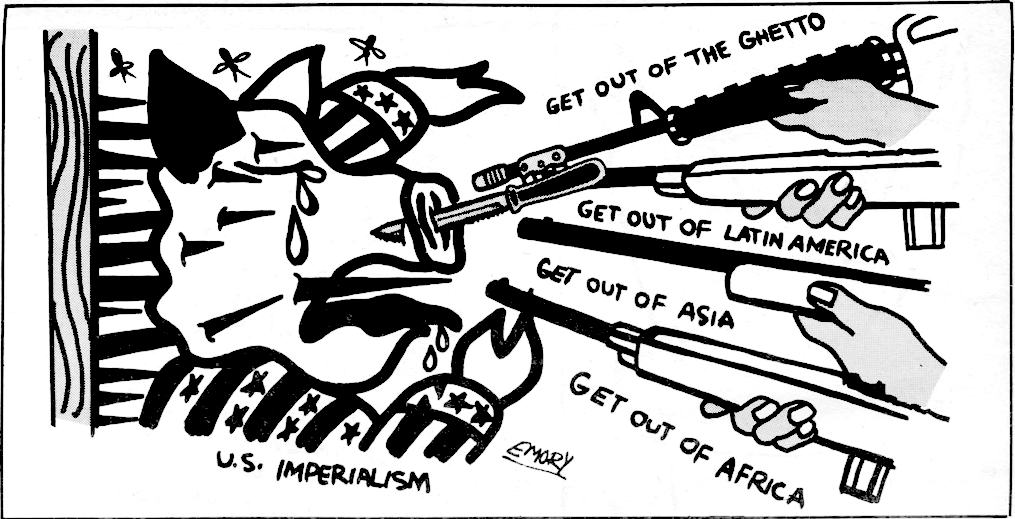
From ‘The Black Panther: Black Community News Service’, June 20, 1967, Oakland, California
It is not known when the first permanent inhabitants, other than Indians, arrived in what was to be the United States. There is insufficient evidence for the historians to make this decision, altho some authorities have pointed out that it is possible the ancient Phoenicians settled in New Hampshire, by way of Iceland and the British Isles, as early as 480 B.C. However, none of the evidence hinting at ancient Phoenician, Roman, Chinese, Irish, or Viking settlements is conclusive.
According to the history books, the first Africans were brought to what later became the United States is 1619, but research in old Spanish documents indicates that the history books are wrong about this important fact, as they are about so many others regarding anything pertaining to the “dark continent.”
The correction is most succinctly made by Herbert Aptheker in his book “American Negro Slave Revolts” published in 1943 by Columbia University Press. On page 163, Aptheker writes:
“The first settlement within the present borders of the United States to contain Negro slaves was the locale of the first slave revolt. A Spanish colonizer, Lucas Vasquez de Ayllon, founded, in the summer of 1526, a community whose probable location was at or near the mouth of the Pedee River in what is now South Carolina. The settlement consisted of about five hundred Spaniards and one hundred Negro slaves. Trouble soon beset it. Illness caused numerous deaths, carrying off, in October, Ayllon himself. Internal dissension arose, and the Indians grew increasingly suspicious and hostile.
Finally, probably in November, Several of the slaves rebelled, and fled to the Indians. The next month what was left of the adventurers, some one hundred and fifty souls, returned to Haiti, leaving the rebel Negroes with their Indian friends — as the first permanent inhabitants, other than the Indians, in what was to be the United States.”
Also
Little Tel Aviv: How Portland Got Progressive Through Ethnic Cleansing, by K. C. Sinclair (2026)
500-Year-Old Slave Revolt of 1526 Redefines Freedom as US Turns 250, by Jesse Hagopian (2026)
Hunted and Banned, by Robyn Maynard (2026)
Another way out: What Black America’s migrant history tells us now, by William C. Anderson (2025)
Reflecting on the Roots of Black August & George Jackson, by Critical Resistance (2021)
General Tubman: St. Catharines, 1858, Part I, II and III by Rochelle Bush (2021)
Fitz St. John: A Longshoreman’s Longshoreman, by the ILWU (2020)
Remember/Resist/Redraw #02: Chloe Cooley, Black History, and Slavery in Canada (2017)
Regina’s radical university students hosted the Black Panthers in 196, by Ashley Martin (2016)
An Exchange Between Sam Greenlee and Lawrence Ytzhak Braithwaite (2007)
The Real Resistance to Slavery in North America, by Russell Maroon Shoatz (2005)
A Poetics of Anticolonialism, by Robin D.G. Kelley (1999)
The “Advantages” of British Imperialism, by Reginald Reynolds (1939)
Institutional Racism, by Howard Adams (1988)
The Black Man in a White Society, by Barbara Jones (1969)
A Black Woman Speaks Out, by Barbara Jones (1968)
Military Adventure in Kenya, by Albert Meltzer (1952)
The Chatham Vigilance Committee and the 1858 Rescue of Sylvanus Demarest, from Wikipedia
Seminole Wars (1818-1858), from Wikipedia
The Narrative of Sophia Pooley (1856)
Negrophobia on Canadian Steamboats, from The Provincial Freeman (1854)
Fugitive Slaves in Canada, from The Provincial Freeman (1854)
A Warning Voice, from Voice of the Fugitive (1851)
Away to Canada!, from Voice of the Fugitive (1851)
Slavery Abolition Act of 1833, from Wikipedia
The Baptist War of 1831-1832, from Wikipedia
On the Constitution and the Union, by William Lloyd Garrison (1832)
African Fort (in Spanish Florida), 1814-1816, from Wikipedia
Black Refugees of the War of 1812, from Wikipedia
Black Loyalists, from Wikipedia
Somerset v Stewart (1772), from Wikipedia
The Saltwater Underground Railroad
No One’s Illegal on Stolen Land
