
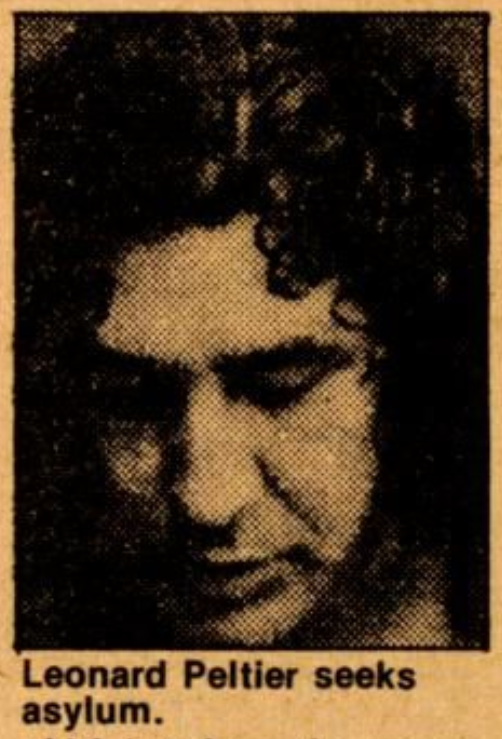
Courts flip-flop over “politics”
From the anarchist periodical ‘Open Road’, Issue One, Summer 1976, Vancouver [MST territory], BC
The recent extradition hearing of American Indian Movement [AIM] activist Leonard Peltier in a Canadian court provided a useful reminder that the supposedly unbendable principles of Anglo-Saxon justice actually suffer from a time warp.
Peltier, a 32-year old Sioux [correction: Lakota-Dakota-Anishinaabe] who is charged with murdering two FBI agents in June, 1975, on the Pine Ridge Reservation in South Dakota, is continuing to fight the extradition to the U.S. on the grounds that he is a political refugee who was persecuted in his native land because of his political beliefs.
After a month of hearings in Vancouver, he has learned at least one thing: that the definition of political has been shaped and embroidered by the judicial establishment over the last century to meet the specific needs of the State and the demands of public opinion in any given age.
The judge in the Peltier case listened to vivid testimony from Pine Ridge residents explaining how a state of war exists between the heavily-militarized U.S. government forces and the Indian nation, and how this struggle was for control of the Indian territories. Then he ruled there was nothing political about the alleged offences.
The decision (it is now being appealed) came as no surprise because British courts in most types of legal proceedings have traditionally been unwilling to hear any argument relating to the use of the judicial system by the State to crush political dissent. The main exception, and this has been a rare occurrence, has been in cases involving extradition to a foreign country.
In the late 19th century, when Canada’s current extradition law was being formulated in Britain, there was a strong public consensus that persons attacking the (non-British) authoritarian governments of Europe should receive asylum in Britain, no matter what method of insurrection was used. This public attitude was reflected in the exemption in the extradition law for “offenses of a political character.”
One of the first occasions in which the courts granted immunity from extradition occurred in 1891 when Angelo Castioni was sought by the Swiss government for the murder of a member of the government of the canton of Ticino during a popular uprising.
The citizens of Ticino had presented a petition to amend the constitution and, under Swiss law, the government was required to put the proposed changes to a vote within a month. The government refused to take the vote and the citizens seized the town arsenal and attacked the municipal palace, at which time the killing occurred. The coup was temporarily successful and a provisional government was established which held power until overthrown by the armed forces of the Federal Government of the Swiss Republic.
Political Extradition
The English judges had little difficulty in ruling that Castioni’s offence was of a “political character” because it was “done in furtherance of or with the intention of assistance, as a sort of overt act in the course of acting in a political manner, a political rising, or a dispute between two parties in the State as to which is to have the government in its hands…” Therefore, offences in the course of coups d’etat or attempted coups would be political.
The same courts demonstrated the effect of political attitudes on their “judicial” decision three years later when a French anarchist, [Théodule] Meunier, charged with murder in France, asked for political asylum. The English judge looked at the earlier decision and decided that “the party with whom the accused is identified… by his own voluntary statement, namely the party of anarchy, is the enemy of all governments.” He concluded that anarchist offences are mainly directed against private citizens, not the governments, and, therefore, Meunier’s offence was not “political”
In 1954, during the height of the Cold War, English judges again showed their adaptability in determining the meaning of “‘political character”. In deciding that Polish seamen who had mutinied were exempted from extradition, even though they had not done so to take power from the ruling party, the English court admitted that judges would always consider the meaning of the term “‘offence of a political character’… according to the circumstances existing at the time when they have to be considered.”
In Canada, the same pattern of self-serving flexibility was demonstrated in the extradition proceedings against American anti-war activist Karleton Armstrong, who had been charged with the bombing of a University of Wisconsin facility which was carrying out research for the U.S. military. The Canadian judge ruled in Armstrong’s case that the university was not an arm of the government and therefore the accused was not being prosecuted for a political offence, even though the bombing was directed against the American war machine. Armstrong was shipped back to the U.S., where he was ultimately imprisoned for a term of 23 years for manslaughter (a bystander had been killed during the bombing.)
In the Peltier case, the judge managed to ignore a whole range of evidence that clearly showed the AIM member would be singled out for persecution on the basis of his political beliefs if he were returned to the U.S.:
— Seventy per cent of the white population of South Dakota believed him guilty even before he went to trial, according to an extensive poll.
— AIM has been subject to a deliberate “dirty tricks” counter-offensive by the U.S., which includes harrassment through phoney arrests, trumped-up charges and long, involved and costly court cases.
— Peltier’s close friend, Anna Mae Aquash, was murdered with a bullet in the back of her head under mysterious circumstances in South Dakota shortly after her arrest on a phoney charge. The FBI at first tried to palm it off as death due to exposure.
— U.S. authorities have consistently used tainted and bought-off testimony and have tampered with evidence in their continuing war against native Indian militants. In a number of cases, such government misconduct has caused the charges to be thrown out of court.
— The civilian population of the Pine Ridge Reservation has been intimidated, harrassed and terrorized by a para-military intervention on the part of the FBI and other government agencies, which are conducting Vietnam-style pacification program under such code names as Operation Cable Splicer and Garden Plot.
Like the anarchist Meunier, who was shipped home because his politics represented a threat to governments everywhere, Peltier is under virtual sentence of death because the militant native movement of North America is equally worrisome to the Canadian and U.S. governments. Considering the extent of oppression of native people from the High Arctic to southern Canada, it would undoubtedly benefit Ottawa to assist the U.S. in destroying the most active elements of AIM. After all, the Mounties [RCMP] have already publicly branded the native movement as a “principal threat to the peace and stability of Canadian society.”
But the same sort of public opinion that saved the bourgeois rebels of the last century is now being mobilized to force the Canadian judiciary to have a second look at its current definition of political.
A key element in the campaign is a flurry of letters, telegrams and other representations on behalf of Peltier to be sent to Justice Minister Ron Basford, c/o The House of Commons, Ottawa, Ont., Canada.
More information on the case is available from the Leonard Peltier Defense Committee, Box 758, Station A, Van-couver, B.C., Canada.
Also
Somerset v Stewart (1772), from Wikipedia
Royal Ethiopian Regiment, 1775–1776, from Wikipedia
Black Refugees of the War of 1812, from Wikipedia
The Chatham Vigilance Committee (1850+), from Wikipedia
Away to Canada!, from Voice of the Fugitive (1851)
A Warning Voice, from Voice of the Fugitive (1851)
Fugitive Slaves in Canada, from The Provincial Freeman (1854)
The 1860-1861 Extradition Case of John Anderson, from Wikipedia
The Sea-Serpent, by Tekahionwake & Sa7plek Joe Capilano (1911)
East and West of Suez, by F. A. Ridley (1941)
A Black Woman Speaks Out, by Barbara Jones (1968)
Native Alliance for Red Power – Eight Point Program (1969)
Capitalism, the Final Stage of Exploitation, by Lee Carter/Maracle (1970)
The Six Nation Iroquois Confederacy stands in support of our brothers at Wounded Knee (1973)
Frank Clearwater and Buddy Lamont Killed at Wounded Knee, from Akwesasne Notes (1973)
Wounded Knee: The Longest War 1890-1973, from Black Flag (1974)
“Jails are not a solution to problems” – Anna Mae Pictou Aquash interviewed by Candy Hamilton (1975)
Martin Sostre and the Open Road Interview (1976)
The Brave-Hearted Women: The Struggle at Wounded Knee, by Shirley Hill Witt (1976)
Indian Activist Killed: Body Found on Pine Ridge, by Candy Hamilton (1976)
Anna Mae Lived and Died For All of Us, by the Boston Indian Council (1976)
Palestinians and Native People are Brothers, by the Native Study Group (1976)
Repression on Pine Ridge, by the Amherst Native American Solidarity Committee (1976)
400 Years Later, by Leonard Peltier (1976)
The Butler-Robideau Trial: The Rain of Terror, by Peggy Berryhill (1976)
Chronology of Oppression at Pine Ridge, from Victims of Progress (1977)
Excerpts from Leonard Peltier’s Trial Statements With Regard to Anna Mae Pictou Aquash (1977)
Review of ‘Open Road’, from Cienfuegos Press Anarchist Review (1977)
Review of ‘The Life and Death of Anna Mae Aquash’, by Akwesasne Notes (1978)
Anna Mae Aquash, Indian Warrior, by Susan Van Gelder (1979)
Indian Activist’s Bold Life on Film, by John Tuvo (1980)
Statement by Leonard Peltier on the Sixth Anniversary of the FBI Attack (1981)
Solidarity with Palestinian and Lebanese Freedom Fighters, by Leonard Peltier (1982)
Against the Corporate State, by Gary Butler (1983)
Henry Bibb Walton, by John K. A. O’Farrell (1985)
Solidarity from Anti-Authoritarians, by Leonard Peltier (1990)
Leonard Peltier Regarding the Anna Mae Pictou Aquash Investigation (1999-2007)
Redemption, by Standing Deer, Seth Tobocman & Barbara Lee (2000)
What is the Native Youth Movement? (2002)
Native Spirituality in Prisons, from Wii’nimkiikaa (2005)
(PDF) Free John Graham – Honour Anna Mae Aquash (2009)
Josiah Henson, by Eli Yarhi (2015)
A Gustafsen Warrior in Exile: The Story of ‘OJ’, by Rob Smith (2016)
Richard Pierpoint, by Zach Parrott (2016)
Leonard Peltier’s Statement for Ramona Bennett (2018)
Anna Mae Pictou Aquash: Warrior and Community Organizer, by M.Gouldhawke (2022)
Leonard Peltier to be transferred to house arrest, edited by HIWH (2025)
Canada sees dramatic rise in deportations, asylum seekers among majority, by Tessa Bennett (2025)
No One’s Illegal on Stolen Land
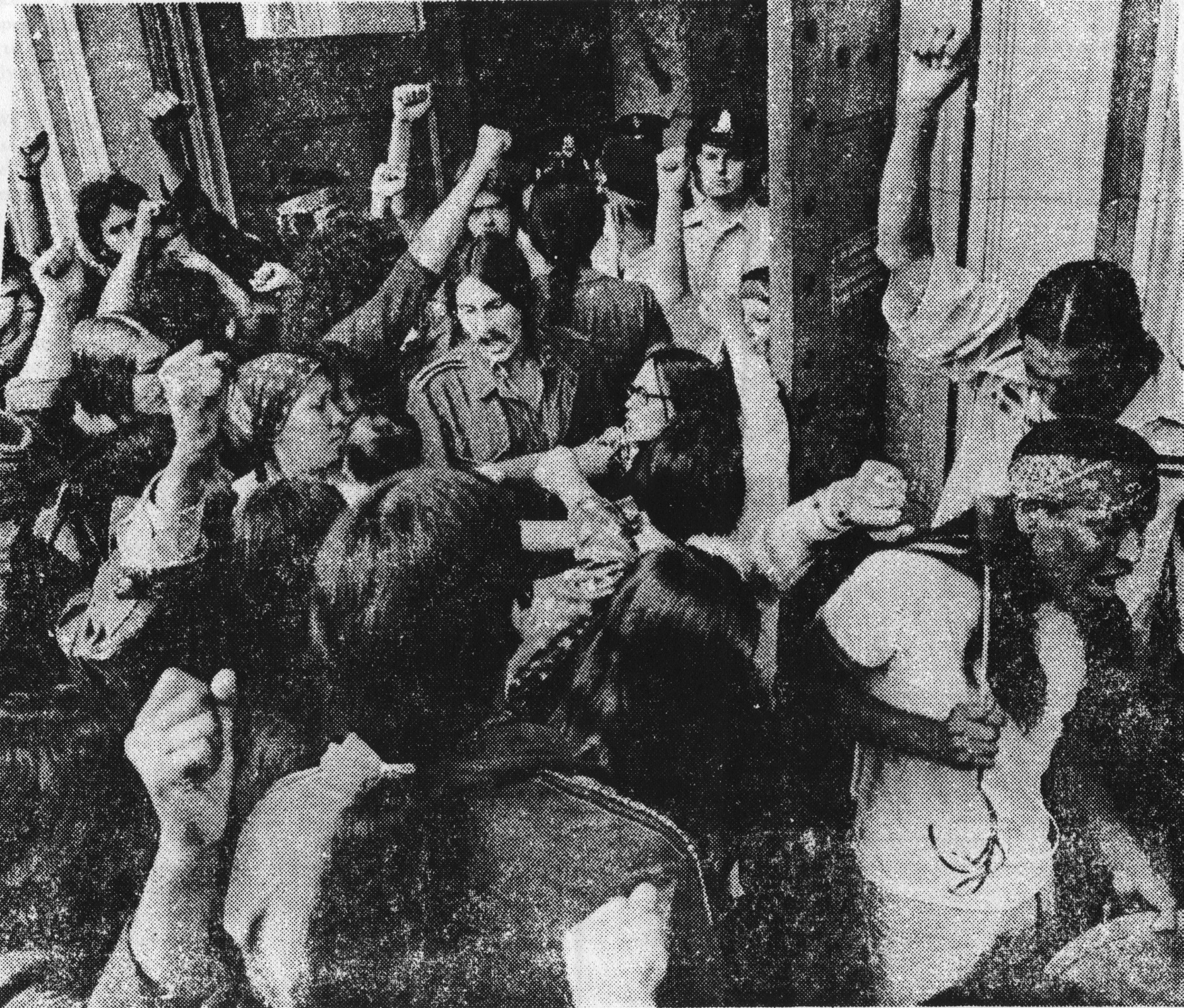 Peltier supporters outside the court in Vancouver (MST territory), BC
