
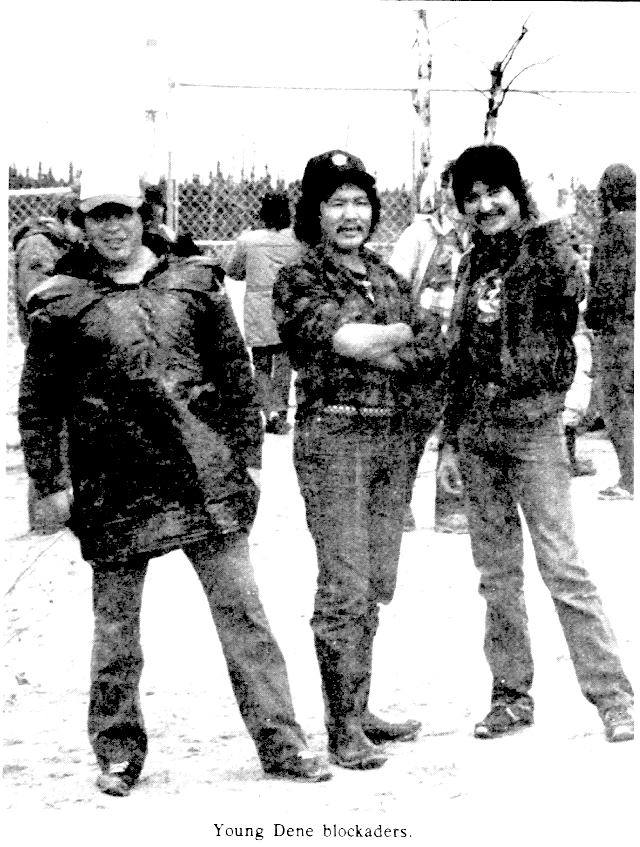
From ‘Open Road’, Spring 1986, Vancouver (MST territory), BC
Dada-the. Literally, “death-rock” in Dene, uranium in english. In 1984, Canada became the number one producer and exporter of uranium in the western world, surpassing the USA for the first time. Most of this uranium is mined in the homeland of the Dene peoples, northern Saskatchewan, Canada. It was uranium from the Northwest Territories which helped produce the nuclear bombs exploded over Hiroshima and Nagasaki. Today, uranium mined in Saskatchewan directly fuels the nuclear chains and weapons programs of several western nations, foremost USA and France.
Throughout the 1970’s, the social democratic government of Saskatchewan diligently built up the infrastructure necessary to accommodate the boom in uranium exploration and mining. Resistance to ‘progress’ was discouraged by co-opted native leadership, who emphasized economic benefits to impoverished constituencies. Indeed, the Federation of Saskatchewan Indians [FSIN] proceeded to set up, with state/corporate funding, the Saskatchewan Indian Corporation (SINCO) whose main function was to truck the uranium to southern Canadian distribution points. SINCO Security is a special arm of this enterprise, responsible for guarding the uranium mine sites.
The constellation of transnational resource corporations now active in northern Saskatchewan include French, West German, American and Japanese based interests. The high grade of uranium ore close to the surface, and compliant Canadian and Saskatchewan state corporations are major factors attracting the transnational investment. However, just as significant is the relatively low level of political opposition in Saskatchewan, compared to Australia or Namibia. Saskatchewan thus remained the only important growth area for the global uranium industry, undercutting competing areas in terms of price, quality and assured supply.
Northern Saskatchewan is a beautiful country of abundant forests, wild berries and other edible plants, wildlife, fish and interconnecting lakes and rivers. The air is still refreshing to breathe and the water tastes good. A person can still catch a fish or animal with some assurance it is free of toxic chemicals and pollutants. This 300,000 sq. km. area is rapidly changing from one of the few unpolluted spots in the world to a radioactively contaminated ‘national sacrifice area’. Spills and leaks of radioactive materials and toxic chemicals that spread wastes into the environment, worker accidents and radiation ‘overexposure’ are common at uranium mines in Saskatchewan.
The wastes from the 25 open pit and underground mines that were operated near Uranium City from 1953 to 1982 were dumped without treatment onto nearby land and into lakes. One lake now contains no fish or plant life because the water has become too acidic from chemicals used to process the uranium. Some lakes have more wastes than water and some of these 12 million tonnes of wastes have overflowed into Lake Athabasca. The extremely dangerous radioactive radium wastes from the Cluff Lake operations which began in 1978 have been placed in nearly 3,000 two-tonne concrete containers, of which 200 are now leaking. In 1982 a spill of over two tonnes of this material with radiation levels 600,000 times the regulation level was reported. Cluff Lake Mining has still not decided what to do with this material.
The latest and most spectacular accident was the spill of 100 million liters of radioactive liquid with radiation levels at least 20 times regulation levels at the Key Lake mine in 1984. The open pit at Key Lake is the world’s largest and contains a very high grade ore. Many spills occurred at Rabbit Lake mine during its operations from 1975 to 1984. From 1975 to 1977 the waste liquid released into Wollaston Lake frequently contained toxic levels of ammonia.
In spite of these problems and catastrophic accidents the government departments responsible for the protection of the environment at both federal and provincial levels continue to allow explorations to proceed. One of these developments is the Collins Bay ‘B-Zone’ open pit which began operations last summer. This mine is especially dangerous because the uranium is actually under the bottom of Wollaston Lake. Wollaston Lake is the major commercial fishery of northern Saskatchewan and many Dene families make their living from it.
The thin sheet steel dike that has been built to keep lake water out of the pit may not be high enough to withstand strong waves which are a common occurrence on the lake. Radiation will seep through the ground and even more radiation will spread into the lake when the dike is removed after operations are completed. Radiation from the wastes that will be placed in the nearby abandoned Rabbit Lake mine pit will also leak and leach into Wollaston Lake and also spread into the environment through the air.
The ‘B-Zone’ is only one of many high grade deposits in the Wollaston area. There are four more deposits under Wollaston Lake at ‘A-Zone’, ‘D-Zone’, ‘Eagle South’, and ‘Eagle Point’ in Collins Bay. Several more deposits are located west of Wollaston Lake at Dawn Lake, Midwest Lake, McLean Lake, Raven-Horseshoe, West Bear, McCarthur and Cigar Lake adjacent to the south-west shore of Waterbury Lake. The deposit of 230,000,000 pounds of 10 per cent average grade uranium at Cigar Lake is even larger and richer than Key Lake and one uranium company stated that robots may be needed to remove it because radiation levels will be so high in the underground mine needed to remove the ore.
Mining this extraordinarily high grade uranium ore is so profitable that one American uranium executive was quoted recently calling Saskatchewan “the Saudi Arabia of the uranium business.” The lax licensing and environmental protection regulations by both provincial and federal governments encourage developments and ensure profitable operations. In fact both levels of government are directly involved in the uranium industry through the provincial crown corporation Saskatchewan Mining Development Corporation (SMDC), which is involved at Key Lake, Cluff Lake, Cigar Lake, Dawn Lake and other mines and exploratory drills; and the federally owned Eldorado Nuclear, which recently purchased the Rabbit Lake/Collins Bay operation from Gulf Minerals.
International corporations are enjoying the political climate of the Saskatchewan uranium business. Foreign companies involved with SMDC in the Cigar Lake venture include Cogema Canada, a subsidiary of the Atomic Energy commission of France, and Idemitsu Kosan of Japan. The president of one company operating in Saskatchewan was quoted in the March 1985 issue Saskatchewan Business: “I’d rather face the technical problems of mining Cigar Lake than the political hassle of developing a uranium mine in Australia.”
Four day blockade of uranium mine
In the summer of 1985 an unprecedented protest took place in northern Saskatchewan on the west side of Wollaston Lake. All traffic in and out of Rabbit Lake and Collins Bay uranium mines was blockaded for eighty hours from June 14 – 17, 1985. A few kilometres up the road from the blockade, mining had continued unhindered by opposition for over a decade. Mining for uranium has taken place in northern Saskatchewan for over three decades. The action marked the first publicly announced, planned act of civil disobedience against the uranium industry in Saskatchewan.
The blockade was significant for several reasons. First, it was a response to the appeal of the Dene people of Wollaston Lake, who initiated and led the actions. In the past, resistance to uranium mining in northern Saskatchewan has been initiated by urban-based groups, including the American Indian Movement and assorted non-native antinuclear groupings. These initiatives were often met by suspicion and even hostility by the Dene, who have experienced their share of ‘well-meaning’ colonial interlopers.
Second, it marked the first co-ordinated international mobilization. In addition to the scores of Dene who came to help the people of Wollaston from several villages in northern Saskatchewan and Manitoba, non-native anti-nuclear/pro-Dene land rights activists came from across Canada, and protests took place in Toronto, Montreal, Copenhagen, Dublin, Stockholm and several Australian centres.
Third, it was the first act of resistance to uranium mining in Saskatchewan to receive national media attention, spurring state and corporate officials to respond with both coercive and co-optive means.
Over the period of the blockade about 250 people participated, with about 10% being non-native. The vast majority of blockaders were Chipewayan/Dene residents of the nearby community of Wollaston Lake. Supporters came from the northern Dene communities of Lac Brochet, Black Lake, Pinehouse, Southend, La Ronge and lle a la Crosse. Supporters also came from southern Canadian communities in BC, Alberta, Ontario and Quebec.
An hour and a half after lifting the blockade, 22 eighteen-wheeler trucks rolled through into the mine site. This negated claims by industry spokesmen that the blockade had no effect on operations of the mine. There is no question that the blockade sent a shockwave through the state/corporate apparatus which operates the mines. The opposition was shown to be alive and well, but mining continued without missing a beat. The momentum of 300 years of colonialism in northern Saskatchewan pushed through another ‘victory’. For the Dene and for the Earth, the battle was lost but the war was on.
The blockade was preceded by a four day gathering at Wollaston Lake. Meetings began in early afternoon and continued well into the evening. Speaker after speaker stood up and expressed their concerns from the heart. Each night, after the meetings, dancing would begin and go on until dawn. Benjamin Denedcheze of Lac Brochet opened a community meeting in the Wollaston Band Hall, June 12th with the following prayer: “We Natives and Whites, let us put our minds and hearts together and may the Great Spirit guide us to whatever aid we can find to save Mother Earth, because she gives and she provides. So let us keep her clean as she was for generations and help work together without hurting one another.”
Eldorado built a new gate across the road just a few weeks before the blockade. It was erected about two kilometres from the mill buildings, cleverly placed just around a corner where the mill buildings were out of view and keeping open an access road to the main waste area. A sign on the gate read “No Trespassing: Trespassers Will Be Prosecuted,” in English, French, Cree and Chipewayan syllabics. But despite all Eldorado’s preparations they were not ready for the large group of people that closed the road Friday morning, June 14th.
When the cars, trucks and vans holding about 150 people arrived, Eldorado security vehicles sat a few hundred yards inside the gate. After a short while, a group of Dene elders and supporters walked around the gate. There they asked the Eldorado staff for a meeting with mine management. The request was refused. Hector Kkailther, Chief of the Lac La Hache Band of Wollaston Lake then phoned Saskatoon to request a meeting with mine manager Mike Babcock. The atmosphere remained calm when Babcock agreed to a meeting, but no date or location was set.
Friday the road was turned into a place for celebration and living. It was a sight that could bring spirit back into the heart of the most burnt-out activist. A cooking fire sat square in the middle of the road. Large stones were pushed in front of the gate and used as comfortable stools. People sat calmly as if there wasn’t a worry. In the evening, elders stood around the fire and sang songs as old as the land while beating a Caribou skin hand drum. At the same time young and old participated in a traditional round dance — people danced in a circle with the fire and elders in the centre. On the side of the road about 25 tents were pitched.
In sharp contrast to this peaceful scene was the ever present dull roar of mine machinery and vigilant Eldorado mine security personnel. But the sound of the drum and singing carried well into the Eldorado camp. Some of the mining staff seemed to expect flaming arrows to come flying across the gate at any moment.
Saturday, Chief Kkailther announced that Babcock agreed to a meeting at the mine gate Monday, June 17th. Soon afterwards the RCMP (federal police) announced there would be no traffic in or out of the mine site until after the meeting. It looked as though the people’s views would finally be heard. The stress of dealing with the threat of arrest was temporarily relieved. More and more people arrived to take part in the blockade.
The blockade was also physically bolstered by the erection by protesters of a second ‘security gate’ on the road, which served to keep guns, alcohol and drugs out of the blockade environment. The RCMP were informed they would have to relinquish their guns and submit to being escorted by Dene elders if they wished to enter the blockade area. The police became indignant at this request and so were refused entry.
Sunday the mood changed dramatically. The RCMP arrived in plain clothes from inside the mine site. They had flown across from Wollaston and landed inside the mine area. A short, private meeting was held with Chief Kkailther. The RCMP gave the word that Babcock would not meet until after the blockade was lifted, and the place would be the mine site or at Eldorado headquarters in Saskatoon.
Only a small delegation of Dene Chiefs and elders would be permitted to attend. And to top it off, the RCMP said, “The trucks will get through.” It was later leaked by an Eldorado employee that Babcock had been willing to meet with everyone at the mine gate but that the RCMP had intervened, perhaps with orders from their state superiors. A confrontation was being forced. It was time to make a decision. Monday afternoon the Wollaston people and supporters sat in a circle amongst the trees and held council. The decision was made to lift the blockade pending the outcome of the meeting.
The meeting was held in Saskatoon on the following Thursday, June 20th. Most of the Dene Chiefs of northern Saskatchewan attended, as did corporate and state officials. However, the dominant personality at the meeting was one Sol Sanderson, the pro-nuclear president of the umbrella group, Federation of Saskatchewan Indian Nations. Sanderson was quoted as saying, “We’re talking about the bottom line being dollars, yes, for Indian development, for Indian control.” Chief Kkailther was clearly intimidated by Sanderson’s brazen paternalism and the threats of economic catastrophe to his people should the mines shut down. The importance of the protest was downplayed and replaced with promises of economic funds for community development.
False and outrageous statements were made by Sanderson in an effort to split the Dene from outside supporters, and discredit the support work that had been done. Quote, “We’re not going to be preoccupied with protestors because these same protesters from the outside are protesting in Europe and across this country now with Greenpeace opposing our traditional livelihood in terms of fur, hunting, trapping…”
Continued resistance is uncertain. Supporters across the country are waiting for direction from the Dene people, pending further meetings with state and corporate officials, both Indian and non-Indian. It is important to continue support of resistance at Wollaston. There are vital questions which are not being addressed by the state, corporations and the FSIN. The question of the legality of Treaty #10, land claims, and aboriginal rights and protection of those for the Dene peoples of northern Saskatchewan. Treaty #10 was signed in 1907. Elders who were in their teens at the time of its signing tell how the people were guaranteed that their hunting, fishing and trapping would never be disrupted. The treaty was written in English — none of the Dene could read the document. To this day, the reserve lands promised under Treaty #10 have never been allocated.
Another serious question for the Dene in dealings with the state/corporate apparatus is long-term clean-up of mine sites and the problem of existing wastes. Eldorado has proposed that three people from the Wollaston community be nominated to regularly visit the mine and observe monitoring. The Dene have been saying that they want to be part of monitoring, and want to conduct water sampling — they don’t want observer status.
It is of vital importance for people to continue support for the resistance at Wollaston Lake. The Dene want and need information if they are to make decisions in the best interests of the people and the land.
For more information, contact:
Lac La Hache Band,
Wollaston Lake, Saskatchewan,
Canada SOJ 3C0
Collins Bay Action Group,
Box 3183,
Vancouver, B.C.
Canada V6B 3X6
N.B. “Voices From Wollaston Lake,” a book documenting the Wollaston Lake people’s struggle against uranium mining, focusing on the June 1985 gathering and road blockade will be published in Spring 1986. Contact CBAG at above address for more information on this.
Also
Anti-Uranium Summit Sheds Light on Toxic Industry, by Sean Summers & Unicorn Riot (2026)
The Downward Spiral of Militarism, by K. C. Sinclair (2025)
The Human Cost of Nuclear Testing, by the International Campaign to Abolish Nuclear Weapons (2021)
(PDF) The Irradiated International, by Lou Cornum (2018)
For The Navajo Nation, Uranium Mining’s Deadly Legacy Lingers, by Laurel Morales (2016)
Indigenous Canadians Are Fighting the Uranium Mining Industry, by Michael Toledano (2015)
Why an apparent Israeli nuclear test in 1979 matters today, by Leonard Weiss (2015)
The victims of Fallujah’s health crisis are stifled by western silence, by Ross Caputi (2012)
Confronting Ward Churchill, uranium mining and repression in Vancouver (2007-2008)
Canada’s Deadly Secret: Saskatchewan uranium and the global nuclear system, by Jim Harding (2007)
For a nuclear-free and independent Pacific, by Susanna Ounei-Small & Norm Dixon (1995)
Uranium, by Magnus Isacsson (1990)
Lubicons Declare Autonomy, by Reality Now (1988)
NATO Fighter Planes Invade Innu Territory, from Open Road (1987)
Against Nuclear Technology, by Pierleone Porcu (1986/2015)
Strange Victories, by Midnight Notes / Elephant Editions (1985)
How We See It, by the Vancouver Five (1983)
AIM Brothers: Busted Not Broken, from Open Road (1982)
Japanese Delegation Supports U.S. Anti-Nuclear Movement, by Tom Barry (1978)
Who Gets Political Asylum?, by Sandra Montague (1976)
The Russell-Einstein Manifesto (1955)
Stop the Bomb, by Murray Bookchin (1954)
Mankind and the State [on nuclear war], by Marcus Graham (1946)
Gentlemen, You Are Mad, by Lewis Mumford (1946)
No One’s Illegal on Stolen Land
Anarchism & Indigenous Peoples
