
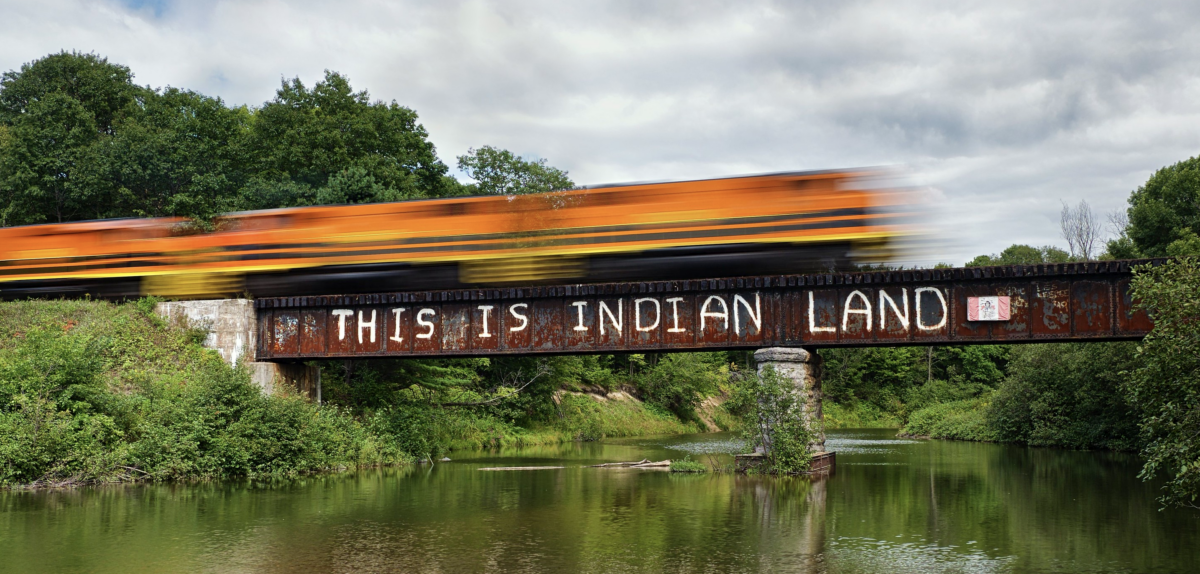
From ‘Open Road’, Fall 1988, Vancouver (MST territory), BC
Since the white man came to this continent, native peoples have been struggling to survive in the face of genocidal colonization. These days their patience has turned to outrage as they see time and again, even as they jump through courtroom hoops and have a real desire to share, that the white man serves corporate interests and not the people, least of all theirs. Canada is seeing renewed resistance in the form of direct action as native peoples come together to protect their land and way of life from encroachment and destruction.
* * *
The Gitksan-Wet’suwet’en of the Skeena region in northwest BC recently claimed a victory with a blockade at Sam Greene Creek on the Babine River. Since May of ’87 (see OR #22) the Gitksan-Wet’suwet’en have been fighting the provincial and federal governments for legal recognition and jurisdiction over 22,000 square miles of their territory. In spite of this land title action, Westar Timber was going to build a bridge across the Babine to access these northern territories. But the Gitksan-Wet’suwet’en for weeks had set up a blockade of tents, smokehouses and sweatlodges, forcing Westar into the courts where the two filed applications for opposing injunctions.
In passing judgment, the judge used the Babine River as a dividing line, allowing Westar to log south of the river, but preventing them from building a bridge. Since the logging companies can’t get logging permits unless a bridge is built and the Gitksan-Wet’suwet’en never disputed the territory south of the Babine, this is definitely a victory.
* * *
In mid-October, the Lubicon Lake Crees set up barricades on roads near their settlement at Little Buffalo in Alberta’s northerly Peace River region. After nearly half a century of patient, persistent attempts at negotiations with the Canadian state for a reserve, the Lubicons had had enough.
They renounced the jurisdiction of Canadian courts and authority, stating no one would be allowed to enter unless they had the Lubicon’s permission. Well, it got premier Getty moving; he ordered the queen’s cowboys to dismantle the blockades and, in the process, arrested 27 people. But Chief Bernard Ominayak stayed firm with his people — he said more blockades would be set up if the premier wasn’t prepared to negotiate in good faith. Sixty hours after the blockades were torn down, Ominayak and Getty agreed that the band would receive 204.5 square kilometres of provincial crown land for a reserve and the surface rights to another 40.5 square kilometres.
The attorney-general’s department has offered to drop the contempt of court charges if those arrested apologize to the court, but none of them is willing to do so. Terry Laboucon, the first of those charged, has been fined $200 but refuses to pay, and his lawyer declares that his client did not recognize the court’s right to hear the case. Frederic Lennarson, who is also charged said, “We acknowledge the power of the police state stormtroopers to drag us before the court, but we don’t recognize the court’s jurisdiction.”
While the Lubicons and Alberta have agreed on the size of a reserve, the federal government will only provide services to band members who qualify as status Indians. The band says everyone of its 478 members must be included in the settlement. The difference in figures involves anywhere between 75 and 200 people. Meanwhile, in the absence of any agreement, Alberta has encouraged extensive oil exploration. The Lubicons say this has destroyed their way of life; oil drilling near Little Buffalo has brought alcoholism and crime but no benefits. The wells in the Lubicon’s hereditary homeland produce more than $1,000,000 of oil a day. None of the 245 kilometres they’ve been allotted has any oil wells on it.
* * *
Ka-Daki-Menm, “Our Land,” known as Temagami, has been the homeland of the Teme-Augama Anishinabi for 6,000 years. These people have never ceded their 4,000 square mile area in any government treaty. “Officially” the Teme-Augama Anishinabi occupy a 100 square mile reserve, Bear Island, at Lake Temagami’s southern outlet in Ontario. They have been involved in a legal battle for recognition of their land rights and jurisdiction for their entire traditional area for fifteen years.
Plagued not only by the genocidal violence of white invasion and colonization, but more recently by hydro-electric flooding, clearcut logging, white tourists, and the ensuing hunting and fishing prohibitions — all contribute to the erosion of their land-based economy. The final degradation has been thrust upon them and their land, and they are fighting back.
On May 17, 1988, the minister of natural resources announced that the construction of the Red Squirrel Road extension and the Pinetorch Road development would go ahead. If completed, this extension would link with Liskeard Lumber road, enabling the government and corporations to obliterate, through clearcutting, the land they stole.
On May 22, the Teme-Augama Anishinabi Tribal Council decided by consensus to form a blockade on the west and east ends of the proposed Red Squirrel extension to “stop further bush road developments in our unsurrendered Motherland.” On June 1, they established two blockades — the Wendaban and Misabi Camps, and are committed as a community to maintain these camps until there is no threat of further road developments and their still active land claim has been settled. The Ontario court of appeal hears their aboriginal claim in January 1989.
* * *
On the east coast, the Innu of Nitasinan in the Quebec/Labrador/Newfoundland region have resorted to doing sit- and camp-ins on the air farce runways and bombing ranges in an attempt to stop the low-level military flight testing that has been destroying their way of life.
In Goose Bay, Newfoundland, 150 natives were arrested in October after occupying the main runway at the Goose Bay Air Farce Base. They were protesting military aircraft training. The queen’s cowboys joined the military police to clear the runway of the people of the Sheshatshit Innu Band. Nine were charged with mischief. Jets from Canada, West Germany, the Netherlands, Britain and the United States do approximately 50 testflights a day. 10,000 Innu live in Quebec and Labrador.
* * *
The Barriere Lake Band in Quebec is also using direct action to protect their land and way of life. The Algonquins of the Rapid Lake Reserve, numbering about 450 members, have a 59-acre reserve north of Ottawa. The reserve is eroding badly and there is no more land to build houses, existing homes are over-crowded, and they need a new school. They have been severely affected by clearcut logging and see the installation of hydro lines as another infraction. All this development scares away the animals; most members rely on hunting and fishing for their survival and the band is worried about the environmental damage and the effect this may have on their children.
The Barriere Lake Band has never relinquished jurisdiction over their territory. The Wampum belt agreement recognized that any use of land and resources would be negotiated with the First Nations. Despite repeated efforts at gaining rights, the band was getting nowhere. So in July, they set up information blockades on the highway running through their land. They also set up an encampment to impede further development of hydro lines. Regular hunting and fishing activities continue from there.
The band also set up an encampment on parliament hill in late September/early October to force a moratorium on clearcutting and other environmentally damaging activities. About 70 people took part in the action. The tents were torn down and people served with notices to appear in court.
* * *
On June 1, 1988, members of the Mohawk Warrior Society set up a roadblock that lasted 29 hours. They blocked the Mercier bridge outside of Montreal with cars, trucks and gravel to protest a raid on the Kahnawake Reserve earlier that day. At the centre of the raid is a dispute over the sale of tax-free cigarettes. During the raid 17 people were arrested and $450,000 in cigarettes were seized when 200 RCMP wearing bullet proof vests and armed with machine guns swooped down on six cigarette shops on the reserve.
Under the Jay Treaty signed in 1794 between the United States and Britain, all Mohawk Nations are allowed to trade and carry out business deals with each other. These treaty rights were brought into Canadian law when the constitution was signed in 1982, and are protected.
Kahnawake residents said they wouldn’t reopen the road until federal officials initiate negotiations addressing “the invasion of our territory, the sovereignty of the Mohawk Nation and our mutual treaties.” Kahnawake Council member Brain Deer said “this isn’t about cigarettes, it’s about a foreign government invading our territory.”
The blockade came down when Chief Joe Norton met with Ottawa for negotiations. No guarantees were worked out though; the feds wouldn’t promise to not raid the reserve again and in turn Norton refused to guarantee that the sale of “contraband” cigarettes would stop.
Sovereignty has always been at the bottom of disputes between the Mohawks and the Canadian state. In 1958 the St. Lawrence Seaway was pushed through Mohawk land in the wake of a settlement that many Mohawks say was signed illegally by the band councils.
* * *
Self-determination and autonomy in the face of degradation and repression by the state should be regarded with utmost respect. Each and every one of these actions are the result of a culmination of decades of refusal by the Canadian state to give recognition to native peoples and their right to self government. Give your support and write to the tribal councils to find out how:
* Gitksan- Wet’suwet’en Hereditary Chiefs; Box 229, Hazelton, BC, VOJ 1Y0 (604-842-6511).
* Naskapi Montagnais Innu Association; Sheshatshit, Labrador, AOP 1MO.
* Teme-Augama Anishinabi; Bear Island, Temagami, Ontario, POH 1CO (705-237-8944).
* Mohawk Nations; c/o Akwesasne Notes, PO Box 196, via Roosevelt Town, NY, USA, 13683-0196 (518-358-9531).
* Lubicon Lake Band; 3536 – 106th Street, Edmonton, Alberta.
* Canadian Alliance in Solidarity with Native Peoples;
16 Spadina Road, Toronto, Ontario (416-964-0169).
— thanks for Ecomedia Toronto for some background information
Also
The Indian Claims Commission is illegal, unjust and criminal, by Karoniaktajeh (1965)
Who Gets Political Asylum?, by Sandra Montague (1976)
Gitksan-Carrier [Wet’suwet’en] Declaration (1977)
Wounded Knee: The Longest War 1890-1973, from Black Flag (1974)
Indian Wars in Quebec, by Peter McFarlane (1981)
AIM Brothers: Busted Not Broken, from Open Road (1982)
Resistance at Wollaston, from Open Road (1986)
Innu Campaign Against the Militarization of Ntesinan, by Ben Michel (1986)
NATO Fighter Planes Invade Innu Territory, from Open Road (1987)
Lubicons Declare Autonomy, by Reality Now (1988)
Solidarity from Anti-Authoritarians, by Leonard Peltier (1990)
How to Become an Activist in One Easy Lesson, by Joe Tehawehron David (1991)
Thoughts on the Constitution and Aboriginal Self-Government, by Howard Adams (1992)
Chronology of Teme-Augama Struggle, by the Kingston Temagami Action Group (1996)
What is the Meaning of Sovereignty?, by Sharon H. Venne (1998)
Ralph Chaplin Hanging Out With Chief Leschi in Tacoma, by Arthur J. Miller (2001)
(PDF) B.C. Native Blockades & Direct Action: from the 1980s to 2006, by Warrior Publications
Indigenous Resistance, 1960s to 2007, by Warrior Publications (2007)
Colonization: A War for Territory, by Zig-Zag (2012/1999)
IdleNoMore in Historical Context, by Glen Coulthard (2012)
Oka Crisis: 1990, by Warrior Publications (2014)
Wet’suwet’en / Gitxsan / Haudenosaunee / Mi’gmaq Strong, edited by HIWH (2020)
Anarchism, May Day and Colonialism, by K. C. Sinclair (2026)
