
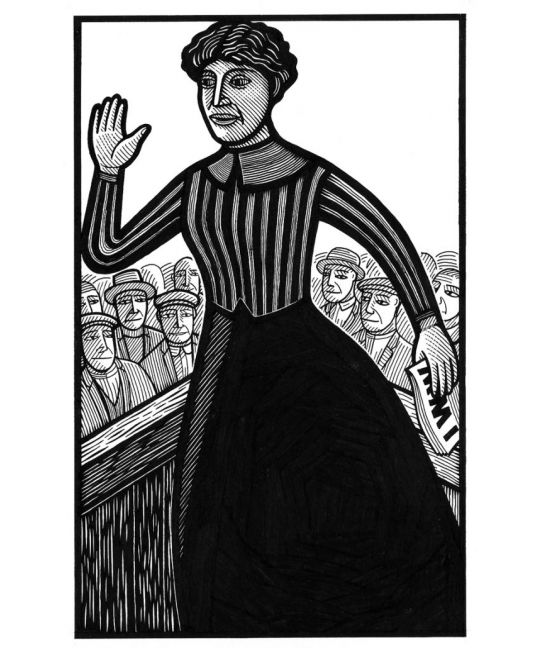
From ‘The Liberator’, January 28, 1906, Chicago, edited by Lucy E. Parsons
In No. 21 of The Liberator, A. Klemencic suggested that a general movement be set on foot now to inaugurate the movement looking to an observance of the 1st of May as an International Labor Day.
This suggestion is timely. What more fitting time than the first of the beautiful month of May, when all nature has aroused from its long winter sleep, when birds are singing, flowers bursting and fields and forests are taking on their beautiful verdure, for the sons and daughters of all lands to quit the abominable slave pens, the factory with its hideous din and smoke and dirt, the black, foreboding mines, and the red-hot forging mills, and come together for one day to feel the warmth of a common interest, of solidarity and fraternity?
By making this day an International holiday, there are so many pledges that the working class can make to each other, for instance: they can declare against war, or if the “powers that be” wish war, they can do their own fighting; they can decide how many hours they propose to work; they can declare in favor of the General Strike and prepare to enforce it.
Let us hear from the readers of The Liberator regarding the first of May as an International Labor Day.
L. E. P.
1st of May International Holiday – Andrew Klemencic (1906)
From ‘The Liberator’, March 4, 1906, Chicago, edited by Lucy E. Parsons
Who among us proletaires did not get a ray of hope at the result of the “Socialist Convention” held in Paris, 1889, declaring the “First of May an international holiday”? It was a very natural inspiration for the class conscious toilers, who, nourishing themselves with a “glimpse” of the motto “Proletaires of the world unite.” Just think of it; what it does mean when all work has to cease one day at least at the toilers’ will around the globe!
The imagination of one day of freedom for the oppressed and exploited all over the world, met with fear and trembling by the lords and masters of the bread. With anxiety and apprehension they looked for the day when the all powerful giant “Labor” would dictate his own rights on what he produces and distributes. All the parasites were aroused to the fact that it is nothing coming to them, “since they are doing no useful work, therefore neither shall they eat.” Apostle Paul had no use for parasites. That is why “the powers, by the will of God,” in their histories gave them away and blaringly showed that they only possess powers by will of “OUR carelessness and ignorance.”
However, the 1st of May did not realize what was hoped for it by the toilers; politicians succeeded to cradle and mesmerize that big boy “Labor.” In order that the fakirs may have an easier time of it. The leading “parliamentary socialist dignitaries” expelled from subsequent “Conventions” the “crazy and fanatic Anarchists.” The leading lights of “political conquest” conquered seats in various parliaments of Europe and solved their own social problem.
After the expulsion of anarchists from the “Zurich Convention,” 1896, the Anarchist agitation was thought to be blotted out for good. The popular demand for the eight-hour work day was forgotten. Agitation for the general strike was called impossible, therefore crazy. Anti-military manifestations were declared impracticable, and so it was no use for the “voters” to bother with those problems: the congressmen will settle all these “knotty problems in the halls of parliaments.” There was no need of manifestations; the leaders will settle all troubles and disputes.
It has been my lot to be a speaker on May 1, 1890, in Trieste, Austria, witnessing the tremendous enthusiasm that stirred up the hearts of proletaires present at that memorable public garden open air meeting. The masses were ready to act. Nothing was too radical for them. Anarchist literature was at a premium. I was thrilled with fervor and courage at the magnitude of the rousing display in the awakening for the manifestation of a new life and the readiness to “take our rights” as the creators of all wealth, was stern and impressive.
Again it was my lot to run up against indignities and ostracism which was meted out from the “party socialists” in Switzerland in consequence of my “May Day” address at the cathedral in Chaux de Fonds, 1891.
Comrades E. Pouget, F. Pelloutier, C. Paulet and a few more were working hard in Paris in the early nineties to maintain the agitation for the eight hour work day and for the popular demonstration of May 1.
It was this group of men meeting at the office of the “Pere Peinard” that developed the idea of the “Bourse du Travail,” and also helped to organize it into something like the “Trades Councils” in this country. The radical elements in these “councils” formed the “Federation Generale du Travail.”
1900, the organization to start with was still under control of politicians. However, this organization was patterned after the Spanish “Federacion Obrera,” which is fully ten years older and is the oldest revolutionary workingmen’s organization.
The I.W.W., which was organized last year in Chicago, is based also on the same principles: class struggle, solidarity of the workers, possession and control of production, distribution and communications by the industrial unions engaged in the respective utilities or services. Since the socialist schemers succeeded in France to grab more for more graft, the radicals turned the tables in the convention at Burges two years ago, where, for the first time in the history of “organized labor,” two-thirds of the delegates accepted the Anarchist method to reach the old popular demand: the eight hour work day on May 1, 1906, by what they call “Direct action.”
It was decided to organize an intense agitation in favor of eight hours. Every city and village has its committee at work for organizing meetings, distributing revolutionary literature, placarding of manifestos and other incidentals as they may happen along during this period.
The understanding is that the workmen shall go to work on May 1, but work eight hours and no more. The next day they propose to do the same thing, and in this way it believes the eight hour day will be an established fact wherever strong enough to impose it, to the exploiters.
The strike will be general throughout France, with the exception that in the south the farm laborers are demanding the six hours work day. The eight hours has been won one year ago. Propaganda among soldiers is considered as a most urgent necessity, and to that effect the first manifesto was published, entitled:
“TO THE RECRUITS,”
with the following clear cut passages:
“When you will be commanded to discharge your rifles against your brothers in misery, as it has been the case in Chalon, Martinique and Limoges, workers, soldiers of tomorrow, you will not hesitate, you shall abide. You shall shoot, but not your own comrades’ you will shoot those ‘brutes’ in human forms called officers that may dare to give you such contemptible orders.”
“If you should be sent to the frontier, to defend the money bag of the capitalist class against other abused workers like yourselves, you shall not move. All war is criminal. To the order of mobilization you will answer immediately by the general strike and the insurrection. May 1, 1906, those among your comrades that are struggling against the oppression of the bosses will show their determination not to slave any longer than eight hours a day. To this occasion you will be asked to drown in blood this effort of dignity and independence of the workers. There, again, recruits, you shall refuse to play the role of policemen and proclaim full solidarity, which binds you with the manifestants.”
Another manifesto was issued by the “Confederation,” entitled “War Against War,” with the same object — to educate the soldier not to shoot working people.
In Spain the same movement is going on. Some effort is also made in Italy, Switzerland, Belgium, Germany and Austria to support the “French move.” In this country the I.W.W. took a decision last year to stand by the international agitation, and I think that the Anarchists can very properly join their effort in the world’s grandest agitation for a common roundabout attack of the capitalistic “hydra,” which is fed on life and blood of the proletaires of all creeds and beliefs.
A. KLEMENCIC
Also
(Zine) No One’s Illegal on Stolen Land (1988-2026)
Anarchism, May Day and Colonialism, by K. C. Sinclair (2026)
Anarchists and the Wild West, by Franklin Rosemont (1986)
The Making of Honoré Jaxon, by Steven Sapolsky (1986)
The Haymarket Tragedy, by Paul Avrich (1984)
The Haymarket Martyrs, by Lucy E. Parsons (1926)
The Trial a Farce, by Lucy E. Parsons (1911)
A Rebel May Day, from Industrial Worker (1909)
We Must Not Stop!, by Lucy E. Parsons (1907)
Patriotism, by Lucy E. Parsons (1906)
Lucy E. Parsons’ Speeches at the Founding Convention of the Industrial Workers of the World (1905)
A Piece of History, by Lucy E. Parsons (1895)
Publisher’s Note, by Lucy E. Parsons (1887)
Arrest of Mrs. Parsons and Children, by Lizzie M. Holmes (1887)
To the Workingmen of America, by the International Working Peoples’ Association (1883)
