
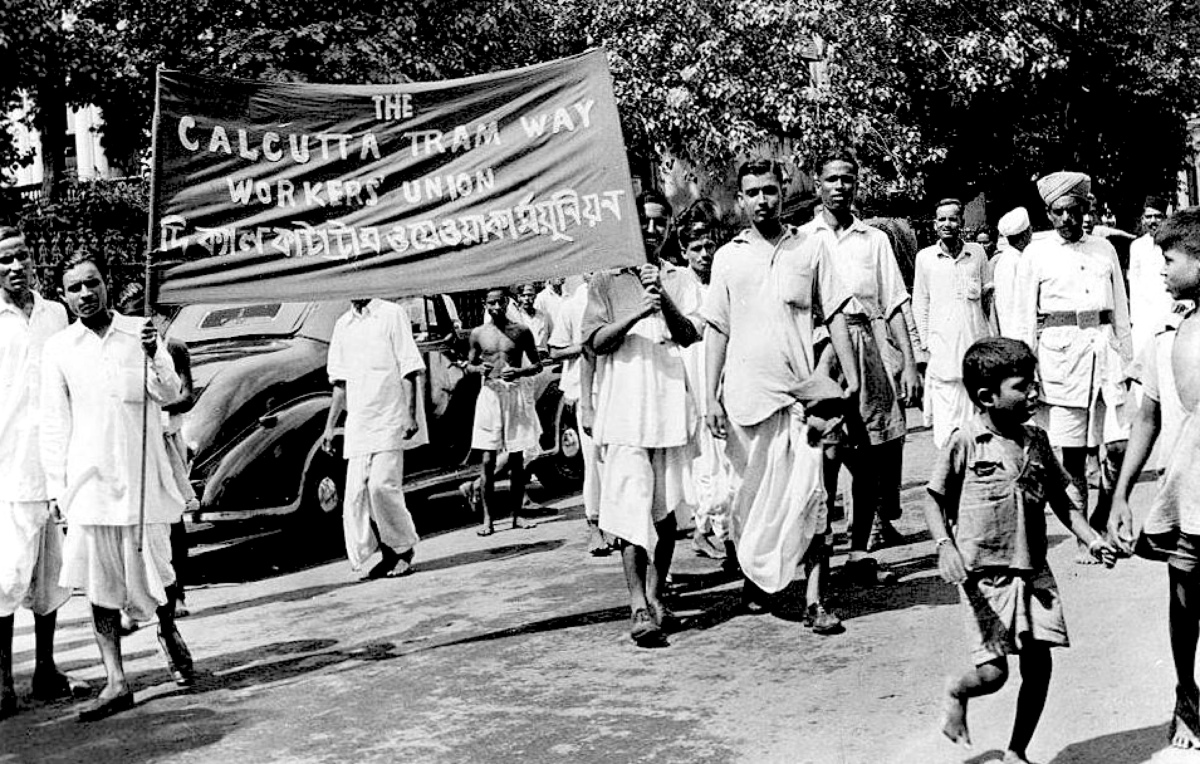
From the front page of ‘War Commentary: For Anarchism’, Mid-August 1942, London, UK
The blood of the Indian people, the blood of Amritsar, flows again under the blows of tyranny. In the cities of India, unarmed masses are shot down by the guns of British money, and the chosen leaders of the Indian people are imprisoned for demanding the elementary rights of men. Wherever the Indians raise their heads in protest, bullets and lathis greet them with mutilation and death.
Once again the British ruling class shows its true face. The mask of liberalism donned to deceive the Indians is put aside at last, and the stalwarts of national independence in Europe, the champions of minorities, the supporters of the Russian fight against invasion and oppression, take up arms to crush the Indians who ask for freedom.
The Indian leaders, courted but recently by Cripps (the self-styled friend of Nehru), are denounced as fifth columnists, traitors, friends of Japan, blackmailers. The British gutterpress spews its calumnies on the Indian nationalists and the Indian people. The worn out lies are used to justify the British action. We are defending the Indians in spite of themselves! We are saving them from the clutches of the wicked and cruel Japanese! We are preventing the Hindus and the Moslems from exterminating each other!
Britain who for the last two hundred years has been engaged in more wars than any other country, presumes to teach the Indians how to live in peace! Britain, which after a century and a half of paternal rule has still left 90 per cent of the Indian population illiterate, pretends that her rule is beneficial to India! The Nabobs, who for generations have grown fat on the sweat of the Indian masses, pretend that they are protecting these masses from the exploitation of Japan! Can any sane and honest man in this country support this fantastic accumulation of deceit and folly?
Yet, in this country, hardly a voice is raised in protest to the cruelty and reaction of the British Government’s policy in India. The Labour Party sits in smug silence, and any protest that might have been raised by individual M.P.’s [Members of Parliament] has been carefully avoided by sending Parliament on holiday.
The Communist Party, both in India and in this country, pursues its usual course of toadying to the Government and betraying the workers, and demonstrates the hypocrisy of its own canting talk about freedom in India. The so-called workers’ parties who aided the government to fix the collar of slavery on the necks of the British Workers, cannot be expected to prevent the maltreatment and slaughter of the Indian workers.
Eventually the evil policy of the British government will inevitably bring down disaster on its own head. By their suicidal folly, the rulers of Britain are sealing the fate of their own Empire, and for the Labour Party and the Communists this new betrayal will only contribute to their final discredit in the eyes of the workers of this country. But the academic contemplation of eventual and final consequences will serve no purpose now. It will not save the Indians from present oppression or the British Workers from the consequence of their government’s folly in India.
The British Worker must realise that the interests of workers all over the world are one and identical. They must realise that their freedom is bound up with the Indian people and that if they acquiesce in a denial of this freedom, they are only hastening the final elimination of their own liberties.
Therefore, the British Workers should express in speech and in action, everywhere, and in every way they can, their protest against the tyranny of British reaction in India and their solidarity with the Indian masses in their struggle for freedom. Only in this way can Imperialism, whether British or Japanese, be destroyed and the liberties of the British as well as Indian Workers, be gained.
Also
Anarchism and Revolutionary Defeatism, by K. C. Sinclair (2025)
Har Dayal: Three Years That Made a Difference, by Anuradha Kumar (2023)
The Memorialization of Mewa Singh, by Jastej Luddu & Fenn Stewart (2022)
White Right and Labor Organizing in Oregon’s “Hindu” City, by Johanna Ogden (2019)
M. P. T. Acharya, International Anarchism and Indian Independence, by Ole Birk Laursen (2017)
No Gods, No Masters, No Brahmins, by Maia Ramnath (2015)
“Come O Lions! Let Us Cause a Mutiny:” Anarchism and the Subaltern, by Tariq Khan (2015)
East Indians of Oregon and the Ghadar Party, by Johanna Ogden (2014)
Anarchism in India, by Jesse Cohn (2009)
Komagata Maru, by Hugh Johnston (2006)
Two Revolutions: The Ghadar Movement and India’s Radical Diaspora, by Maia Ramnath (2004)
Bhagat Singh and the Revolutionary Movement, by Niraja Rao (1997)
A Time For Shame and Atonement, by Third Force (1956)
New Phase in Oil Struggles, by Freedom (1953)
Malaya, by Albert Meltzer (1948)
British Intervention in Asia, by Marie Louise Berneri (1945)
Man-Made Famines, by Marie Louise Berneri (1943)
The Lebanon Crisis, from War Commentary (1943)
Our Policy, by Albert Meltzer (1942)
Anarchists Uphold the Empire, from The Word (1942)
East and West of Suez, by F. A. Ridley (1941)
“What Are We Fighting For?”, by Vernon Richards (1939)
The “Advantages” of British Imperialism, by Reginald Reynolds (1939)
Anarchist Tactic for Palestine, by Albert Meltzer (1939)
Anti-Fascism: Capitalist or Socialist?, by Vernon Richards (1938)
Blood in Palestine, by Solidaridad Obrera (1936)
Nationalism in India, by M.P.T. Acharya (1933)
Liberty and Love Rise and Fall Together, by Har Dayal (1914)
The Coming Anarchy, by Peter Kropotkin (1887)
No One’s Illegal on Stolen Land
Anarchists on National Liberation
Anarchism & Indigenous Peoples
