
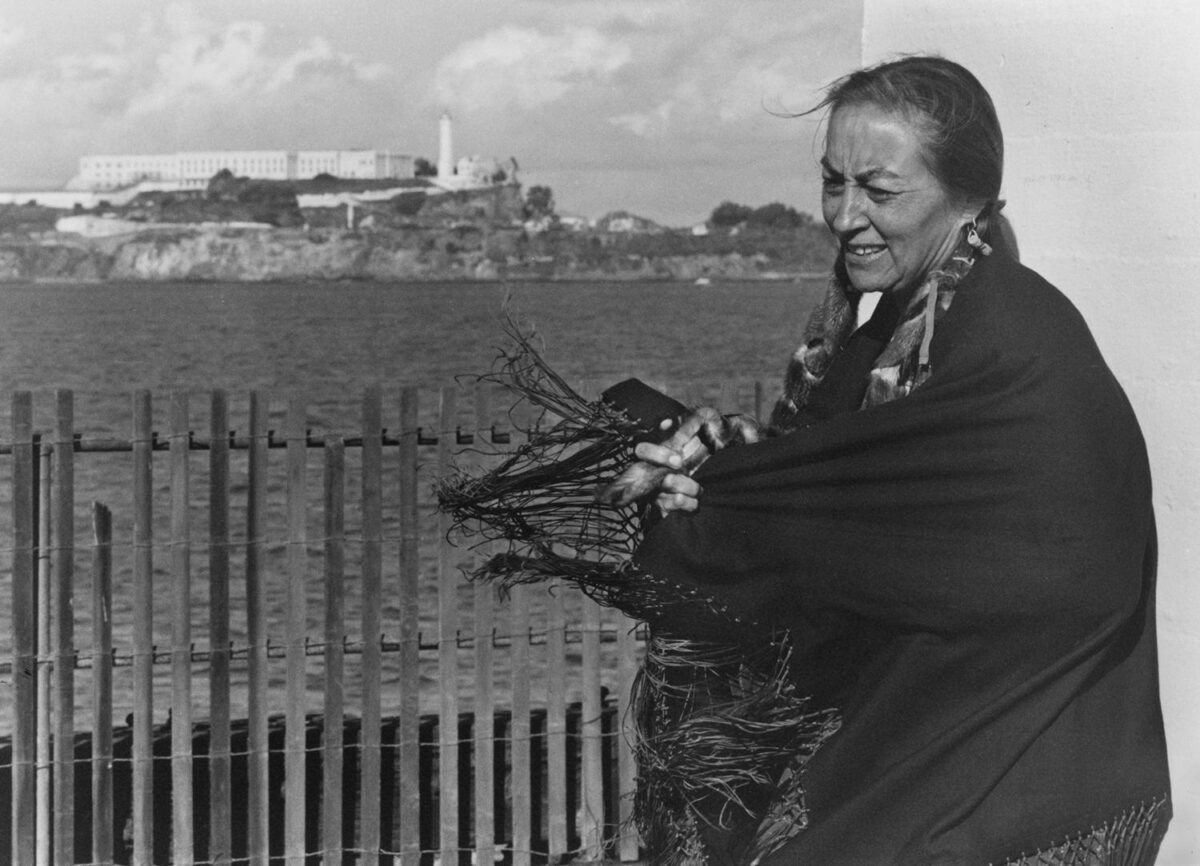
Stella Leach (Colville-Oglala Lakota), photo by Ilka Hartmann
From ‘The Dispatcher’, published by the International Longshoremen’s and Warehousemen’s Union (ILWU), March 11, 1970, San Francisco
ALCATRAZ, Indianland — “You folks are just like a labor union on strike. You have to last one day longer than the other guy.”
The speaker was Louis Goldblatt. ILWU secretary-treasurer who was part of a labor delegation which paid a call recently on the 150 Indians who have occupied Alcatraz Island, a former federal prison in the middle of San Francisco bay, for three months.
Mrs. Stella Leach — half Sioux, half Colville — gave the delegates a grand tour of the island which the Indians hope to turn into a college and cultural center.
The Indians hope to establish a Center for Native American Studies, an Ecology Center, an American Indian Spiritual Center and an Indian Training School on the island.
She spoke warmly of the assistance the occupiers had received from unions in the area, including the ILWU.
Joe (Indian Joe) Morris, Local 10 sergeant-at-arms, arranged the boat ride across the choppy bay and the tour. Morris, who grew up on a Montana reservation, is a member of the Blackfoot tribe and, with Mrs. Leach, a member of the Council of the Indians of All Tribes.
Also making the trip were LeRoy King, Northern California regional director; Odell Franklin, Local 10 secretary-treasurer; Jack Hogan, Bill Bailey, Gay Near and David Jenkins, all of Local 10.
Representatives of the Electrical Workers and the American Federation of Teachers also came along.
For several hours, Mrs. Leach, who came to the island as a nurse the second day of the occupation and “decided to stay,” led the union members around the island. This 50 year old mother of six spoke of the Indian’s long struggle for dignity.
“We want to live like human beings, not Disneyland objects. We want to build a monument here not only for our own people, but for all races.”
“We have found that the white man doesn’t care about anything but his own greed. He even treats his own people like dirt. Just look at how union men fought and have had to keep fighting just to keep off their knees.”
The first stop was in a nursery where 10 or 15 Indian children were hard at work drawing, under the guidance of two young women.
EDUCATION
There are four teachers on the island who run classes for children for the first through the seventh grade. The school has been accredited by the Berkeley School District.
The morning is spent on required subjects, while in the afternoon the children learn native American history, culture and crafts.
The adults are divided in work crews, maintaining and restoring the island, cleaning up the material and spiritual refuse of hundreds of years of human despair.
Indeed, it’s strange to see such vibrancy and hope on an island which for so many years represented the lowest type of human degradation. Mrs. Leach said that before it was a federal prison, Alcatraz was a prison for Indian warriors, and before that a Spanish prison.
She took the delegation down into the hole, the old Spanish dungeon, where Indian braves had been taken, ripped away from their homelands and their people. She spoke with feeling of the white man’s fouling of the earth, of his own surroundings.
“Now ecology is the big thing, but it’s just a pacifier. We don’t want to live on cement blocks like you people. The white man has just discovered what we have been trying to tell him for hundreds of years. Our faith comes from the earth.”
She said the Indians were united as never before in support of their claim to Alcatraz. “This land is ours, by treaty, and we will not give it up. My people and I will die on Alcatraz if we have to.”
BROKEN PROMISES
“We took Alcatraz because of all the broken promises. Some of our students are doing research on the old treaties, and we have found that we have never once broken our word — not once — while white men have violated 71 treaties. We gave our solemn word, and we took them at their word too. They said they were Christians.”
“We are starting a political move here to uplift the Indian because we have a right to walk like men. We have a right to do away with hunger, despair and poverty. You are the squatters here, not us. We won’t permit our children to die anymore.”
So the waiting game continues.
Recently, negotiations with the federal government were opened, as the Council met with Robert Robertson, head of vice-president Agnew’s committee on Indians.
“They want to negotiate about getting us off Alcatraz. We want to negotiate about money for our center. Alcatraz is not negotiable.”
Also
Proclamation of the Indians of All Tribes at Alcatraz (1969)
Indians Meet to Press Alcatraz Claim, by Earl Caldwell (1970)
We Have Endured, We Are Indians, by the Pit River Indian Council (1970)
Alcatraz Is Not An Island, by Richard Oakes (1972)
Richard Oakes, Alcatraz and More, by Hank Adams (1972)
The Brave-Hearted Women: The Struggle at Wounded Knee, by Shirley Hill Witt (1976)
Clarence Victor Carnes (Choctaw, 1927–1988), survivor of the Battle of Alcatraz, from Wikipedia
Against Ecology, by Pierleone Porcu (1988)
Taking Back Fort Lawton, by Bernie Whitebear (1994)
Ralph Chaplin Hanging Out With Chief Leschi in Tacoma, by Arthur J. Miller (2001)
Vancouver City Workers Strike, from Face to Face With the Enemy (2007)
Stella Leach (1918-2010), from Wikipedia
Land, Labour and Loss: A Story of Struggle & Survival at the Burrard Inlet, by Taté Walker (2015)
Mexican Workers in the IWW and the Partido Liberal Mexicano (PLM), by Devra Anne Weber (2016)
Sunrise on Alcatraz, by LaNada War Jack (2019)
Alcatraz is not an island, Red Nation interview with LaNada War Jack (2019)
Hopi History: The Story of the Alcatraz Prisoners, by Wendy Holliday (2019)
Alcatraz Is Not an Island, by Dean Chavers (2019)
Drive behind occupation of Alcatraz lingers 50 years later, by Felicia Fonseca & Terry Tang (2019)
We Hold the Rock!, by Joseph Gillette (2020)
LaNada War Jack, by Charlotte Hansen Terry (2021)
Indigenous labour struggles, by M.Gouldhawke (2022)
(Zine) No One’s Illegal on Stolen Land (1988-2026)
