
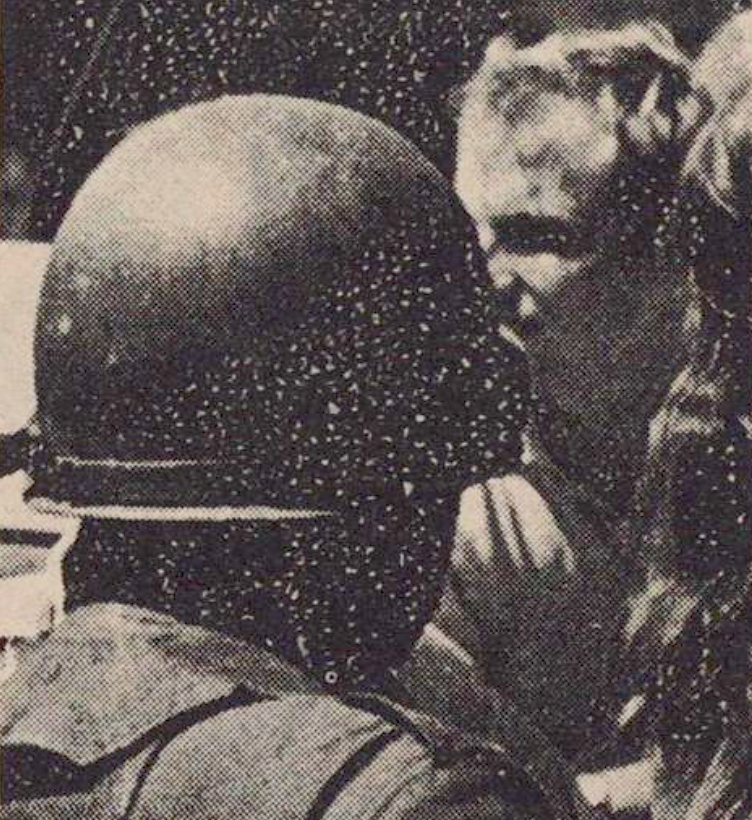
From ‘Berkeley Barb’, May 8-14, 1970, Berkeley, California
Despite periodic rumors of “crack-downs” and tighter immigration policies, Canada still seems to be a haven for draft dodgers and military deserters.
At present, the Toronto American Deserter’s Committee estimates that there are 20,000 draft dodgers and 5,000 deserters in Toronto alone, with many more on the way — as many as 2,000 a month this summer.
The reason, of course, is Canada’s announced position that draft violations cannot, under law, be held against an applicant for “landed immigrant” status. And, for the most part, the law is followed. “Immigration officers,” says a pamphlet from the Montreal Council to Aid War Resisters, “…will not ask about an individual’s draft status, and it is not advisable to volunteer the information.”
(However, Harvey Maurer of the Toronto ADC points out that discrimination “of a bureaucratic and unprovable nature is occasionally practiced.” But blatant violators are punished. Just recently, three Royal Canadian Mounted Pigs were put on trial for kidnapping after they “escorted’ three deserters to the U.S. border, where they were captured by the Shore Patrol.)
There are also a number of organizations throughout Canada devoted to aiding those who wish to immigrate. The Toronto Anti-Draft Programme and the Montreal Council to Aid War Resisters, for example, devote most of their time to counselling prospective immigrants on the ins and outs of the law.
Aside from offering a few tips (“‘Applying for status is a suit and tie affair. You must look clean cut and epitome of middle-class standards”), these two groups can also help you find a job (rather essential) and a place to live. Other groups, however, look beyond the basic problems of getting in [and] staying in. The Red, White and Black, for instance, is trying to form an “underground community”‘ for those who have already “landed” (i.e., been accepted for permanent residence).
But perhaps the most broadly based group is the American Deserters’ Committee, with offices both in Toronto and Montreal. Formed in December, 1969 by ex-Americans, the ADC insists on viewing desertion “as a total live commitment.”
“The physical act of Desertion” says an ADC position paper, “involves an instantaneous severing of nearly all the traditionalaties of the individual’s former life experience… The Deserter soon finds himself set in an alien world, alone, unaided, and condemned without any of the traditional or social attachments which he could identify with and be strengthened by.”
The ADC also notes that deserters are likely to be younger than draft resisters, and therefore more vulnerable. Add to this the fact that a deserter had already been fucked over by the military (perhaps even to the point of seeing actual combat), and you’ve got a rather serious problem.
To aid the deserter in his “transition,” the ADC first supplies the essentials — food, shelter, and a job (which they say is necessary to fight depression) — and then moves on to social and psychiatric needs, through its counselling center and adjacent coffee house and drop-in center.
Ultimately, of course, the ADC hopes to build on the “commitment” signalled by the initial act of desertion. “We can relate desertion to the potential betterment of man, or to an act of rebellion against inhumanities,”says its position paper. “But no matter what level we recognize as most true, in the final hour, it becomes the question of whether this personal act will go unheeded and unrecognized.”
Draft dodgers, too, should realize that they are making a pretty final decision, since the statute of limitations on selective service violations doesn’t apply if you’re out of the country. The only way you can get back to the U.S. without getting busted is to renounce your American citizenship, and take out Canadian papers. Which means five years as a landed immigrant FIRST.
But if you’ve got to skip, here are the people to write to for help:
THE MONTREAL COUNCIL TO AID WAR RESISTERS, Case Postale 5, Succarsale Westmount, Montreal, Quebec, Canada. This group will send you a free four page tabloid size pamphlet detailing immigration procedures. (If you’re thinking about moving to Montreal, remember that most [missing words, Quebecois speak French?]
TORONTO AMERICAN DESERTERS’ COMMITTEE, 75 Huntley, Toronto, Ontario, Canada.
THE TORONTO ANTI-DRAFT PROGRAMME, 2347 Yonge St., Suite 14, Toronto, Ontario, Canada. For $2.00, they’ll send you their 100 page “Manual for Draft-Age Immigrants to Canada.”
* * *
“If a guy can go to Canada and be effective in organizing up there, ” said a spokesman for the Berkeley MDM, “then I think it’s definitely O.K. But if he’s going up there merely to escape the draft as a personal individual, with no thought about its political implications, it’s a mistake.”
The MDM (Movement for a Democratic Military) is a G.I. organization dedicated to fighting (non-violently, at present) for the rights of servicemen and women, both at home and abroad. Two of its main concerns, of course, are ending the war in Vietnam, and attacking military racism.
Although it ranges from Seattle to San Diego, the MDM is still a West Coast organization, “But,” said the spokesman (a civilian), there is a very strong G.I. movement right now. And it’s building all the time, it’s getting stronger.”
The most visible manifestation of the movement is the emergence of “underground newspapers” like “The Final Flight” (Hamilton Air Force Base) and “Up Against the Bulkhead MF”‘ (Alameda Naval Air Station/Treasure Island).
While confining themselves primarily to military matters, these papers often devote space to the ideas of such people as Jerry Rubin, Bobby SeaIe and Huey P. Newton, using them as means of relating the military microcosm to the world at large.
And from time to time, the papers offer advice on ways to fuck the System, under the general philosophy expressed by “Iron Scrotum” in the first issue of “Up Against the Bulkhead”: “Just remember… that the Navy attempts to do things logically and ends up doing things illogically. So if we do the most illogical thing we can think of the two illogics will cancel out. And we will be free.”
Of course, infiltrating the armed forces takes a certain amount of revolutionary dedication to begin with. But the MDM is quick to point out that, since the military prefers not to take chances, anyone who makes it clear that he’s on a heavy political trip stands a good chance of being discharged in five or six months. Sometimes honorably.
But, to be perfectly fair, an activist — whether radical or revolutionary — also stands a fair chance of landing in the brig, or falling prey to violence.
Roger Priest, for example, who founded “OM, The Servicemen’s Newsletter.” was charged last June 29th with 14 violations of the Uniform Code of Military Justice, despite the fact that he edited the paper during off-duty hours.
A Supreme Court decision ostensibly prohibited the military from court-martialing GIs for offenses committed on their own time. But the military seems to think that the only way it can defend the Constitution is by being exempted from its provisions.
And just last week, on April 29th, shots were fired into the MDM Headquarters in Oceanside, California, seriously wounding Marine Pfc. Jesse Woodward, who belongs to the organization. The assailants are (and probably will remain) unknown.
One thing that an activist NEEDN’T fear, said the MDM spokesman, is being hassled by the non-“lifer” (career) servicemen themselves.
“Of course people should have an understanding of what organization is. It’s not just handing out slogans and then waiting for people to follow you. Organizing is working with people to change their points of view, and to show them by experience that they OUGHT to change them. But if you’re at all able to deal with people, you won’t meet any resistance in the service.”
Naturally, the brass and the lifers have a somewhat different attitude. Their first move is generally to isolate the “trouble-makers,” and, if that fails, to punish him in some way, “And usually that’s exactly when you begin to be effective as an organizer, because the men will rally behind you.”
One of the biggest problems faced by the MDM, according to the spokesman, is the lack of support from the outside people. “We have a serious complaint about the peace movement,” he said. “For all their talk, they’re not supporting the GIs who could stop the war. Most GI organizations are operating on a real low budget, so they don’t have as much impact as they COULD have.”
To help foster such popular support, the MDM is sponsoring an Armed Farces Day rally to compete with the more traditional Armed Forces Day band-and-bullshit ceremonies to be held at Fort Ord on May 16th.
“We’re asking civilians to go out to the base and talk to the MDM people out there and show that the resisters inside the military really have a lot of people on the outside that are willing to back them up.” More information — including maps and a handy guide for distinguishing the people from the brass — is available at the MDM Bay Area Headquarters, 2214 Grove Street in Berkeley.
Military Service, by Errico Malatesta (1902)
There is currently much discussion among French comrades about whether an anarchist should meet the draft obligation, evade the draft, or desert.
Some say that the anarchist, who naturally abhors militarism and continuously makes propaganda against it, must at any cost refuse to wear the abhorrent uniform and take up fratricidal arms, in homage to our principles and to set a good example.
Others say that refusing service forces one to go abroad, where, for economic reasons and because of differences in language and customs, he is incapable of making propaganda, whereas it is useful and necessary to bring the spirit of rebellion and the yeast of anarchist ideas within the very ranks of the army.
We believe that the matter does not have a single solution, applicable to all individuals, under all circumstances.
Aside from considerations of personal advantage, which we shall not get into, it is certain that, depending on each person’s particular talents and the dose and type of courage he possesses, some can be more useful by entering the army, making propaganda among soldiers and setting an example, when the case arises, of refusing obedience and open rebellion, while others better succeed by deserting and facing the vagabond life of a man in an illegal position.
The essential thing is that, within or outside of the army, one always keeps aflame his hatred against the institution, always keeps alive the spirit of propaganda and sacrifice.
Also
About Face: Veterans Against The War
No One’s Illegal on Stolen Land
Clarity Contra Complicity [on Aaron Bushnell’s action], by K. C. Sinclair (2025)
Zombies in Terrace: Uncovering Canada’s most significant mutiny, by Brittany Gervais (2019)
Who Gets Political Asylum?, by Sandra Montague (1976)
A Black Woman Speaks Out, by Barbara Jones (1968)
The Avalanche, by Clara Cole (1947)
Reaction in Canada, by Walter Brooks (1939)
No Conscription!, by the No Conscription League of New York (1917)
The Conscripts Strike, by Louise Michel (1881)
The Chatham Vigilance Committee and the 1858 Rescue of Sylvanus Demarest, from Wikipedia
Fugitive Slaves in Canada, from The Provincial Freeman (1854)
A Warning Voice, from Voice of the Fugitive (1851)
Away to Canada!, from Voice of the Fugitive (1851)
Black Refugees of the War of 1812, from Wikipedia
Black Loyalists, from Wikipedia
“In Canada during the last world war butchery, I spoke against conscription, and I am proud for having done so.”
Marcus Graham, Statement to the Court, Freedom of Thought Arraigned (1938)
