
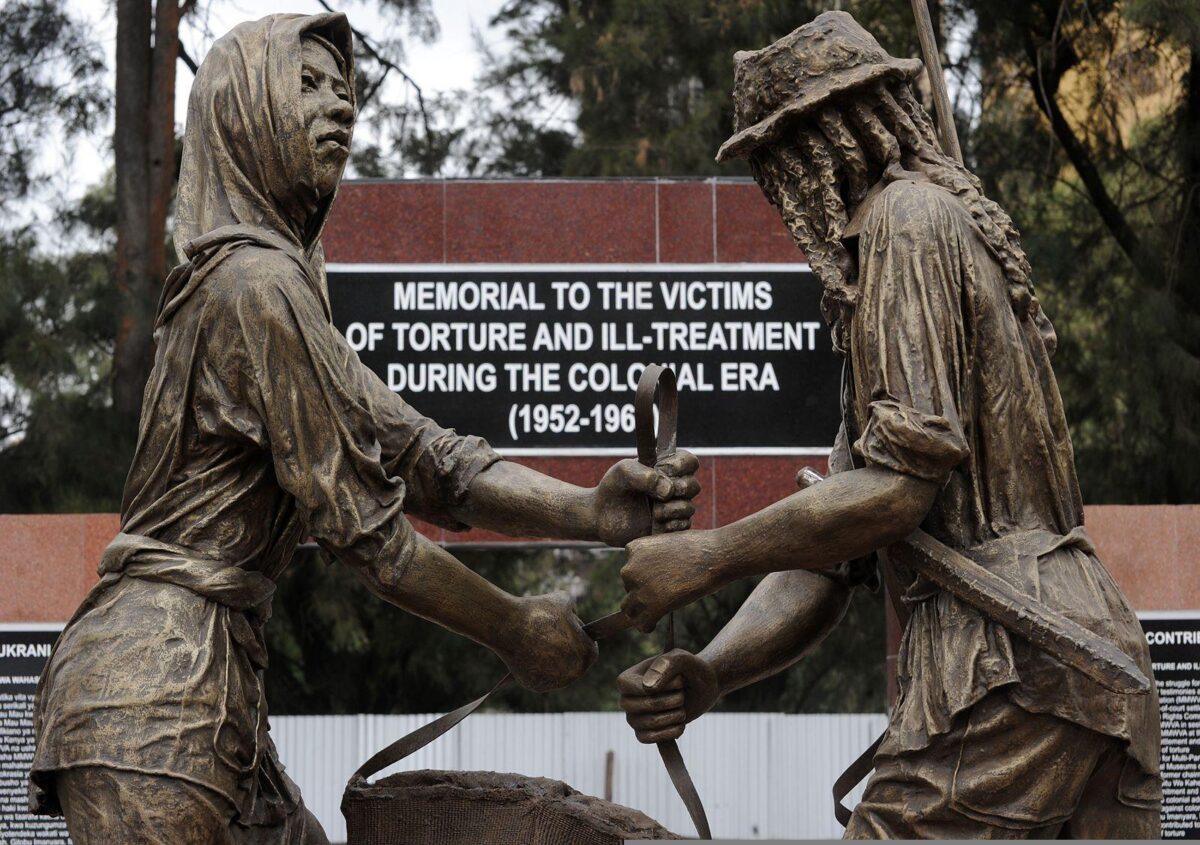
Uhuru Park, Nairobi, Kenya
Evacuation Eventually — Why Not Now?
From ‘Freedom: The Anarchist Weekly’, November 8, 1952, London, UK
The sensation-mongers of the Press have a godsend in the very name of the Mau Mau of Kenya, conjuring up visions of witchcraft and secret jungle societies beloved of the novelette-reader for whom Fleet Street caters. Foreign-sounding words soon acquire a particular meaning in English and anyone who scrutinised the pulps can soon explain the difference between a submarine (heroic) and a U-boat (sinister) and laugh to scorn the pedant who translates U (i.e. Untersee) boat as exactly meaning submarine. Mau Mau sounds vicious, primeval, the mysterious jungle, and all that, in the context as presented by the journalists, but how absurd it makes the attempts to yoke the same thing to Communism, and the efforts to build up a sort of jungle-Marxism sound much more ridiculous in Africa than they could possibly do in Malaya.
How pathetic this is in conjunction with the efforts of certain papers to build up a vindictive attack on Jomo Kenyatta, and to present the glamorous picture of the “European settler” beset by hostile natives and preserving a stiff English upper lip in the midst of it all, Malaya “Planter’s Wife” style. It is rather difficult to believe in it when one knows both Jomo Kenyatta and some of the recent “European settlers”, but without doubt some people believe it, and up comes Mau Mau to take the place of the so-called “Stern Gang”, or Kenyatta to take the place of Moussadek.
The bitter attacks made by some of the national papers on Jomo Kenyatta are revealing — for instance, the reactions of his English wife appear to vary with which paper one reads — but what is patently absurd and yet widely believed is the story that he is acting on behalf of Moscow. There is nothing Moscow could do or has done in Kenya. China is not adjacent, as it is in Malaya. No Soviet-dominated countries are near. The Communist Party in South Africa is the nearest geographically, and it is of negligible account. Jomo Kenyatta, furthermore, belonged always to the group of African anti-imperialists whose concern was the African people always, and who fell out with the Communists — who at one time gave them ideological support — simply because they would not toe the Moscow line and direct the African struggle along Moscow paths which dictated imperialism in the popular Front and war-time days, and anti-imperialism only in the early “Red Front” and (later) Hitler-alliance days, when it suited their political book.
The very fact that Jomo Kenyatta in London spoke on all anti-imperialist platforms — even Anarchist — would make him anathema to the Communists, but frankly “Communist” is just a convenient label to pin on anyone nowadays, even in countries like Kenya, the Sudan and other parts of Africa where Stalin is unknown. But what is above all so ridiculous is the certain knowledge the eventually compromise will have to be reached, and whatever they say about Jomo Kenyatta now that he is imprisoned and his followers persecuted, will be retracted in later years just as it was with regard to Jawaharlal Nehru. They heaped the same abuse on Nehru and for that matter George Washington; could they not spare us just this once the personal abuse against a man who appears at a prominent position of the anti-imperialist struggle?
Jomo Kenyatta is assailed today, but then so was Gandhi yesterday, and maybe they will have to retract it all when the man is dead, as they did in Gandhi’s case. For let us not forget that while they abuse in print the man in the prominent position in the colonial movement, this is but the manifestation of something else — bitter and relentless persecution of all those who stand in the ranks of the rising subjected people.
While it may seem poetic justice that those who once persecuted Nehru now must fawn on him to keep his country in the Commonwealth, those who were shot down will never come back to life, those who were beaten with lathis and expelled to the Andamans will never regain their health, those who lived out years in prison will never get their youth back. These do not receive the “poetic justice” that come with the years to Nehru, and while the gutter press at home cries out that Jomo is that or this, when in years to come they may have to refer to him as a great patriot should the line change, out in Kenya hundreds are arrested or beaten or shot down for their part in the rising against imperialism.
As for the “European settlers” the writer wrote a very prophetic piece about that bunch when he had seen them leaving England — though in that instance he was speaking about the Bahamas. But it also applies to Kenya and he knows of at least one company director who went out to that unhappy country as a “refugee” from “socialism”. In Freedom (May 29th, 1948), I wrote of the “Exodus in style” of “English refugees” to the Bahamas. “The refugees were not the miserable refugees from Stalin-controlled Europe, escaping from racial persecution via hellships to Cyprus concentration camps. No, the refugees from Britain were of a much different category. They were lords, ladies and gentlemen, escaping from high income tax, via luxury liners to the swell hideouts of the Bahamas.”
Out they went, complaining about “lack of opportunity”, the high rate of taxation, frustration to businessmen. etc., etc. in England. all crying out — as did the group of businessmen I spoke of (who had been fined for selling adulterated food). Farms in Kenya and castles in the Bahamas according to taste, but it is in Kenya the reckoning is today and maybe it will be in the Bahamas tomorrow.
As I said, to us national distinctions mean nothing, the world is one, let them go wherever they choose and the farther away the better. But these people are not going out to live on their own labour. They go out there to live on the sweated labour of the coloured people. If the coloured workers rise to defend themselves from exploitation, the aristocrat exiles expect us to go out and defend them, just as they expect us to defend them from any attack from outside wherever it may come. . . . The whisky-boozers of Singapore and the English Rajah of Sarawak expected British arms to be used to defend them against the Japanese. In the same way the white nabobs of India expected British arms to be used for years to defend them against the Indians. And now the East African “pioneers”, the businessmen who went out and invested their money in Kenya, expect us to defend them from the Kikuyu African.
The Kikuyu is not bitterly nationalistic and he would perhaps agree with the last remark in the article referred to: “The lords and ladies who left these shores with repugnance should go, not with all the goods they have taken and not worked for, but with nothing save the hands they had to work with in order to earn their living. Perhaps they would not then be so anxious to flock to compete with the superior intelligence of the coloured man.”
The soldiers who are being flown to Kenya are not people who invested their money in East African farms because they were dissatisfied with post-war conditions in England. They are the mugs now known as “brave Tommies“, formerly “lazy British workers”, who were subjected to post-war austerity in order that it might be possible to send military reinforcements on such occasions as this. They should not be subjected to the risk of death for nothing, nor should the Kikuyu be subjected to military rule.
There will be no more “colonization” such as decimated the Red Indian or the Polynesian, least of all in Africa where the Negro has the bitter warning of South Africa ever before him. The Army is all for such adventures as the present — if they haven’t one place they want another, and apparently from the Press the only concern the War Office has expressed is that too many military commitments at once will deplete them of crack regiments for the Coronation! — but public opinion can and must make itself felt against this senseless adventure, for the sake of which the life tribute is demanded of youth — if not death itself, then at least two years of service — as well us restrictions imposed on everyone.
Russia will not be a ha’penny better off if we leave Kenya altogether. It can no more enter Kenya than it can enter Switzerland, without embroiling other countries, but in any case all the arguments against leaving Kenya are equally applicable to Palestine, India, Pakistan, Burma, and Persia. But there we have a fait accompli!
The arguments against Kenya independence may also be held against Gold Coast independence, but let us face the truth of it, that what is delaying that recognition is solely a concern for those investments which will eventually have to be abandoned.
INTERNATIONALIST.
[A known pen-name used by Albert Meltzer. -Ed.]
Also
How Canada helped kill an anti-imperialist hero, by Cassandra Kislenko (2021)
The Somalia Affair, by Richard Foot (2019)
(Zine) An Anarchist on Palestine, by Albert Meltzer (1939-1996)
Farewell Albert, by Lorenzo Kom’boa Ervin (1996)
Albert Meltzer, anarchist, by Stuart Christie (1996)
I Couldn’t Paint Golden Angels, by Albert Meltzer (1996)
Anarchism: Arguments For and Against, by Albert Meltzer (1996)
The Myth of Benevolence, by Milan Rai (1995)
Into the Green, by Black Flag (1989)
Question and Answer on Anarchism: Anti-Imperialism, by Albert Meltzer (1987)
Review of ‘Open Road’, by Cienfuegos Press Anarchist Review (1977)
Wounded Knee: The Longest War 1890-1973, from Black Flag (1974)
The Floodgates of Anarchy, by Stuart Christie & Albert Meltzer (1970)
Inevitable War in the Middle East, by Albert Meltzer (1968)
From DuBois to Fanon, by C.L.R. James (1967)
Neither East Nor West, by Marie Louise Berneri (1952)
Palestine, by Albert Meltzer (1948)
Malaya, by Albert Meltzer (1948)
Middle East Notes: Civil War, from Freedom (1948)
Fine Day For The Race, by Albert Meltzer (1947)
Manifesto of the Anarchist Federation on War (1943)
Man-Made Famines, by Marie Louise Berneri (1943)
The Lebanon Crisis, by War Commentary (1943)
India’s Struggle for Freedom is Our Struggle, by War Commentary (1942)
Our Policy, by Albert Meltzer (1942)
National Independence, by Albert Meltzer (1942)
Palestine and the Jews, by Albert Meltzer (1942)
Anarchists Uphold the Empire, from The Word (1942)
For Anarchism, by War Commentary (1941)
East and West of Suez, by F. A. Ridley (1941)
The “Advantages” of British Imperialism, by Reginald Reynolds (1939)
This Is Not A War For Freedom!, by War Commentary (1939)
Anarchist Tactic for Palestine, by Albert Meltzer (1939)
“What Are We Fighting For?”, by Vernon Richards (1939)
Capitalist Peace, by Ethel Mannin (1938)
Those Who Make War Possible, by Spain and the World (1938)
Manifesto Against War, by George Padmore (1938)
Mussolini’s War Upon East Africa, by Marcus Graham (1935)
The African Roots of War, by W.E.B. Du Bois (1915)
Another Little War, by Freedom (1887)
Our Colonizations, from Le Révolté (1884)
Albert Meltzer texts at the Anarchist Library
Texts by or about Albert Meltzer at the Kate Sharpley Library
Texts by or about Albert Meltzer at Libcom
Anarchists & Fellow Travellers on Palestine
Anarchists on National Liberation
