
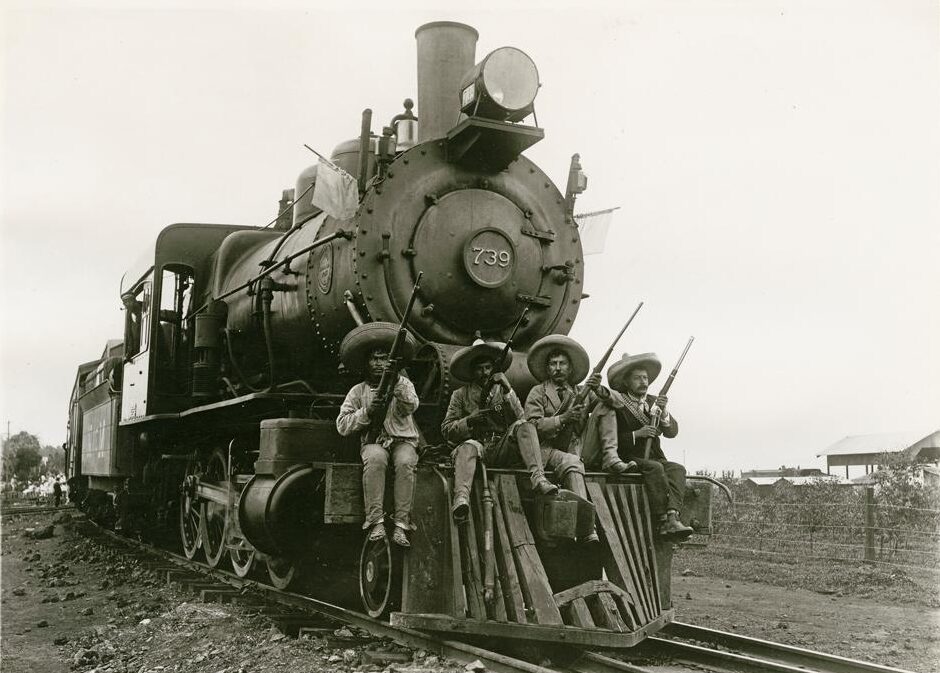
From ‘Mother Earth: Monthly Magazine Devoted to Social Science and Literature’, July 1911, NYC, published by Emma Goldman, edited by Alexander Berkman
The Morgans and Rothschilds of the world are quite unanimous in their belief that the victory of the political aspirant Madero has put an end to the Mexican revolution. The revolution inspired by the economic awakening of the Mexican people, which therefore goes beyond Diaz the Second, is naturally very hateful to our financiers. This awakening means land and liberty, through expropriation; that is, the people’s taking back of the land from the land robbers; a liberty which would inevitably lead to brotherhood, to Communism.
Naturally, plutocracy dreads such a revolution worse than an epidemic. To stop the spread of such a terrible contagion, capitalism borrowed the strong arm of the United States government. That accounts for the American troops at the border; that also accounts for the sudden arrest of the Junta leaders. Ricardo and Enrico Magon, Librado Rivera, Anselmo Figueroa had to be gotten out of the way, since they are the intellectual leaders of the revolution. For years these men have toiled to awaken their people, to arouse them to the terrible exploitation and robbery practiced by the sharks of Wall Street, the human beast that was growing fat on the blood of the Mexican peons.
To awaken the people is indeed a crime. The more so if those people, once awakened, would fight. That is why these brave heroic men were subjected to persecution, to arrest and imprisonment. They are charged with offending against the neutrality laws. What a farce! Washington dispatches troops to the border of Mexico, ready to interfere any moment. Washington permits Mexican troops to pass to Lower California, across American territory — yet Washington has the impudence to speak of neutrality laws! Surely American soldiers were not at the border for their health. They were there for business, the moment the international speculators, the gentlemen thieves of America, England, Germany, and France, would give the word.
Thieves are known to hold together. The service so obligingly rendered by the United States government was as contemptible and dirty a job as the one done by Bismarck in 1871. The hatred between Germany and France was turned into passionate love, the moment it became necessary to dispose of a common enemy — the people. That’s why Prussian soldiers were sent to drown the Commune in the blood of the Communards.
Time was when America represented a haven of rest to all the oppressed of the world [correction: primarily Europeans -Ed., 2026]. The servility of Washington to Wall Street in the Mexican affair shows conclusively that America is now the haven of international exploitation. Was it not American capital that supported the Tzar, thus aiding him to suppress the revolution in Russia? It is the same power that is now killing the revolution in Mexico.
Taft and his clique broke the neutrality laws. Yet it is not they that are sent to prison, but Magon and his comrades. What a mockery of neutrality! As to the methods that are being used in America to trap a victim, their horrors are well-nigh a commonplace.
For days and weeks the office of Regeneración, the organ of the Mexican Liberal Party, was watched, the mail stolen, the printer approached with a heavy bribe to induce him to refuse to print the paper. And when the men were finally arrested, everything was turned topsy-turvy and demolished. In true “free American” vandalism style.
But all in vain. Regeneración continues its great work among the Mexican people. It continues to carry the inspiring message of Land and Liberty. Nor has the ardor of the revolutionists been subdued. Fighting goes on! Must go on!
Unfortunately, the workers of America still lack the spirit of solidarity, at least for their Mexican brothers. Else their reply to the brutal interference and persecution by the American authorities would ere this have been the General Strike or some other great popular protest. The very least the workers should and must do is not to remain indifferent to the tremendous struggle in Mexico, and not to be fooled and hoodwinked by the lying press and stupid, unscrupulous politicians.
The Mexican revolution is an economic and social struggle. It is not merely for the moment, but for all times; not only for the Mexican peon, but for the workers everywhere. That is why the Mexican revolution should receive the moral and financial aid of all true haters of our damnable system, of all lovers of liberty.
* * *
As we are going to press we received the following telegram:
Ricardo Magon arrested again to-day. Inform radical press and secure all publicity possible. Financial situation desperate. If you can assist do not delay.
* * *
Indeed, we need not be surprised at the indifference of the American labor if we consider the attitude of the Socialist party toward the Mexican revolution. An attitude so cowardly, contemptible and disgusting as to deserve the severest chastisement by the entire international revolutionary proletariat.
Not enough that the party leaders ridicule and slander the rebels of Mexico, but they are actually playing into the hands of capitalism by their treachery to the brave fighters for Mexican liberty. Think of it, the Bergers, Waylands, Ghents, and consorts rendering valuable service to the cheap political aspirant Madero. What bankruptcy of the Socialist party! As if it is not known to every social student that Madero is enacting the role of that henchman of the Commune, Thiers. Yet Madero, the henchman of the Mexican revolution, enjoys the co-operation of the party of Eugene Debs.
Lest our readers think we are misrepresenting or exaggerating, we quote from the declaration of Berger issued through his secretary, W. G. Ghent:
Comrade Berger is wasting no sympathy on the “insurrectos” of Lower California. Comrade Berger is a Socialist, and he stands by the principles and traditions of the international Socialist movement, The “insurrectos” are not Socialists, but are, in the main, opposed to Socialism. Their movement is not predominantly a Mexican movement. It is a movement originating in the United States and its promoters and followers are a mixture of men of every creed except Socialism. Some of them are merely vague utopians. Some of them are so-called “direct actionists.” Others are avowedly Anarchists. Still others are revolutionists by temperament and would as readily revolt against a Socialist administration as against a capitalist administration. The Socialist party can afford to have no connection with this movement.
In response to a severe criticism from one in whose veins still flows revolutionary blood, Mr. Ghent has this to say in the New York Call of July 5th:
Comrade Roland D. Sawyer seems to me to mistake the Socialist position in regard to revolution and to misunderstand the character of the “insurrection” in Lower California. This “insurrection” was no more a class war than would be an invasion of Comrade Sawyer’s front yard by a dozen hoboes intent upon starting a “rough house.” The warriors were not Mexicans, and they had no more business across the line than would the hoboes have in Comrade Sawyer’s yard. They were not Socialists, but “blanket men,” “direct actionists’ and Anarchists. Anarchists do not fight the class war in behalf of the workers, and any one who thinks so needs badly to read Plechanoff’s little book.
Anarchist philosophy is an opposite of Socialist philosophy, and Anarchist activity is directed quite as much against Socialism as against capitalism. Socialists have no more right to support an Anarchist revolt than they have to support a rebellion such as that of the slaveholders of 1861 or of the Magyars in 1848-9. A good deal of sentimental Anarchism is being absorbed at this time by Socialists here and there, and the fact bodes ill for the future. It would seem that this vexing question must some day be fought out all over again.
The above stamps Ghent and his boss not merely as traitors to the international revolutionary movement, but also as rank ignoramuses.
Instead of referring to the Plechanoff pasquil [satirical attack], these disciples of Marx would do better to study the Communist Manifesto. Therein they may find that Socialists of former days, ere they became Congressmen or Secretaries of political bosses, either participated in the revolutions or, at least, decently abstained from blackmailing the heroes of revolutionary epochs. The Paris Commune had the support of all the revolutionary Socialists. The sole exception were the miserable clique of “scientific” Socialists which attempted to supervise, from London, the uprising of 1871, and that failing, did not hesitate to throw mud on the heroic Communards.
History repeats itself. The same wretched political clique, the modern Socialist Scientificos, act in like contemptible manner towards the rebels of Mexico.
But for the I.W.W. boys and the Anarchists who joined the Mexican revolution from its very inception, the revolutionary traditions of the international proletariat would have been shamefully betrayed. It is they to whom credit is due for the wonderful perseverance, in the face of terrible odds, of the Mexican uprising. Should the latter, which is one of the most significant social events since the Paris Commune, be defeated, the responsibility to a large extent will have to be laid at the door of the Socialist party of America and its spokesmen Berger, Ghent, Wayland, et al. They are working with Madero, with Wall Street, and Washington against the Mexican revolution — for political considerations. But they will only gain the contempt and condemnation of the revolutionary element everywhere.
Anarchists & Socialists debate the Mexican Revolution (featuring anti-Indigenous/anti-Mestizo racism)
The Mexican Revolt, by Voltairine de Cleyre (1911)
Open Letter to Eugene V. Debs, by Lucille Norman (1911)
Murderous Silence: Luigi Galleani and Cronaca Sovversiva, from Regeneración Sezione Italiana (1911)
The Mexican People are Suited to Communism, by Ricardo Flores Magón (1911)
When Put to the Test, by William C. Owen (1912)
Anarchists Who Are All Talk?, by Estela Arteaga / No More Charades!, by Lucia Norman (1916)
U.S. Socialists and the Mexican Revolution, by Dan La Botz (2010)
“The Whole World is Our Country” [featuring racism from Luigi Galleani], by Kenyon Zimmer (2015)
Also
Mexican Anarchists and their supporters (compilation)
The Probable Intervention, by Praxedis G. Guerrero (1910)
Reds Die For Freedom, by the Industrial Workers of the World (1911)
The Eagle and the Serpent, by Ricardo Flores Magón (1911)
To the American People, by Ricardo Flores Magón (1911)
People of America, by Ricardo Flores Magón (1911)
The True Crisis, by Ricardo Flores Magón (1911)
Will this Struggle be Drowned in Blood?, by Voltairine de Cleyre (1911)
The Traitors!, by Ricardo Flores Magón (1912)
The Land, by Enrique Flores Magón (1917)
The Pacification of the Yaqui, by Librado Rivera (1927)
Woman Without a Country, by Emma Goldman (1933)
Preface to ‘Land and Liberty’, by Albert Meltzer (1977)
Mexican Workers in the IWW and the Partido Liberal Mexicano (PLM), by Devra Anne Weber (2016)
The Chaparral Insurgents of South Texas, by Aaron Miguel Cantú (2016)
La batalla de Oaxaca, de Laura Castellanos y Heriberto Paredes (2019)
Jacinto Lives! Memories from St. Louis (2021)
(Zine) No One’s Illegal on Stolen Land (1988-2026)
No One’s Illegal on Stolen Land
Ricardo Flores Magón texts at the Anarchist Library
Dreams of Freedom: A Ricardo Flores Magón Reader
