
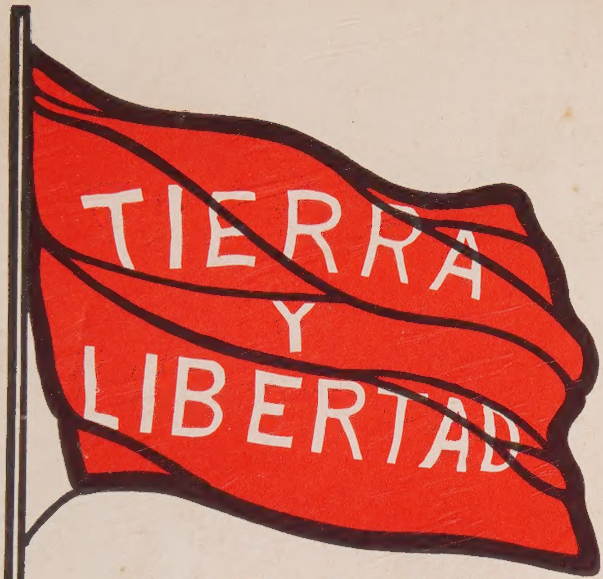
Art by Flavio Costantini
From the book, ‘Land and Liberty: Anarchist Influences in the Mexican Revolution‘, edited by David Poole, first published by Cienfuegos Press, 1977, based on the 1913 booklet published by the Partido Liberal Mexicano
Successive regimes in Mexico treated people, in the manner of the Chinese Emperors, “like plants or animals.” But matters came to a head when, purely as a military adventure, that sawdust Caesar, “the little Napoleon” the Emperor Napoleon III, decided to invade. Originally head of an Allied force — including England and Spain — the first time this trio of imperialist forces were allies since the Crusades! — in the sacred cause of making Mexico pay its debts, Napoleon III decided to stay on after they were settled, putting in as puppet Emperor the ill-fated Austrian Archduke Maximilian.
Long warfare under President Juarez, the decisive Northern victory in the American civil war with the attendant probability of the Monroe Doctrine of non-intervention being enforced, and the imperialist drive of Bismarck’s Prussia which threatened France at home, combined to the collapse of this adventure. The French army left and Juarez set Mexico on the road to ‘reform.’
Alas, political reform was not enough. The Indians and the peasants were left out. When Porfirio Diaz succeeded to the presidency, the reforms of Juarez were fading. In the course of his re-elections, and the dictatorship of Diaz was constantly and naturally re-elected, Mexico became increasingly impoverished and sold to foreign interests.
Don Porfirio thought he could forget the people. Until one day in 1910 when a sudden explosion of the mass of the Mexican people overthrew his regime and all his apologists. In came a benign, free-thinking liberal, Don Francisco Madero, a man of goodwill, naive, utopian and guided by spiritualist advisers.
During presidency, Madero, bitterly attacked by the clericals and the reactionaries, sabotaged by agents of American capitalism, there was in reality not much accomplished by way of social reform, but the people began to take over for themselves. There was a sheer lack of ability to govern from the central point that led to regional revolutions of one kind or another.
All these regional revolutions were characterised by American journalists as coming from ‘bandits’. The capitalist who had come into the country under Diaz and stolen the land from the people was not a ‘bandit.’ Those who drove him out were. No stories were bad enough to retail about them.
The atrocity stories about the ‘bandits’ coming from Yankee journalists who spent a week or two in and out of the country, or from military adventurers who turned up to get in their thousand dollars worth of loot and ten cents worth of observation, must be unsurpassed in the world, for sheer Munchausening, and it must be borne in mind that the regime that had been thrown out had been notorious for its audacious cruelty and savagery in surpassing the peasants and the Indians.
But of course the Western world saw only the gracious life of the wealthy in their romantic haciendas, their way of life that recalled Old Spain. Like Virginia, all this was paid for by brutality to the slave world beneath; like Virginia, it perished the same way.
Pancho Villa was one of the most audacious ‘bandits’; a man of blood, perhaps, but in no way as vicious as those he attacked . . . alas for his reputation, he defied the United States Army itself, and General Pershing was sent over the border to crush him . . . not a scrap of reputation was left him afterwards by the scribblers! — until years later he became a dead ‘national hero’ of a Mexico that had to be wooed by capitalists.
Emiliano Zapata was a man of another calibre. He too was a general and a leader of his people. But he had no ambitions like Villa. He saw the Indian way of life threatened and realised how much in danger it was, not only from peonage, but from the growing capitalisation of Mexico. At first he listened to Madero, thinking that trust could be placed in ‘the little father.” Madero was murdered by agents of Carranza. One political agent after another came to Zapata to try to enlist him, because of the growing success of ‘his’ army. Zapata remained unconvinced. He began to see in his ‘simple way’ that all that his people needed was to be left alone.
In the cities there was a small but effective, anarchist movement. It was this idea of anarchism that enthralled Zapata and his people . . . the film “Viva Zapata” gives a very graphic picture of this romantic anarchism, which was more realistic than anything the political parties could offer.
In the country and the cities, under the impossible title of the Mexican Liberal Party, the anarchists had grouped themselves. The battle for Land and Liberty — Tierra y Libertad — continued after Zapata had been ambushed, after the Carranzistas had established themselves, and ultimately been defeated by Obregon, after the revolution had been crushed.
The course of the revolution was followed by a London anarchist William C. Owen working with Ricardo Magon. He was in California editing Magon’s paper Regeneracion which acted as a spearhead for the Mexican revolutionaries. It was a more hazardous business that it perhaps sounds at this distance, Magon died in Fort Leavenworth jail, imprisoned under the Espionage Act.
It is to Owen’s presence that we owe these essays, originally published in pamphlet form by the Mexican Liberal Party in Los Angeles. Owen’s comments are not always as wise as they might have been, but he was a tireless propagandist for the libertarian cause in and out of Mexico, and Magon’s fire and fervour shine through the essays he translates.
So much is written about events in Russia, the same old paths gone over, over and over again, (the same old lies too), and almost nothing about Mexico, which were perhaps more important for social, though not, alas for world, history that we need not apologise that this small book is less than comprehensive.
The irony of victory by the State has repeated itself in Mexico — Zapata has become a national hero (how he would have stormed!) and even Magon is not entirely beyond posthumous canonisation (did he not die in the foreign enemy’s prison?). The Counter-Revolution in Mexico dresses itself in the stolen clothes of the Revolution, more flagrantly even than in Russia, where Makhno, at least, does not suffer the final indignity of being classed a great Russian patriot . . . though such an insult is not beyond the Ukrainian nationalists!
The essays in this book show what the Mexican people were really battling for. It was dearly expressed in the grand red anarchist slogan of Land and Liberty. This book is worth reading after a re-showing of “Viva Zapata’’, or for historical background of another old movie “Juarez.” And it is worth a mention that one film about the Mexican Revolution “Viva Villa” happened to be on release in Spain about the time that the generals decided to re-impose capitalist law and order in 1936 — and everywhere the workers went to the barricades to the tune of that revolutionary celebration in song, “La cucaracha” . . . . . . .
Albert Meltzer.
Also about Mexico on this site
Voices of Mexican Anarchists and their Allies
Reds Die For Freedom, by the Industrial Workers of the World (1911)
Capitalism in Mexico, by Honoré J. Jaxon (1911)
Will this Struggle be Drowned in Blood?, by Voltairine de Cleyre (1911)
The True Crisis, by Ricardo Flores Magón (1911)
The Traitors!, by Ricardo Flores Magón (1912)
The Land, by Enrique Flores Magón (1917)
The Pacification of the Yaqui, by Librado Rivera (1927)
Anarchist & Socialists debate the Mexican Revolution (featuring anti-Indigenous/anti-Mestizo racism)
The Mexican Revolt, by Voltairine de Cleyre (1911)
Open Letter to Eugene V. Debs, by Lucille Norman (1911)
Murderous Silence: Luigi Galleani and Cronaca Sovversiva, from Regeneración Sezione Italiana (1911)
The Mexican People are Suited to Communism, by Ricardo Flores Magón (1911)
When Put to the Test, by William C. Owen (1912)
Anarchists Who Are All Talk?, by Estela Arteaga / No More Charades!, by Lucia Norman (1916)
U.S. Socialists and the Mexican Revolution, by Dan La Botz (2010)
“The Whole World is Our Country”, by Kenyon Zimmer (2015)
Also by or about Albert Meltzer
(Zine) An Anarchist on Palestine, by Albert Meltzer (1939-1996)
Albert Meltzer writings on this site
Albert Meltzer writings and photos at the Kate Sharpley Library
Albert Meltzer writings at the Anarchist Library
Also on Ukraine
“Together we will drive out from Ukraine the Austro-German counter-revolutionary armies and overthrow the power of the hetman Skoropadsky. We will not let any other power take its place.”
Nestor Makhno (1918), republished in Mémoires et écrits 1917-1932
The Meaning of the National Problem in the Makhnovshchina, Peter Arshinov (1923)
A Few Words on the National Question in the Ukraine, by Nestor Makhno (1928)
The Downward Spiral of Militarism, by K. C. Sinclair (2025)
How Nazi Collaborators Are Celebrated in Wartime Ukraine, by Marta Havryshko (2025)
Fascism, Militarism and Anarchism: A Tale of Three Ukrainians, by K. C. Sinclair (2026)
Also on this site
No One’s Illegal on Stolen Land
