
From ‘Regeneración’, English Section, February 24, 1912, Los Angeles, edited by William C. Owen
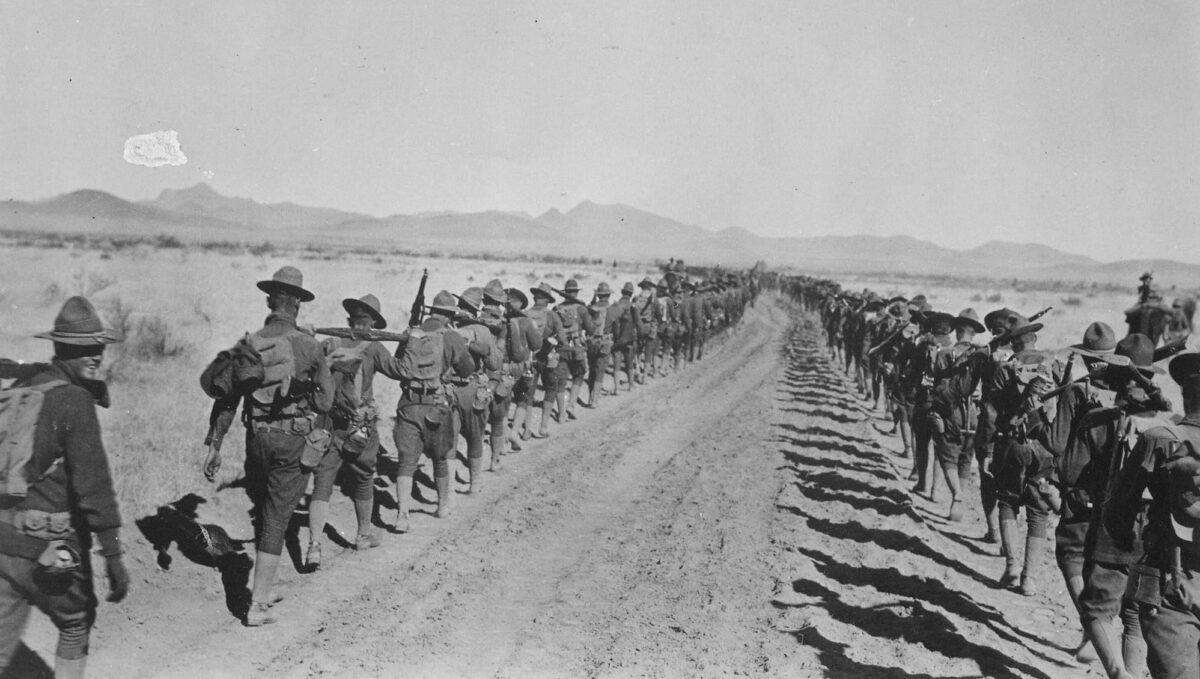
The resolute attitude of the people of Mexico in [the] face of threatened intervention by the United States has caused the government of this country to deny emphatically that it has any intention of invading Mexican territory. We do not know to what extent that declaration may be sincere. The one thing certain is that the American consuls resident at numerous Mexican points have given their government an account of the profound discontent and great indignation provoked among the people of Mexico by learning that the United States was preparing an army of a hundred thousand men to invade the Mexican Republic and establish a protectorate under the Stars and Stripes.
Well; for the moment the United States will not intervene. But does that fact dispel the danger of foreign intervention in Mexican affairs? The Mexican Revolution, by its economic character, must have, as its necessary result, foreign intervention. If the revolution were solely the result of the political ambitions of the various groups who are contending among themselves for supremacy, the United States and other powers would wait tranquilly the coming of peace, feeling assured that their subjects would continue to exploit the natural wealth of Mexico and the labor of the Mexican proletariat.
But this revolution cannot end with the elevation to power of any one of the leaders of the revolutionary bands, just as it did not end with the elevation of Francisco I. Madero to the presidency of the Republic. This revolution will end when each and every one of the inhabitants of Mexico has been made sure of bread, clothing, shelter, education and liberty, as the result of the refusal to recognize private property.
Well then; the great natural sources of wealth are in the power of powerful foreign companies; magnificent estates, forests that are very rich, fine mines, oil deposits that yield abundantly, in addition to great factories and foundries, railways, etc., etc., are all in the foreigner’s power. One can say that all Mexico is being exploited by foreigners, who, in the immense majority of cases, made use of franchises obtained under the dictatorship of Porfirio Diaz, and often employed violence, to obtain control of the natural wealth of Mexico.
By virtue thereof, we Mexicans have been reduced to the condition of slaves to the foreign exploiters; we have been left with no other fortune than our bare arms with which to earn the miserable wages our executioners pay us in exchange for the sweat of our brows, our health, our future.
Misery has been the result of this monopoly of our natural wealth by a few foreign companies and a handful of Mexican bourgeois, and that misery has been the leaven of the formidable movement now shaking our native country and engaging the attention of the bourgeoisie and governments of all the world.
We Mexicans have understood that so long as we are not really masters of the land — that is to say, so long as the land is not the property of each and every one of the human beings who form the population of what calls itself the Mexican Republic — ignorance, hunger and tyranny will be our eternal executioners. We have, therefore, to lay hands on the land; we have to make it our own, even if by so doing we have to challenge the wrath of those who exploit and tyrannize over us.
Therein lies the danger of intervention. We are locked in this iron dilemma; either we must reconcile ourselves to being for ever proletarians, to being for ever serfs; to being for ever slaves, and to continuing to labor for hire, through fear of foreign intervention, or we must resolutely lay hands — powerful, virile and sublimely disrespectful — on that which hitherto has been considered sacred under the laws manufactured by the bourgeoisie — the right of private property.
This we must do, even if we bring the whole universe upon us. We cannot make a half-revolution. All or nothing! Land and Liberty or death! Sooner or later intervention will become a fact, either because of our valor, in snatching from the hands of the bourgeoisie the property it withholds, or from the impossibility of paying off the debt that presses on the nation.
Some day the foreign bankers will no longer be content to wait and they will force their governments to collect from us, at the cannon’s mouth, what Diaz and the Cientificos, what Madero and his family, have pocketed. Diaz escaped with the millions he had stolen. Shall we permit Madero to plant “his” money in foreign banks, that he may dissipate it at his ease in the watering places and grand hotels of Europe?
For the moment the United States hastens to say that it will not interfere, in our affairs; but the European powers, whose subjects are being despoiled of the wealth they have been able to amass by exploiting the Mexican proletariat, will bring such pressure to bear on the American government that finally intervention will become a fact.
If it is not effected by the United States alone, because that nation has not the resources sufficient to carry to completion a work of such a nature, it will be by the combined action of all the powers. But then the Social Revolution will break out in Europe; the European proletariat will rise in its indignation against its governments; the earth will be one flame, and will travel its orbit proud of the fact that for the first time it is trodden by men where formerly there crept, century after century, a humanity submissive and vile.
(From the Spanish of Ricardo Flores Magon)
Also
“While Chiapas, in our opinion, does not pose a fundamental threat to Mexican political stability, it is perceived to be so by many in the investment community. The government will need to eliminate the Zapatistas to demonstrate their effective control of the national territory and of security policy.”
-Riordan Roett, adviser to the Emerging Markets Group of the Chase Manhattan Bank, January 13, 1995
“…that we can’t forgive
and we won’t forget…”
1997 Acteal Massacre, from Wikipedia
Anarchists & Socialists debate the Mexican Revolution (featuring anti-Indigenous/anti-Mestizo racism)
Observations and Comments on the Mexican Revolution, from Mother Earth (1911)
The Mexican Revolt, by Voltairine de Cleyre (1911)
Open Letter to Eugene V. Debs, by Lucille Norman (1911)
Murderous Silence: Luigi Galleani and Cronaca Sovversiva, from Regeneración Sezione Italiana (1911)
The Mexican People are Suited to Communism, by Ricardo Flores Magón (1911)
When Put to the Test, by William C. Owen (1912)
Anarchists Who Are All Talk?, by Estela Arteaga / No More Charades!, by Lucia Norman (1916)
U.S. Socialists and the Mexican Revolution, by Dan La Botz (2010)
“The Whole World is Our Country” [featuring racism from Luigi Galleani], by Kenyon Zimmer (2015)
Also
Mexican Anarchists and their supporters (compilation)
The Probable Intervention, by Praxedis G. Guerrero (1910)
Reds Die For Freedom, by the Industrial Workers of the World (1911)
Impossible!, by Ricardo Flores Magón (1911)
The Eagle and the Serpent, by Ricardo Flores Magón (1911)
To the American People, by Ricardo Flores Magón (1911)
People of America, by Ricardo Flores Magón (1911)
The True Crisis, by Ricardo Flores Magón (1911)
Will this Struggle be Drowned in Blood?, by Voltairine de Cleyre (1911)
The Traitors!, by Ricardo Flores Magón (1912)
The Land, by Enrique Flores Magón (1917)
The Pacification of the Yaqui, by Librado Rivera (1927)
Preface to ‘Land and Liberty’, by Albert Meltzer (1977)
Librado Rivera, by Dave Poole (1980)
Mexican Workers in the IWW and the Partido Liberal Mexicano (PLM), by Devra Anne Weber (2016)
The Chaparral Insurgents of South Texas, by Aaron Miguel Cantú (2016)
La batalla de Oaxaca, de Laura Castellanos y Heriberto Paredes (2019)
Jacinto Lives! Memories from St. Louis (2021)
(Zine) No One’s Illegal on Stolen Land (1988-2026)
Anarchists on National Liberation
No One’s Illegal on Stolen Land
Ricardo Flores Magón texts at the Anarchist Library
Dreams of Freedom: A Ricardo Flores Magón Reader
