
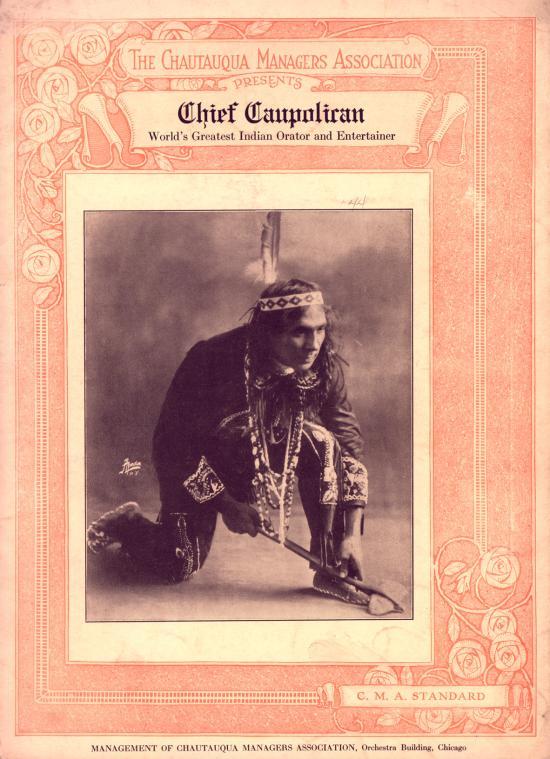
From ‘Regeneración’, English Section, July 19, 1913, Los Angeles, edited by William C. Owen (uncredited)
Caupolican [Emile Barrangon], chief of the Aurocanos [Mapuche], the oldest tribe of Indians in South America, is featured as one of the Orpheum’s principal attractions. He deserves to be, for he is the fortunate possessor of a magnificent tenor voice, trained to great perfection in Paris. He sings in English, French and his native tongue; selections from the world’s great masterpieces. Several of them we had heard rendered by artists of acknowledged rank, and Caupolican need not fear comparison, either as to tone or interpretation.
Moreover, he tells the audience how his tribe holds the Andes, from Concepcion to the Straits of Magellan, together with the islands adjoining the Chilian [Chilean] coast; and how it repelled successfully the Spaniards and all would-be invaders, forcing the Chilian nation, after a struggle that lasted a century, to sue for peace. He has clear-cut ideas as to the value of struggle and liberty, and he gave the “Los Angeles Record” an interview, in the course of which he said, speaking of a vanquished race:
“The Inca empire fell in a day, before the assault of the avaricious and bloodthirsty Spaniards. Why? Because the Incas were trained to rely absolutely on their chiefs; the chiefs thought and ordered; the people obeyed. As a consequence, when the Spaniards captured the leaders, the people were like sheep; no one could lead, and the nation died, a victim of its mistaken ideals. Now, with us, no chief has any authority except in time of war. We as a tribe have no regard for authority as such, so every man is a free man and may become a leader when needed. I hold no nation can last unless every man is freeman. That we have so remained is, to my mind, proof that we are good material for the use of evolutionary forces.”
Having read that, the editor of this section thought he would like to visit Chief Caupolican, and a most pleasant talk ensued. The chief was well informed as to Mexican affairs, naturally was sympathetic, and finally asked: “What about the social revolution that is coming in this country? Are you interested also in that?” When the writer explained that he was an Anarchist, Caupolican answered with a long-drawn “Ah!” In effect, the situation explained itself.
Also
Anarchism, May Day and Colonialism, by K. C. Sinclair (2026)
Indigenous Uprisings in Ecuador, from Wii’nimkiikaa (2006)
The Unconquered Mapuche, from Wii’nimkiikaa (2005)
Indigenous Insurrections in Bolivia & Peru, from Wii’nimkiikaa (2004)
Ralph Chaplin Hanging Out With Chief Leschi in Tacoma, by Arthur J. Miller (2001)
Solidarity from Anti-Authoritarians, by Leonard Peltier (1990)
Kanak Society, by Jimmy Ounei (1982)
Preface to ‘Land and Liberty’, by Albert Meltzer (1977)
American Imperialism Exposed [in Bolivia & Algeria], by Marcus Graham (1943)
The Pacification of the Yaqui, by Librado Rivera (1927)
The Arming of Nations, from La Antorcha (1923)
Armed Peace, from Revista Liberal (1921)
Down with Wars!, by Isolina Bórquez (1914)
The Social Revolution in Sonora, by Ricardo Flores Magón (1914)
Why They Oppose Civilization, from Why? (1913)
A Livelong Propagandist [Honoré J. Jaxon], by William C. Owen (1912)
Concerning the Beginning of the End, from Tiempos Nuevos (1912)
Capitalism in Mexico, by Honoré J. Jaxon (1911)
Will this Struggle be Drowned in Blood?, by Voltairine de Cleyre (1911)
The Eagle and the Serpent, by Ricardo Flores Magón (1911)
The Indigenous Problem, by Manuel González Prada (1906)
Our Indians, by Manuel González Prada (1904)
Which Makes the Greater Savage, the Blanket or the Uniform?, by Emily G. Taylor (1902)
Our New Medicine Man, by Emily G. Taylor (1902)
A Martyr, from The Alarm (1885)
The Indians, from The Alarm (1884)
A Page in the History of Civilization, by F. Girard (1860)
Anarchists & Socialists debate the Mexican Revolution (featuring anti-Indigenous/anti-Mestizo racism)
“…standing out amongst our enemies [who are engaged in a smear campaign against Mexican revolutionaries], Luigi Galleani of Cronaca Sovversiva and Jean Grave of Les Temps Nouveaux.”
-Ricardo Flores Magón, Regeneración, Los Angeles, April 13, 1912
Observations and Comments on the Mexican Revolution, from Mother Earth (1911)
The Mexican Revolt, by Voltairine de Cleyre (1911)
Open Letter to Eugene V. Debs, by Lucille Norman (1911)
Murderous Silence: Luigi Galleani and Cronaca Sovversiva, from Regeneración Sezione Italiana (1911)
The Mexican People are Suited to Communism, by Ricardo Flores Magón (1911)
When Put to the Test, by William C. Owen (1912)
Anarchists Who Are All Talk?, by Estela Arteaga / No More Charades!, by Lucia Norman (1916)
U.S. Socialists and the Mexican Revolution, by Dan La Botz (2010)
“The Whole World is Our Country” [featuring racism from Luigi Galleani], by Kenyon Zimmer (2015)
Also
Ricardo Flores Magón texts at the Anarchist Library
Praxedis G. Guerrero texts at the Anarchist Library
Dreams of Freedom: A Ricardo Flores Magon Reader
Anarchism & Indigenous Peoples
No One’s Illegal on Stolen Land
