
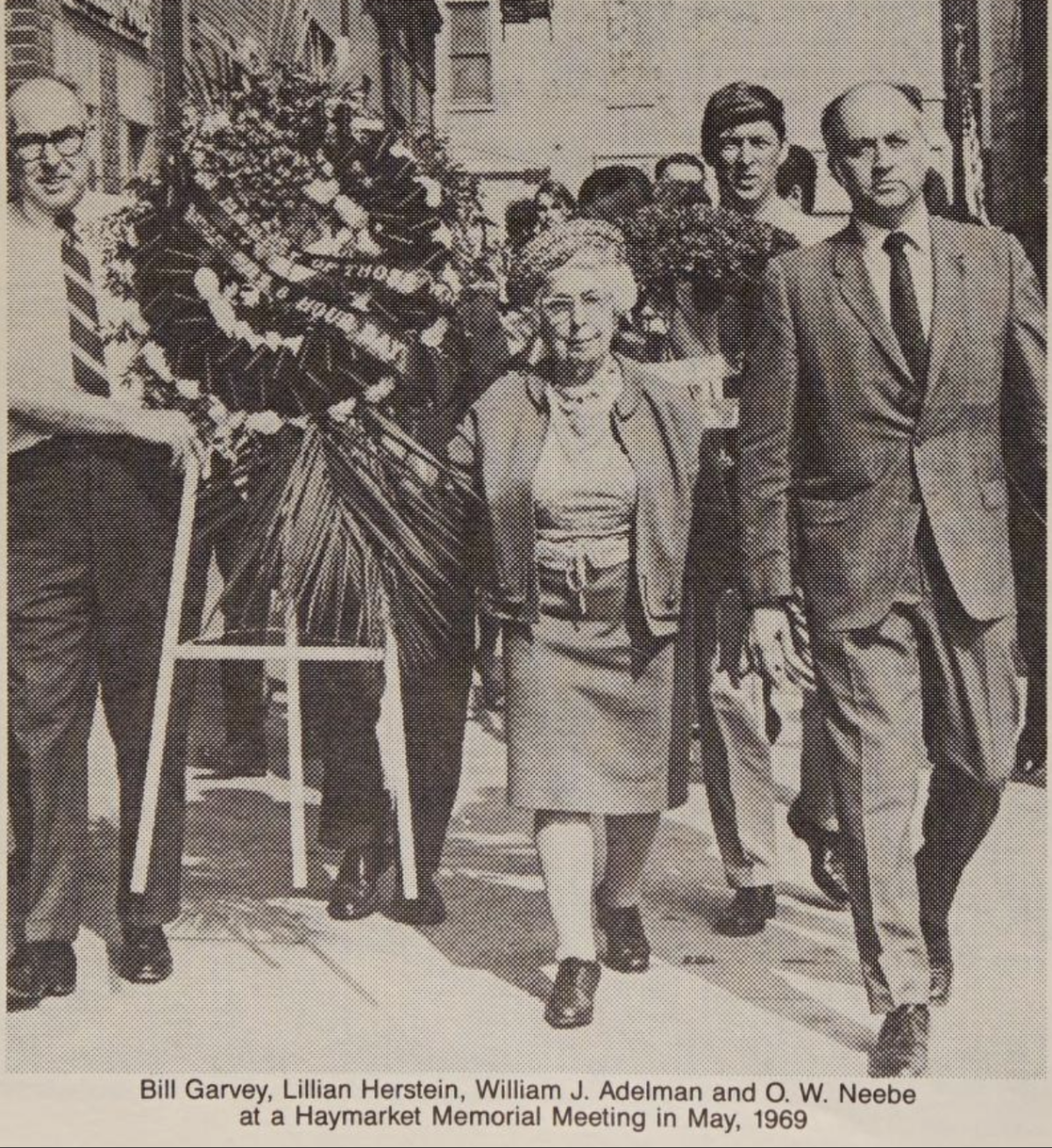
An Interview with Oscar Neebe’s Grandson
From ‘Haymarket Scrapbook‘, edited by Franklin Rosemont & David Roediger, 1986
Oscar William Neebe was 15 when he first heard about the alleged involvement of his grandfather, Oscar Neebe, in the Haymarket Square bombing.
“My brother and I had gotten out of school early and had gone to Mexico City to visit some of my mother’s relatives,” Neebe, now 52, told interviewers. “My uncle couldn’t believe that we had never been told of our heritage. He took us to a May Day celebration and showed us the Diego Rivera mural there honoring the Haymarket martyrs.”
“History books say my grandfather was an innocent dupe because he only donated $2 to the Arbeiter-Zeitung, the German anarchist newspaper,” Neebe continued. “But actually grandfather was more than that because he wrote for the paper and was an active socialist.”
Oscar Neebe was pardoned by Gov. Altgeld in 1893 after serving seven years in the state penitentiary in Joliet.
“Grandfather’s first wife died when he was in prison from what doctors said was an emotional illness caused by the tragedy. Grandfather was deeply affected by this,” said O. W. Neebe.
Oscar Neebe returned to Chicago and married a widow who had been active in the campaign to secure the imprisoned anarchists’ release. They had three children: Walter, Elsie and Rudolph, O. W. Neebe’s father.
“My father quit school in eighth grade at 13 to support the family when grandfather died. My father was a quiet man, unaggressive. He and his sisters and brothers suffered a lot of harassment because of Haymarket, but he never changed his name, probably out of a strange kind of integrity. He never talked to me about Haymarket. But he named me after grandfather.”
“There have been strange events in my life because of my heritage,” Neebe added, recalling a graphic artists’ convention in Aspen, Colorado, where an artist he had known for ten years in Chicago approached him. “The man was very drunk. He threw his arms around me, in tears, and confessed to me that his grandfather was the judge who had sent my grandfather to jail. He kept begging my pardon for what his family had done to mine.”
O. W. Neebe went on to decry the way the United States has subverted labor history by changing May Day (May 1) to “Law Day.”
“It’s very stultifying. You know, almost every country in the world but ours celebrates May Day in honor of the Chicago martyrs. The young don’t learn about their heritage, or labor, or what it has meant to this country.”
As a member of the board of New Trier Township High School, Neebe has seen to it that “Law Day” observances featured speakers to talk about May Day and its meaning, and about the repressive use of such government forces as the police, the FBI, the CIA and the IRS.
“It’s always interesting to watch students become enlightened, and to watch teachers who never gave a darn realize they are part of a system that denies access to education,” Neebe said.
(1975)
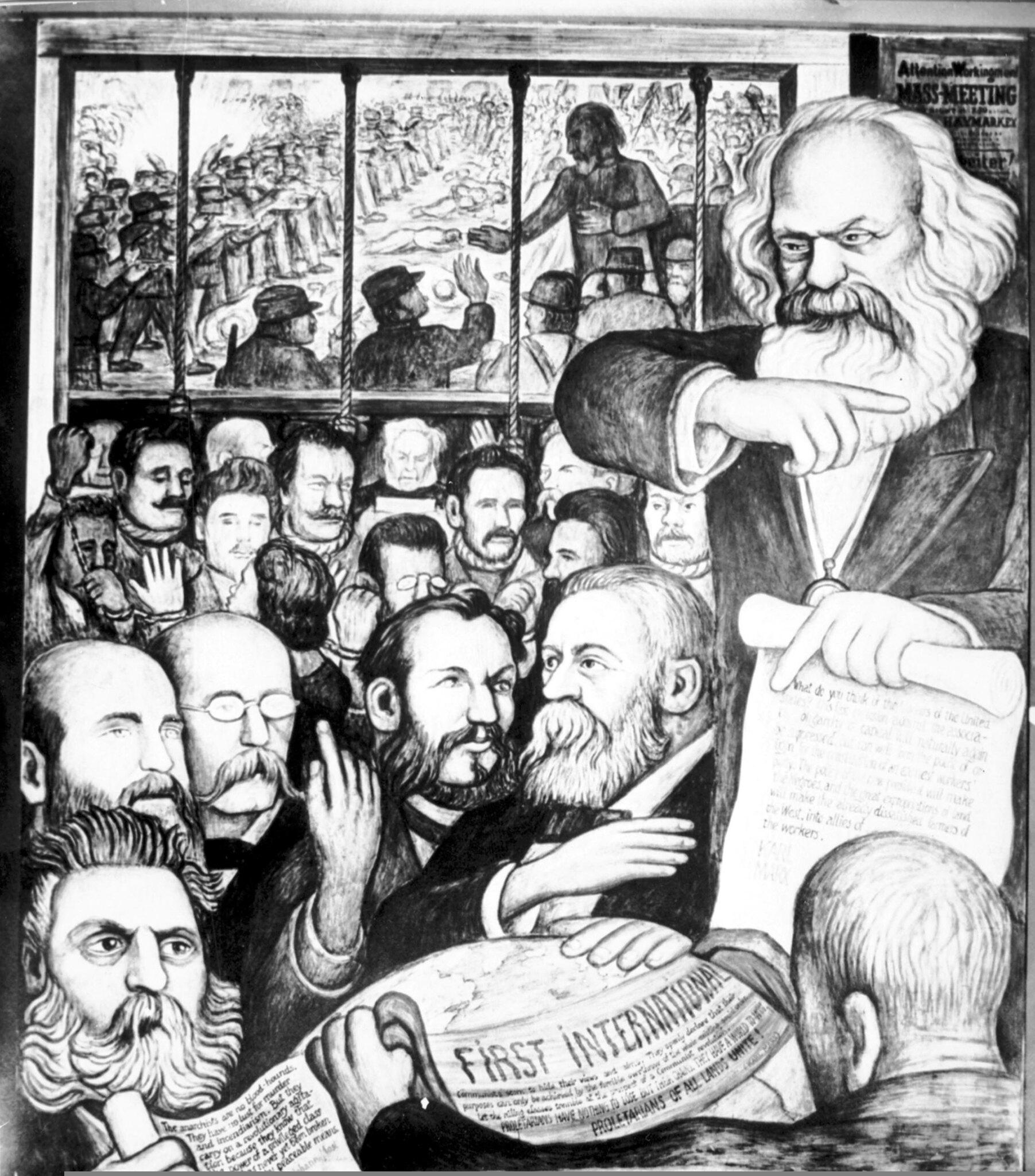 A mural depicting the anarchist Haymarket martyrs and other socialist figures, by Diego Rivera, originally at New York City’s Rockefeller Center and later at the recreational retreat of the International Ladies’ Garment Workers’ Union, Unity House in Pennsylvania.
Also
“At a Chicago May Day celebration last year, Mr. Neebe said he considered it a compliment to his grandfather’s memory that immigrants, many of whom were at the event, ‘have taken this day as their day.'”
OSCAR WILLIAM NEEBE: 1923-2009, by Chicago Tribune (2009)
Oscar William Neebe: Personal Recollections, from the Dramas of Haymarket (1999)
Address of Oscar Neebe to the Court (1886)
Autobiography of Oscar Neebe (1887)
(Zine) No One’s Illegal on Stolen Land (1988-2026)
Anarchism, May Day and Colonialism, by K. C. Sinclair (2026)
Anarchists and the Wild West, by Franklin Rosemont (1986)
The Making of Honoré Jaxon, by Steven Sapolsky (1986)
The Haymarket Tragedy, by Paul Avrich (1984)
The Haymarket Martyrs, by Lucy E. Parsons (1926)
The Trial a Farce, by Lucy E. Parsons (1911)
A Rebel May Day, from Industrial Worker (1909)
We Must Not Stop!, by Lucy E. Parsons (1907)
May First, by Lucy E. Parsons (1906)
Lucy E. Parsons’ Speeches at the Founding Convention of the Industrial Workers of the World (1905)
Life of Albert R. Parsons, by Lucy E. Parsons (1889)
Before the Storm, by Peter Kropotkin (1888)
Arrest of Mrs. Parsons and Children, by Lizzie M. Holmes (1887)
Law vs Liberty, by Albert Parsons (1887)
The Philosophy of Anarchism, by Albert Parsons (1887)
Plea for Anarchy, by Albert Parsons (1886)
Abolition of Government, by Lizzie M. Swank (1886)
“Timid” Capital, by Lizzie M. Swank (1886)
The Famous Speeches of the Eight Chicago Anarchists in Court (1886)
A Martyr, from The Alarm (1885)
The Indians, from The Alarm (1884)
The Black Flag, from The Alarm (1884)
A Free Society, by Albert Parsons (1884)
To the Workingmen of America, by the International Working Peoples’ Association (1883)
