
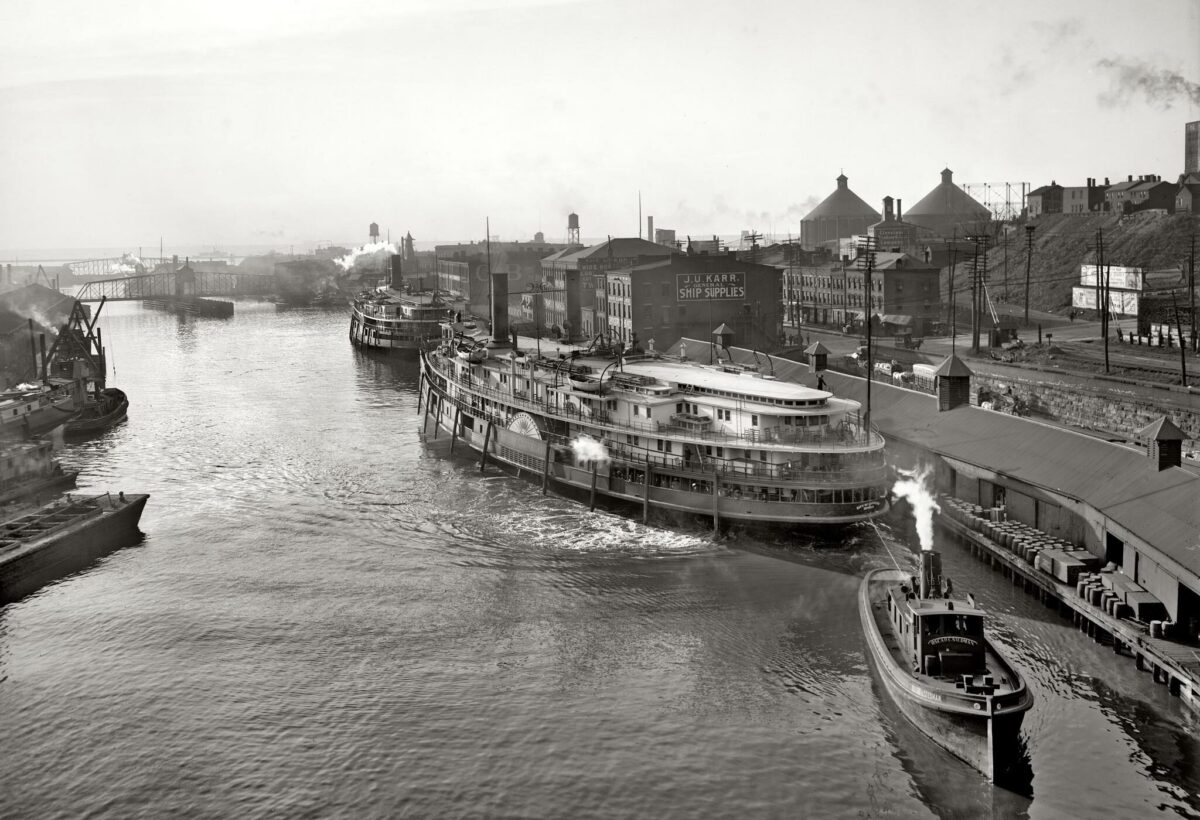
From ‘The Liberator’, December 3, 1905, Chicago, edited by Lucy E. Parsons
Mayor Tom Johnson of Cleveland, O., is alarmed at the growth of suicide in Cleveland, and what is true of Cleveland is equally true of all other centers of population in our so-called civilization.
The mayor is going about it in a unique way to present the “evil”, he is going to establish a kind of confessional in the police department, where sorrow-laden poor people can come and pour their troubles into the attentive ears of our kind-hearted cops. If the poor devils were silly enough to act upon such advice, what a rich field it would be for the detectives! Why, they would have little else to do but lie around the saloons and soak whiskey most of the time, and then go to the “suicide confessional” and tap it for “tips.”
We imagine the Roman Catholic Church would enter a serious objection to this police competition in its field of activity, which has always proven a source of rich “findings.”
But, seriously, is Mayor Johnson earnestly seeking a remedy or a cure for the evil?
Do the rich or well-to-do classes commit suicide as a rule? A few do, it is true, but 99 per cent of all suicides, it is safe to say, are from the poor classes: the cure lies in removing the cause, which is poverty.
Mr. Cooley of Cleveland thus gives the causes of suicide:
“Hard drinking, lack of work, sickness, domestic trouble lead men to suicide. Suicide, domestic trouble, lives of shame drive women to suicide. The records show that the latter cause is the more frequent in the ease of women.”
Many men become hard drinkers for the temporary buoyancy whiskey gives. The woman who falls and who kills herself to rid her life of its shame is usually not at fault for the life she leads.
Poor wages, poor surroundings and the uncertainty of work are among the things that start her on a career that ends in the morgue. Certainty of employment at decent wages creates and nourishes hopefulness in men and women.
In some scheme of society there should be work for all who are able and willing to work. And this certainty should exist until the worker has earned enough to keep him in his old age.
Time was that a man having a position held it during good behavior. Now a new machine may make the trades of thousands worthless. A new carrier may do away with cash boys and girls and messengers. A new machine may enable an employer to do his work with half the number of clerks.
Conditions in work, in commerce and in manufacturing were never so changing as now. And added to this is the brutal practicality of big corporations and big trusts who eliminate from their payrolls men older than forty years.
In the money madness that is on us, many, without business genius to fight a fair fight for a competency, make it sure by the savage method of taking it out of the flesh and blood of their workers.
Children are paid children’s wages for doing men’s and women’s work, and men and women are set adrift. You will find this in cotton mills and you will find it in sweat shops.
L. E. P.
Also
Call or Text 9-8-8 (Suicide Crisis Hotline Canada)
988 Suicide & Crisis Lifeline (USA)
KUU-US First Nations and Aboriginal Crisis Line Support Available 24 Hrs – 1-800-588-8717
Suicide Prevention – First Nations Health Authority
(Zine) No One’s Illegal on Stolen Land (1988-2026)
Anarchism, May Day and Colonialism, by K. C. Sinclair (2026)
Clarity Contra Complicity [on Aaron Bushnell’s action], by K. C. Sinclair (2025)
At home in the house of the Lord, from Open Road (1984)
Restore the Meaning of May Day!, by Oscar William Neebe (1975)
Time is Life, by Vernon Richards (1962)
Reflections on Full-Employment, by Vernon Richards (1958)
The Future of the Proletariat, by George Woodcock (1942)
The Haymarket Martyrs, by Lucy E. Parsons (1926)
Suicide, by Anna Strunsky (1915)
Our Moral Censors, by Emma Goldman (1913)
Hell Here, No Hereafter, from Industrial Worker (1911)
The Trial a Farce, by Lucy E. Parsons (1911)
We Must Not Stop!, by Lucy E. Parsons (1907)
May First, by Lucy E. Parsons (1906)
Patriotism, by Lucy E. Parsons (1906)
Steam, the Tyrant, by Philo Palhomo (1901)
A Piece of History, by Lucy E. Parsons (1895)
Publisher’s Note, by Lucy E. Parsons (1887)
Arrest of Mrs. Parsons and Children, by Lizzie M. Holmes (1887)
“Timid” Capital, by Lizzie M. Swank (1886)
